3NGM image
Deposition Date 2010-06-12
Release Date 2011-05-25
Last Version Date 2024-10-16
Entry Detail
PDB ID:
3NGM
Keywords:
Title:
Crystal structure of lipase from Gibberella zeae
Biological Source:
Source Organism:
Gibberella zeae (Taxon ID: 5518)
Host Organism:
Method Details:
Experimental Method:
Resolution:
2.80 Å
R-Value Free:
0.26
R-Value Work:
0.23
Space Group:
P 21 21 21
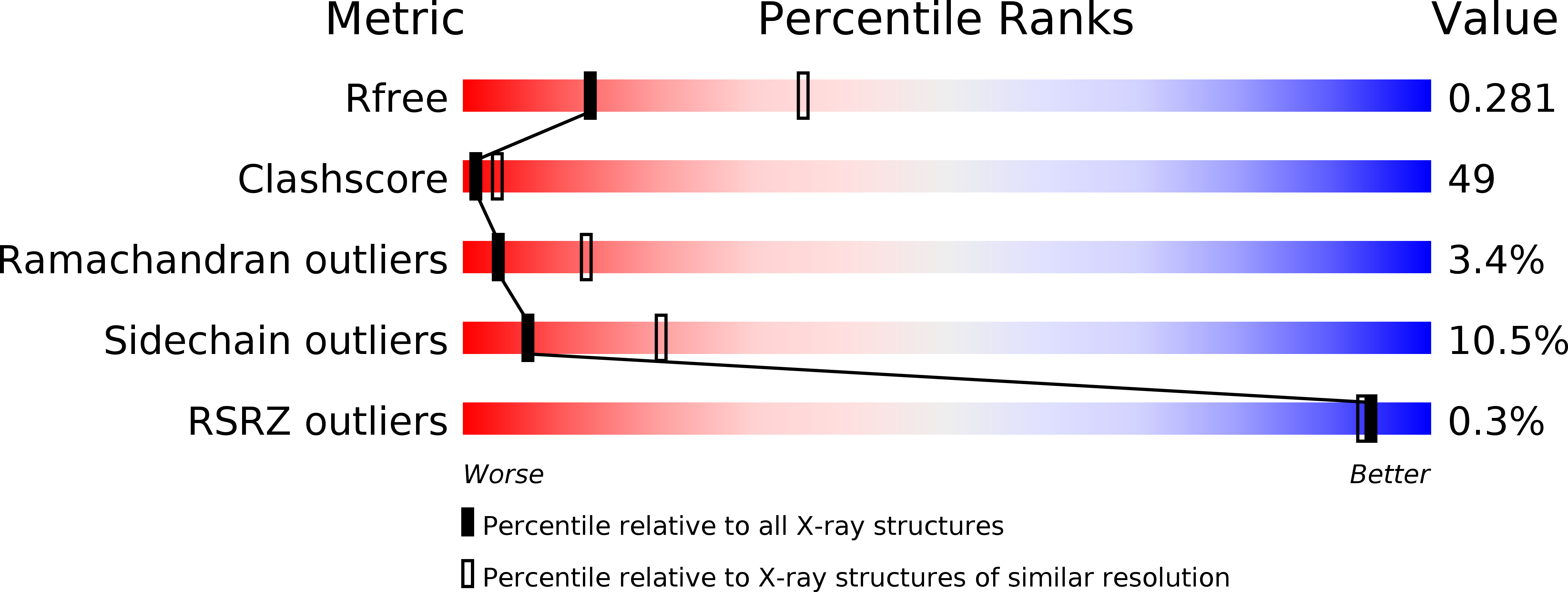
Macromolecular Entities
Structures with similar UniProt ID
Protein Blast
Polymer Type:polypeptide(L)
Molecule:Extracellular lipase
Gene (Uniprot):FGL1
Chain IDs:A, B, C, D
Chain Length:319
Number of Molecules:4
Biological Source:Gibberella zeae
Primary Citation
Crystal structure of a secreted lipase from Gibberella zeae reveals a novel "double-lock" mechanism
Protein Cell 1 760 770 (2010)
PMID: 21203917 DOI: 10.1007/s13238-010-0094-y

Abstact

Fusarium graminearum (sexual stage: Gibberella zeae) is the causative agent of Fusarium Head Blight (FHB), which is one of the most destructive plant disease of cereals, accounting for high grain yield losses, especially for wheat and maize. Like other fungal pathogens, several extracellular enzymes secreted by G. zeae are known to be involved in host infection. Among these secreted lipases, G. zeae lipase (GZEL), which is encoded by the FGL1 gene, was demonstrated to be crucial to G. zeae pathogenicity. However, the precise mechanism of GZEL remains unclear due to a lack of detailed structural information. In this study, we report the crystal structure of GZEL at the atomic level. The structure of GZEL displays distinct structural differences compared to reported homologues and indicates a unique "double lock" enzymatic mechanism. To gain insight into substrate/inhibitor recognition, we proposed a model of GZEL in complex with substrate and the lipase inhibitor ebelactone B (based on the reported structures of GZEL homologues), which defines possible substrate binding sites within the catalytic cleft and suggests an "anti sn-l" binding mode. These results pave the way to elucidating the mechanism of GZEL and thus provide clues for the design of anti-FHB inhibitors.

Legend

Protein

Chemical

Disease

Primary Citation of related structures
Feedback Form
Name
Email
Institute
Feedback