3NFG image
Deposition Date 2010-06-10
Release Date 2010-09-08
Last Version Date 2024-11-20
Entry Detail
PDB ID:
3NFG
Keywords:
Title:
Crystal structure of Dimerization module of RNA polymerase I subcomplex A49/A34.5
Biological Source:
Source Organism(s):
Expression System(s):
Method Details:
Experimental Method:
Resolution:
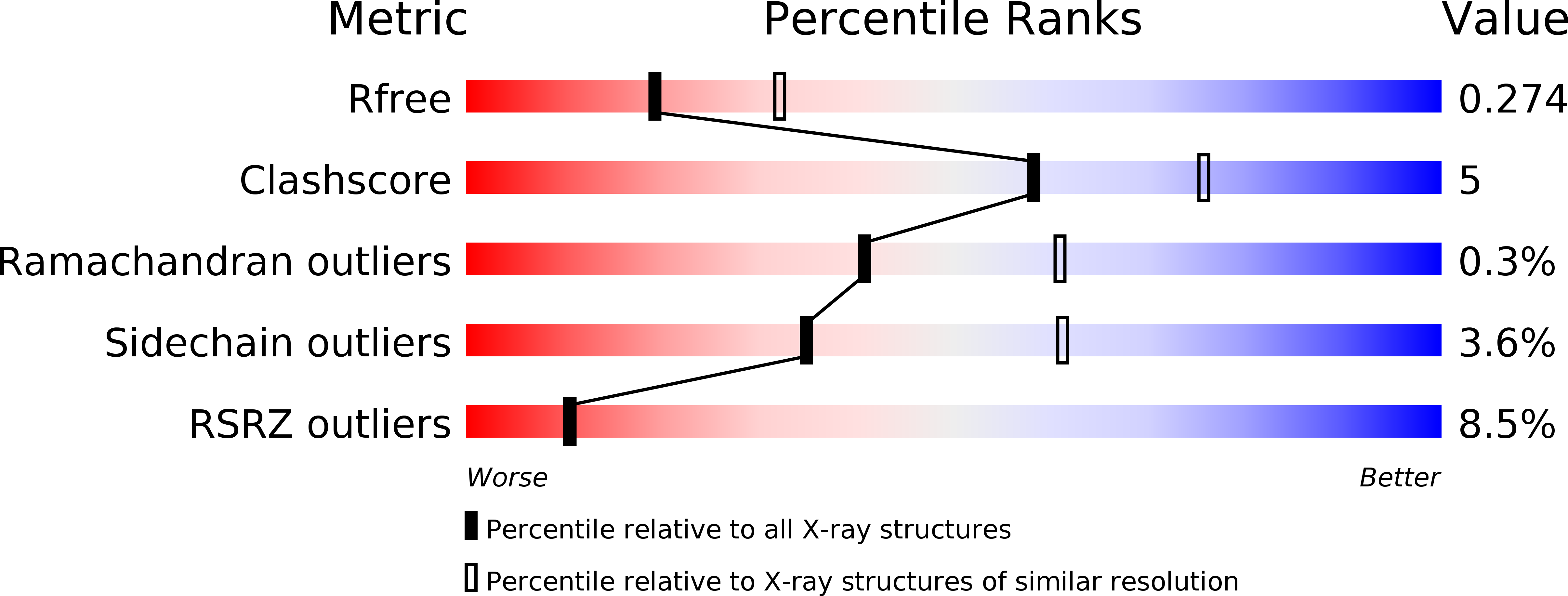
2.51 Å
R-Value Free:
0.24
R-Value Work:
0.19
R-Value Observed:
0.19
Space Group:
P 1 21 1
Macromolecular Entities
Structures with similar UniProt ID
Protein Blast
Polymer Type:polypeptide(L)
Molecule:DNA-directed RNA polymerase I subunit RPA49
Gene (Uniprot):CAGL0J07766g
Mutagens:V72M
Chain IDs:A, C, E, G, I, K, M, O
Chain Length:102
Number of Molecules:8
Biological Source:Candida glabrata
Structures with similar UniProt ID
Protein Blast
Polymer Type:polypeptide(L)
Molecule:DNA-directed RNA polymerase I subunit RPA34
Gene (Uniprot):CAGL0I06006g
Mutagens:L55M
Chain IDs:B, D, F, H, J, L, N, P
Chain Length:123
Number of Molecules:8
Biological Source:Candida glabrata
Modified Residue
Compound ID Chain ID Parent Comp ID Details 2D Image
MSE A MET SELENOMETHIONINE
Primary Citation
RNA Polymerase I Contains a TFIIF-Related DNA-Binding Subcomplex.
Mol.Cell 39 583 594 (2010)
PMID: 20797630 DOI: 10.1016/j.molcel.2010.07.028

Abstact

The eukaryotic RNA polymerases Pol I, II, and III use different promoters to transcribe different classes of genes. Promoter usage relies on initiation factors, including TFIIF and TFIIE, in the case of Pol II. Here, we show that the Pol I-specific subunits A49 and A34.5 form a subcomplex that binds DNA and is related to TFIIF and TFIIE. The N-terminal regions of A49 and A34.5 form a dimerization module that stimulates polymerase-intrinsic RNA cleavage and has a fold that resembles the TFIIF core. The C-terminal region of A49 forms a "tandem winged helix" (tWH) domain that binds DNA with a preference for the upstream promoter nontemplate strand and is predicted in TFIIE. Similar domains are predicted in Pol III-specific subunits. Thus, Pol I/III subunits that have no counterparts in Pol II are evolutionarily related to Pol II initiation factors and may have evolved to mediate promoter specificity and transcription processivity.

Legend

Protein

Chemical

Disease

Primary Citation of related structures
Feedback Form
Name
Email
Institute
Feedback