3ND7 image
Deposition Date 2010-06-07
Release Date 2011-06-22
Last Version Date 2023-11-01
Entry Detail
PDB ID:
3ND7
Keywords:
Title:
Crystal structure of phosphopantetheine adenylyltransferase from Enterococcus faecalis in the ligand-unbound state and in complex with ATP and pantetheine
Biological Source:
Source Organism:
Host Organism:
Method Details:
Experimental Method:
Resolution:
2.40 Å
R-Value Free:
0.26
R-Value Work:
0.21
R-Value Observed:
0.21
Space Group:
P 21 21 21
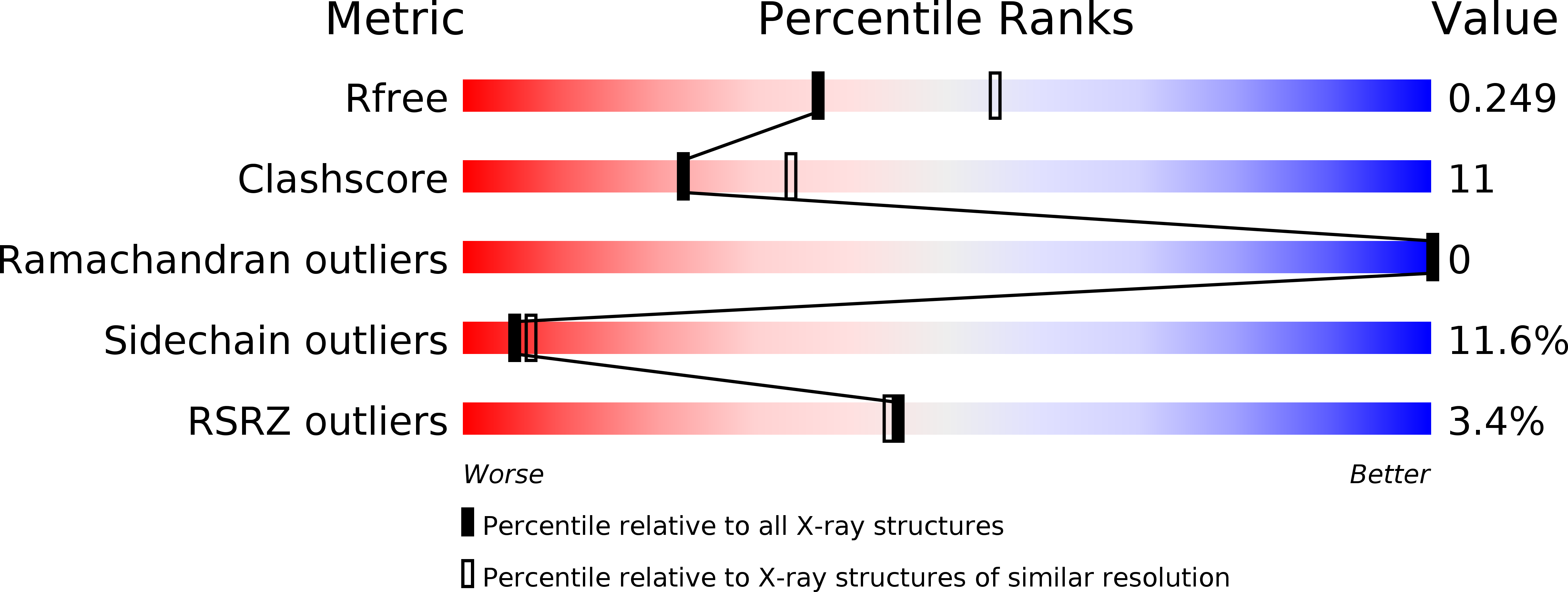
Macromolecular Entities
Structures with similar UniProt ID
Protein Blast
Polymer Type:polypeptide(L)
Molecule:Phosphopantetheine adenylyltransferase
Gene (Uniprot):coaD
Chain IDs:A, B, C, D, E, F
Chain Length:171
Number of Molecules:6
Biological Source:Enterococcus faecalis
Ligand Molecules
Primary Citation
Crystal structure of phosphopantetheine adenylyltransferase from Enterococcus faecalis in the ligand-unbound state and in complex with ATP and pantetheine
Mol.Cells 32 431 435 (2011)
PMID: 21912874 DOI: 10.1007/s10059-011-0102-y

Abstact

Phosphopantetheine adenylyltransferase (PPAT) catalyzes the reversible transfer of an adenylyl group from ATP to 4'-phosphopantetheine (Ppant) to form dephospho-CoA (dPCoA) and pyrophosphate in the Coenzyme A (CoA) biosynthetic pathway. Importantly, PPATs are the potential target for developing antibiotics because bacterial and mammalian PPATs share little sequence homology. Previous structural studies revealed the mechanism of the recognizing substrates and products. The binding modes of ATP, ADP, Ppant, and dPCoA are highly similar in all known structures, whereas the binding modes of CoA or 3'-phosphoadenosine 5'-phosphosulfate binding are novel. To provide further structural information on ligand binding by PPATs, the crystal structure of PPAT from Enterococcus faecalis was solved in three forms: (i) apo form, (ii) binary complex with ATP, and (iii) binary complex with pantetheine. The substrate analog, pantetheine, binds to the active site in a similar manner to Ppant. The new structural information reported in this study including pantetheine as a potent inhibitor of PPAT will supplement the existing structural data and should be useful for structure-based antibacterial discovery against PPATs.

Legend

Protein

Chemical

Disease

Primary Citation of related structures
Feedback Form
Name
Email
Institute
Feedback