3ND3 image
Deposition Date 2010-06-07
Release Date 2011-09-21
Last Version Date 2024-02-21
Entry Detail
PDB ID:
3ND3
Keywords:
Title:
Uhelix 16-mer dsRNA
Biological Source:
Source Organism:
Method Details:
Experimental Method:
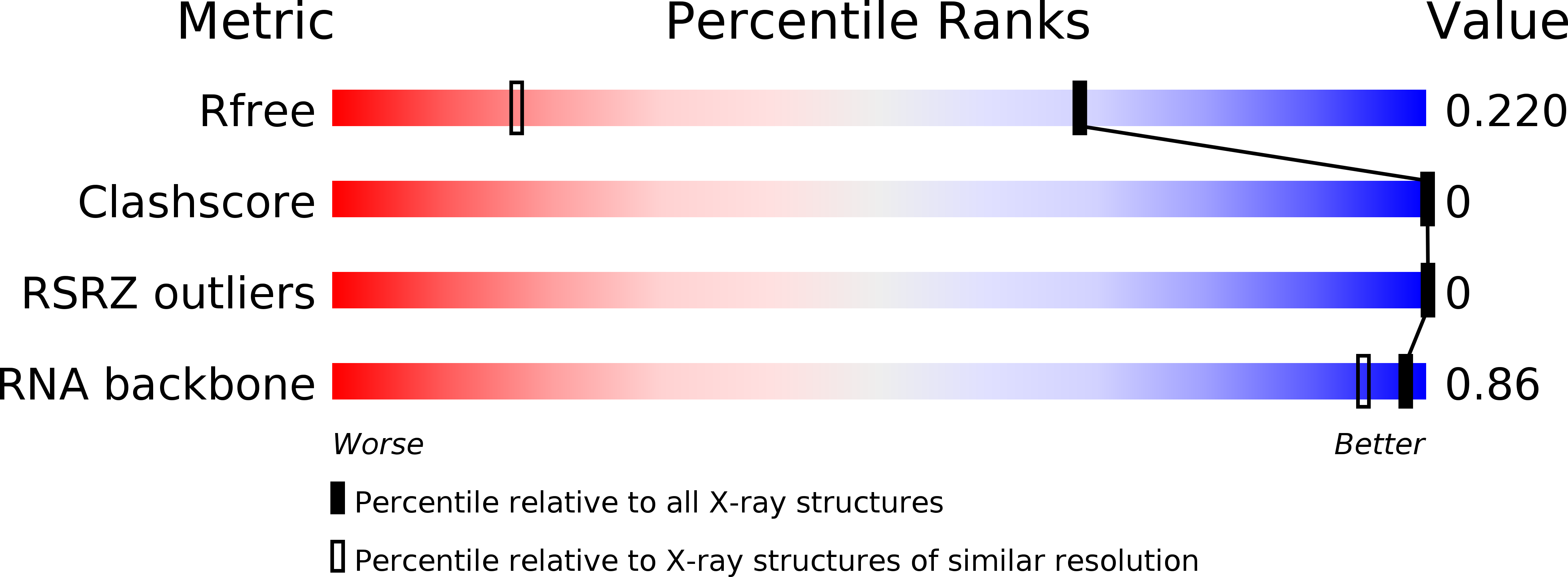
Resolution:
1.37 Å
R-Value Free:
0.22
R-Value Work:
0.18
R-Value Observed:
0.18
Space Group:
H 3 2
Macromolecular Entities
Polymer Type:polyribonucleotide
Molecule:5'-R(*AP*GP*AP*GP*AP*AP*GP*AP*UP*UP*UP*UP*UP*UP*UP*U)-3'
Chain IDs:A
Chain Length:16
Number of Molecules:1
Biological Source:
Primary Citation
The crystal structure of an oligo(U):pre-mRNA duplex from a trypanosome RNA editing substrate.
Rna 17 1870 1883 (2011)
PMID: 21878548 DOI: 10.1261/rna.2880311

Abstact

Guide RNAs bind antiparallel to their target pre-mRNAs to form editing substrates in reaction cycles that insert or delete uridylates (Us) in most mitochondrial transcripts of trypanosomes. The 5' end of each guide RNA has an anchor sequence that binds to the pre-mRNA by base-pair complementarity. The template sequence in the middle of the guide RNA directs the editing reactions. The 3' ends of most guide RNAs have ∼15 contiguous Us that bind to the purine-rich unedited pre-mRNA upstream of the editing site. The resulting U-helix is rich in G·U wobble base pairs. To gain insights into the structure of the U-helix, we crystallized 8 bp of the U-helix in one editing substrate for the A6 mRNA of Trypanosoma brucei. The fragment provides three samples of the 5'-AGA-3'/5'-UUU-3' base-pair triple. The fusion of two identical U-helices head-to-head promoted crystallization. We obtained X-ray diffraction data with a resolution limit of 1.37 Å. The U-helix had low and high twist angles before and after each G·U wobble base pair; this variation was partly due to shearing of the wobble base pairs as revealed in comparisons with a crystal structure of a 16-nt RNA with all Watson-Crick base pairs. Both crystal structures had wider major grooves at the junction between the poly(U) and polypurine tracts. This junction mimics the junction between the template helix and the U-helix in RNA-editing substrates and may be a site of major groove invasion by RNA editing proteins.

Legend

Protein

Chemical

Disease

Primary Citation of related structures
Feedback Form
Name
Email
Institute
Feedback