3N25 image
Deposition Date 2010-05-17
Release Date 2010-07-28
Last Version Date 2023-11-15
Entry Detail
PDB ID:
3N25
Keywords:
Title:
The structure of muscle pyruvate kinase in complex with proline, pyruvate, and Mn2+
Biological Source:
Source Organism:
Method Details:
Experimental Method:
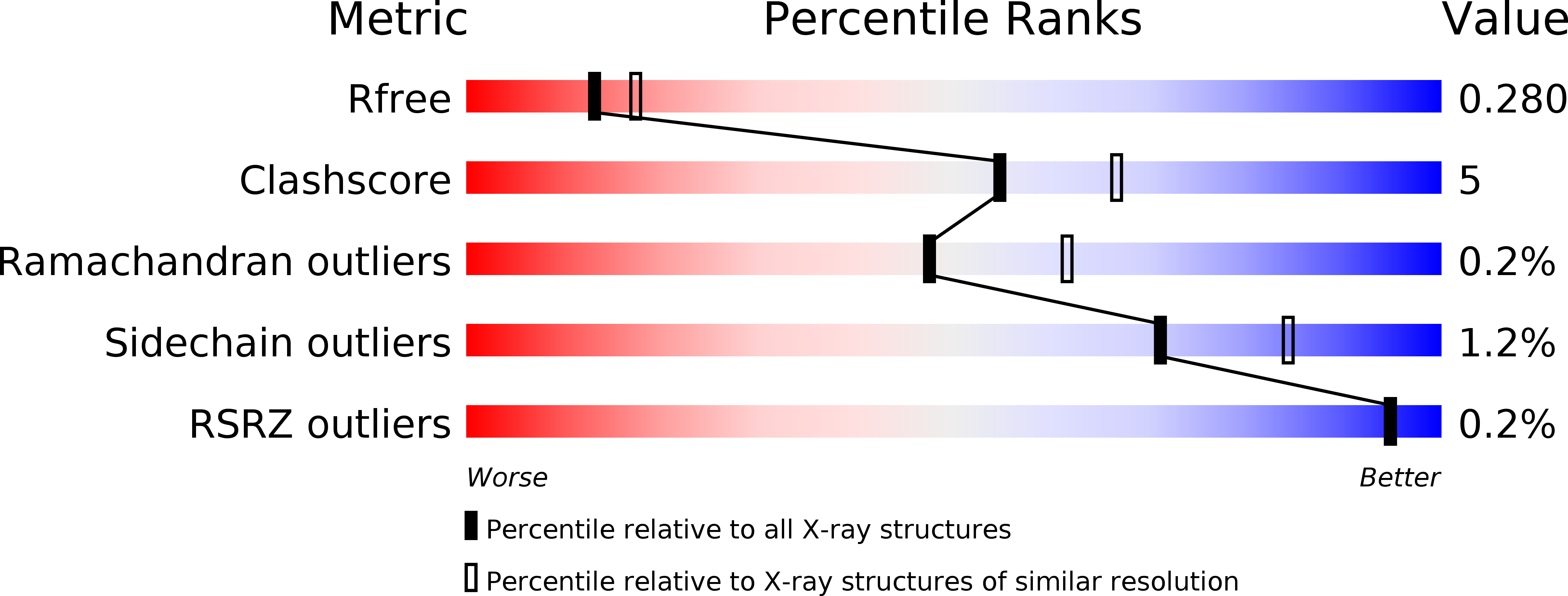
Resolution:
2.41 Å
R-Value Free:
0.26
R-Value Work:
0.20
R-Value Observed:
0.20
Space Group:
P 1
Macromolecular Entities
Structures with similar UniProt ID
Protein Blast
Polymer Type:polypeptide(L)
Molecule:Pyruvate kinase isozymes M1/M2
Gene (Uniprot):PKM
Chain IDs:A, B, C, D, E, F, G, H
Chain Length:531
Number of Molecules:8
Biological Source:Oryctolagus cuniculus
Primary Citation
The pyruvate kinase model system, a cautionary tale for the use of osmolyte perturbations to support conformational equilibria in allostery.
Protein Sci. 19 1796 1800 (2010)
PMID: 20629175 DOI: 10.1002/pro.450

Abstact

In the study of rabbit muscle pyruvate kinase (M1-PYK), proline has previously been used as an osmolyte in an attempt to determine a role for preexisting conformational equilibria in allosteric regulation. In this context, osmolytes are small molecules assumed to have no direct interaction with the protein. In contrast to proline's proposed role as an osmolyte, the structure of M1PYK-Mn-pyruvate-proline complex reported herein demonstrates that proline binds specifically to the allosteric site of M1-PYK. Therefore, this amino acid is an allosteric effector rather than a benign osmolyte. Other compounds often used as osmolytes (polyethyleneglycol and glycerol) are also present in the structure, suggesting an interaction with the protein that would, in turn, prevent the usefulness of these compounds in the study of this and most likely other proteins. These findings highlight the need to verify that compounds used as osmolytes to perturb preexisting conformational equilibrium do not directly interact with the protein, a consideration not commonly addressed in the past.

Legend

Protein

Chemical

Disease

Primary Citation of related structures
Feedback Form
Name
Email
Institute
Feedback