3MUT image
Deposition Date 2010-05-03
Release Date 2010-08-25
Last Version Date 2023-09-06
Entry Detail
PDB ID:
3MUT
Title:
Crystal Structure of the G20A/C92U mutant c-di-GMP riboswith bound to c-di-GMP
Biological Source:
Source Organism:
Homo sapiens (Taxon ID: 9606)
Host Organism:
Method Details:
Experimental Method:
Resolution:
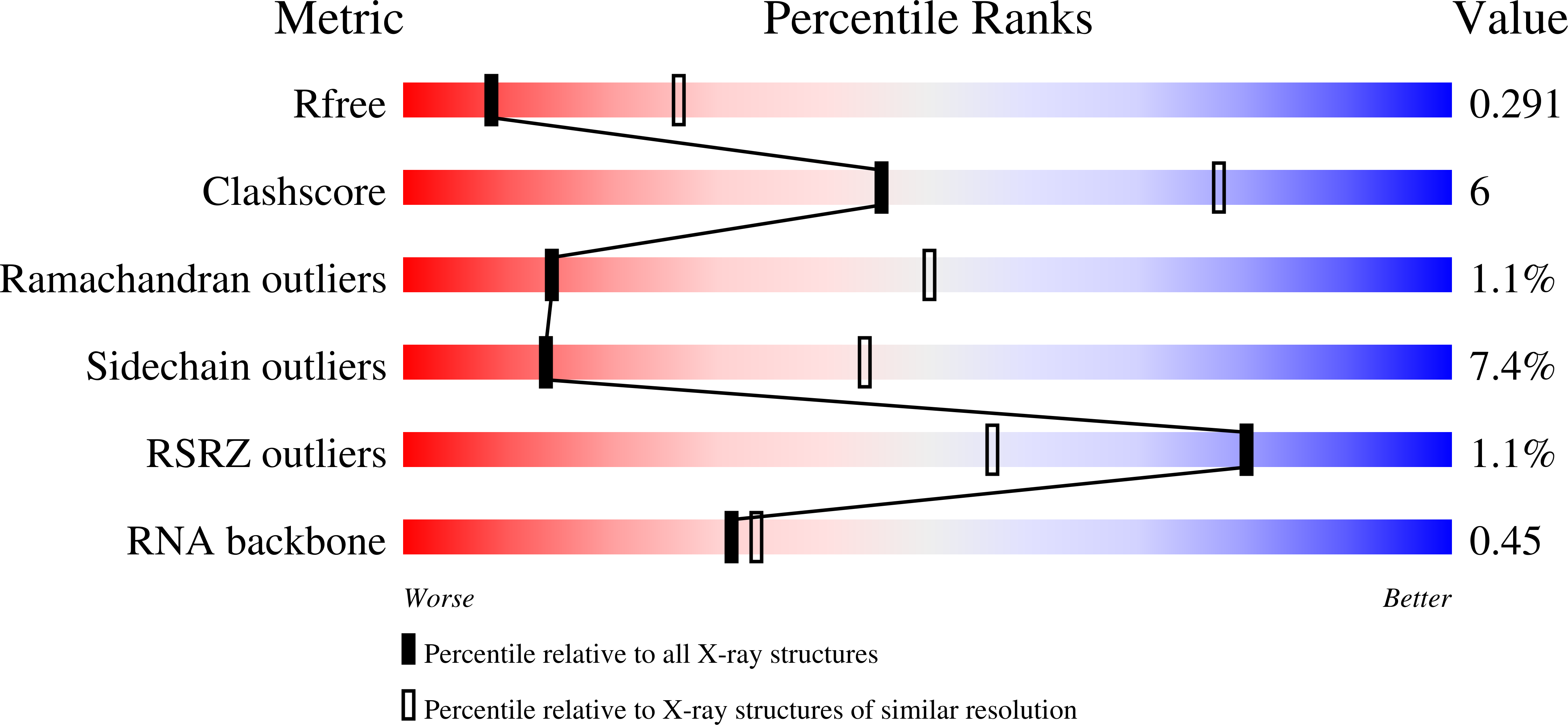
3.00 Å
R-Value Free:
0.26
R-Value Work:
0.23
R-Value Observed:
0.23
Space Group:
P 1 21 1
Macromolecular Entities
Structures with similar UniProt ID
Protein Blast
Polymer Type:polypeptide(L)
Molecule:U1 small nuclear ribonucleoprotein A
Gene (Uniprot):SNRPA
Mutagens:Y31H, Q36R
Chain IDs:A (auth: P)
Chain Length:98
Number of Molecules:1
Biological Source:Homo sapiens
Polymer Type:polyribonucleotide
Molecule:G20A/C92U mutant c-di-GMP riboswitch
Chain IDs:B (auth: R)
Chain Length:92
Number of Molecules:1
Biological Source:
Modified Residue
Compound ID Chain ID Parent Comp ID Details 2D Image
GTP B G GUANOSINE-5'-TRIPHOSPHATE
Primary Citation
Structural and biochemical determinants of ligand binding by the c-di-GMP riboswitch .
Biochemistry 49 7351 7359 (2010)
PMID: 20690679 DOI: 10.1021/bi100671e

Abstact

The bacterial second messenger c-di-GMP is used in many species to control essential processes that allow the organism to adapt to its environment. The c-di-GMP riboswitch (GEMM) is an important downstream target in this signaling pathway and alters gene expression in response to changing concentrations of c-di-GMP. The riboswitch selectively recognizes its second messenger ligand primarily through contacts with two critical nucleotides. However, these two nucleotides are not the most highly conserved residues within the riboswitch sequence. Instead, nucleotides that stack with c-di-GMP and that form tertiary RNA contacts are the most invariant. Biochemical and structural evidence reveals that the most common natural variants are able to make alternative pairing interactions with both guanine bases of the ligand. Additionally, a high-resolution (2.3 A) crystal structure of the native complex reveals that a single metal coordinates the c-di-GMP backbone. Evidence is also provided that after transcription of the first nucleotide on the 3'-side of the P1 helix, which is predicted to be the molecular switch, the aptamer is functional for ligand binding. Although large energetic effects occur when several residues in the RNA are altered, mutations at the most conserved positions, rather than at positions that base pair with c-di-GMP, have the most detrimental effects on binding. Many mutants retain sufficient c-di-GMP affinity for the RNA to remain biologically relevant, which suggests that this motif is quite resilient to mutation.

Legend

Protein

Chemical

Disease

Primary Citation of related structures
Feedback Form
Name
Email
Institute
Feedback