3MLG image
Deposition Date 2010-04-16
Release Date 2010-05-12
Last Version Date 2023-09-06
Entry Detail
PDB ID:
3MLG
Keywords:
Title:
2ouf-2x, a designed knotted protein
Biological Source:
Source Organism:
Host Organism:
Method Details:
Experimental Method:
Resolution:
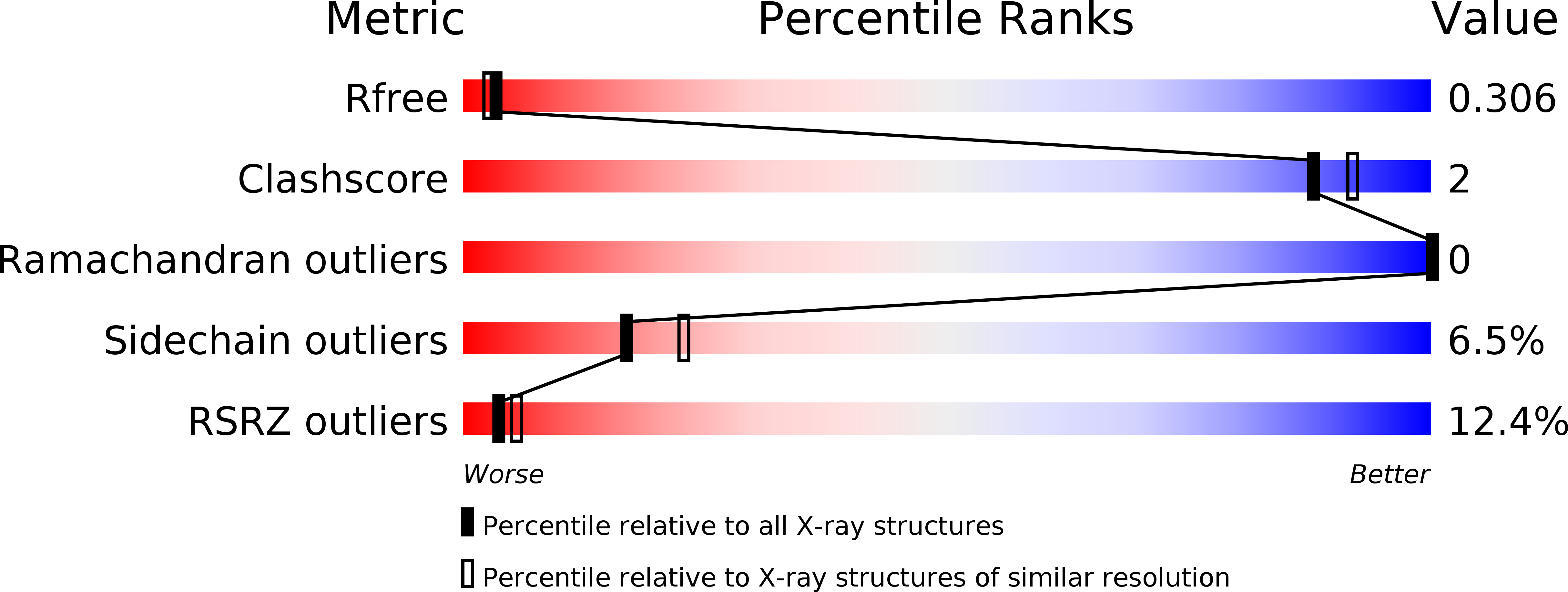
2.29 Å
R-Value Free:
0.27
R-Value Work:
0.24
R-Value Observed:
0.25
Space Group:
P 21 21 21
Macromolecular Entities
Structures with similar UniProt ID
Protein Blast
Polymer Type:polypeptide(L)
Molecule:2X chimera of Helicobacter pylori protein HP0242
Gene (Uniprot):HP_0242
Chain IDs:A, B
Chain Length:189
Number of Molecules:2
Biological Source:Helicobacter pylori
Primary Citation
Structure and folding of a designed knotted protein.
Proc.Natl.Acad.Sci.USA 107 20732 20737 (2010)
PMID: 21068371 DOI: 10.1073/pnas.1007602107

Abstact

A very small number of natural proteins have folded configurations in which the polypeptide backbone is knotted. Relatively little is known about the folding energy landscapes of such proteins, or how they have evolved. We explore those questions here by designing a unique knotted protein structure. Biophysical characterization and X-ray crystal structure determination show that the designed protein folds to the intended configuration, tying itself in a knot in the process, and that it folds reversibly. The protein folds to its native, knotted configuration approximately 20 times more slowly than a control protein, which was designed to have a similar tertiary structure but to be unknotted. Preliminary kinetic experiments suggest a complicated folding mechanism, providing opportunities for further characterization. The findings illustrate a situation where a protein is able to successfully traverse a complex folding energy landscape, though the amino acid sequence of the protein has not been subjected to evolutionary pressure for that ability. The success of the design strategy--connecting two monomers of an intertwined homodimer into a single protein chain--supports a model for evolution of knotted structures via gene duplication.

Legend

Protein

Chemical

Disease

Primary Citation of related structures
Feedback Form
Name
Email
Institute
Feedback