3MK7 image
Deposition Date 2010-04-14
Release Date 2010-08-04
Last Version Date 2024-11-06
Entry Detail
PDB ID:
3MK7
Keywords:
Title:
The structure of CBB3 cytochrome oxidase
Biological Source:
Source Organism(s):
Method Details:
Experimental Method:
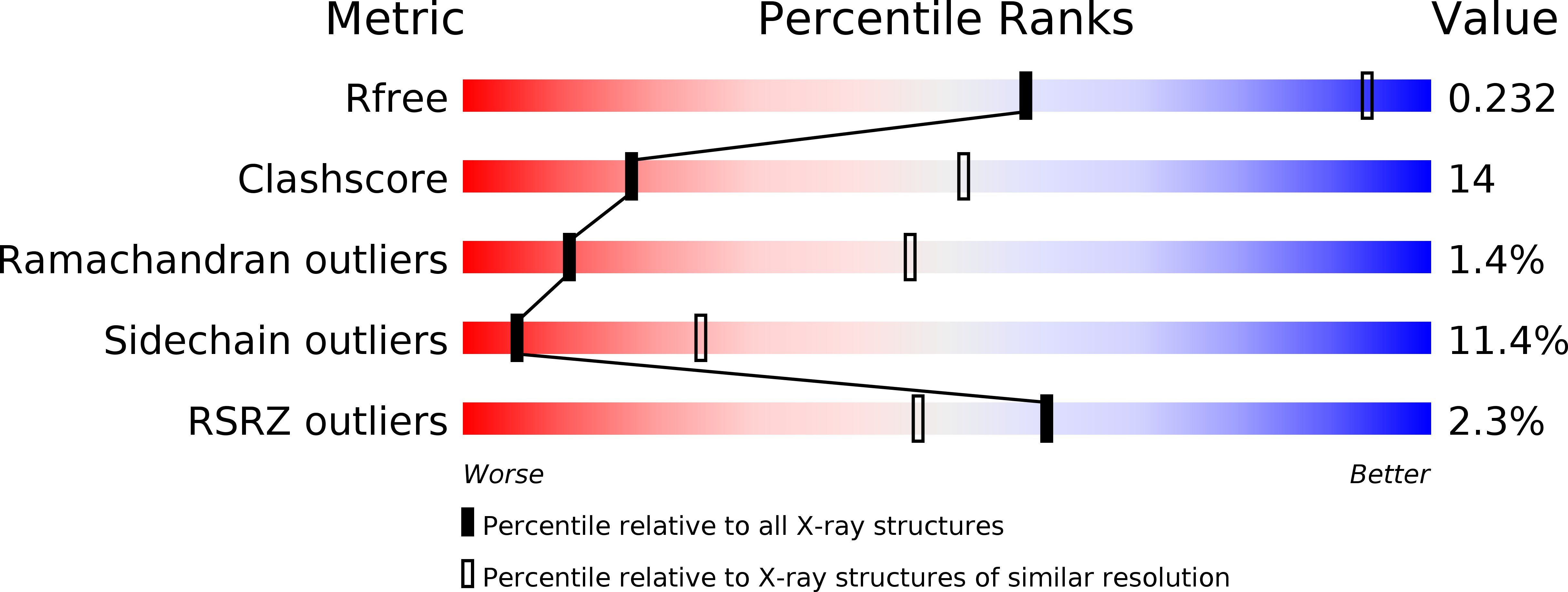
Resolution:
3.20 Å
R-Value Free:
0.22
R-Value Work:
0.18
R-Value Observed:
0.19
Space Group:
P 21 21 2
Macromolecular Entities
Structures with similar UniProt ID
Protein Blast
Polymer Type:polypeptide(L)
Molecule:Cytochrome c oxidase, cbb3-type, subunit N
Chain IDs:A, D, G, J (auth: K)
Chain Length:474
Number of Molecules:4
Biological Source:Pseudomonas stutzeri
Structures with similar UniProt ID
Protein Blast
Polymer Type:polypeptide(L)
Molecule:Cytochrome c oxidase, cbb3-type, subunit O
Chain IDs:B, E, H, K (auth: L)
Chain Length:203
Number of Molecules:4
Biological Source:Pseudomonas stutzeri
Structures with similar UniProt ID
Protein Blast
Polymer Type:polypeptide(L)
Molecule:Cytochrome c oxidase, cbb3-type, subunit P
Chain IDs:C, F, I, L (auth: M)
Chain Length:311
Number of Molecules:4
Biological Source:Pseudomonas stutzeri
Polymer Type:polypeptide(L)
Molecule:30-mer peptide
Chain IDs:M (auth: U), N (auth: X), O (auth: Y), P (auth: Z)
Chain Length:30
Number of Molecules:4
Biological Source:Pseudomonas stutzeri
Primary Citation
The Structure of cbb3 Cytochrome Oxidase Provides Insights into Proton Pumping
Science 329 327 330 (2010)
PMID: 20576851 DOI: 10.1126/science.1187303

Abstact

The heme-copper oxidases (HCOs) accomplish the key event of aerobic respiration; they couple O2 reduction and transmembrane proton pumping. To gain new insights into the still enigmatic process, we structurally characterized a C-family HCO--essential for the pathogenicity of many bacteria--that differs from the two other HCO families, A and B, that have been structurally analyzed. The x-ray structure of the C-family cbb3 oxidase from Pseudomonas stutzeri at 3.2 angstrom resolution shows an electron supply system different from families A and B. Like family-B HCOs, C HCOs have only one pathway, which conducts protons via an alternative tyrosine-histidine cross-link. Structural differences around hemes b and b3 suggest a different redox-driven proton-pumping mechanism and provide clues to explain the higher activity of family-C HCOs at low oxygen concentrations.

Legend

Protein

Chemical

Disease

Primary Citation of related structures
Feedback Form
Name
Email
Institute
Feedback