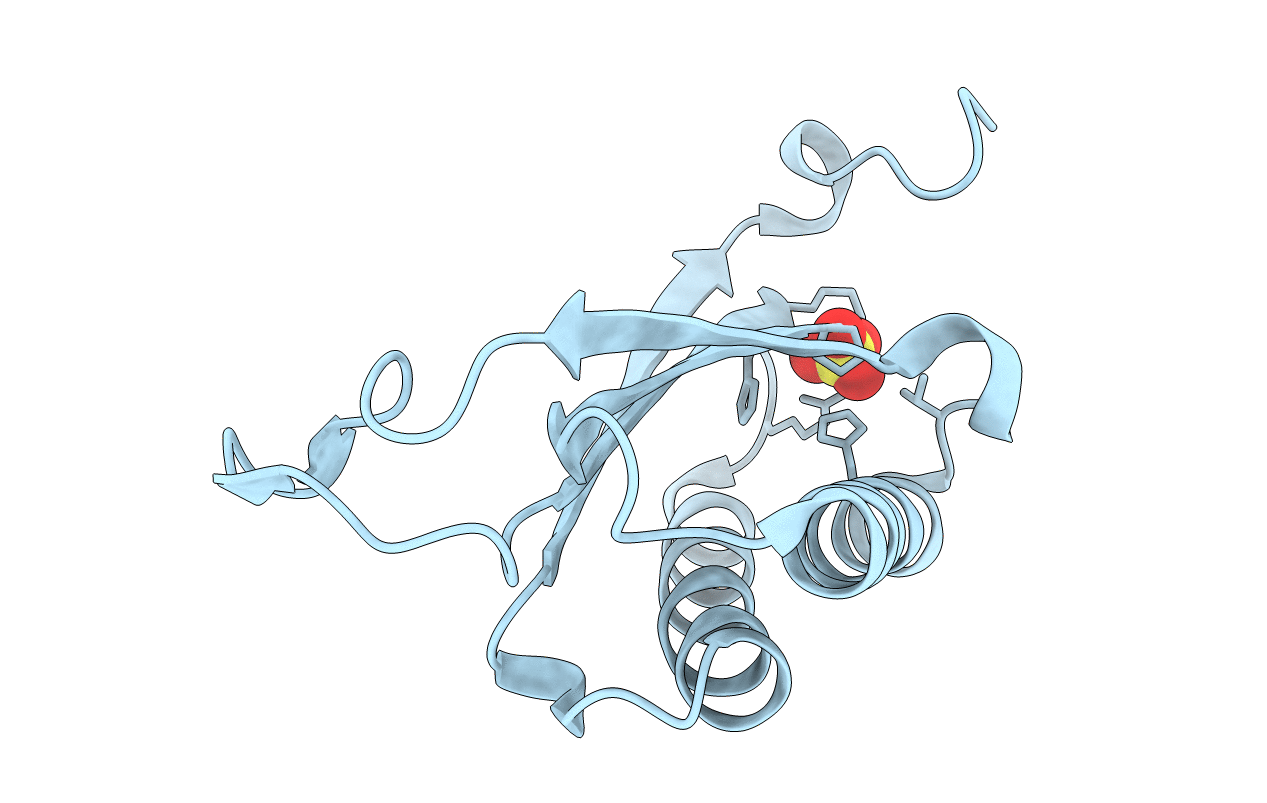
3MF8 image
Deposition Date 2010-04-01
Release Date 2011-01-12
Last Version Date 2023-09-06
Entry Detail
PDB ID:
3MF8
Keywords:
Title:
Crystal Structure of Native cis-CaaD
Biological Source:
Source Organism:
Host Organism:
Method Details:
Experimental Method:
Resolution:
2.01 Å
R-Value Free:
0.23
R-Value Work:
0.18
R-Value Observed:
0.18
Space Group:
P 63
Macromolecular Entities
Structures with similar UniProt ID
Protein Blast
Polymer Type:polypeptide(L)
Molecule:Cis-3-chloroacrylic acid dehalogenase
Gene (Uniprot):cis-caaD
Chain IDs:A
Chain Length:149
Number of Molecules:1
Biological Source:coryneform bacterium
Ligand Molecules
Primary Citation
Crystal structures of native and inactivated cis-3-chloroacrylic acid dehalogenase: Implications for the catalytic and inactivation mechanisms.
Bioorg.Chem. 39 1 9 (2011)
PMID: 21074239 DOI: 10.1016/j.bioorg.2010.10.001

Abstact

The isomeric mixture of cis- and trans-1,3-dichloropropene constitutes the active component of a widely used nematocide known as Telone II®. The mixture is processed by various soil bacteria to acetaldehyde through the 1,3-dichloropropene catabolic pathway. The pathway relies on an isomer-specific hydrolytic dehalogenation reaction catalyzed by cis- or trans-3-chloroacrylic acid dehalogenase, known respectively as cis-CaaD and CaaD. Previous sequence analysis and crystallographic studies of the native and covalently modified enzymes identified Pro-1, His-28, Arg-70, Arg-73, Tyr-103, and Glu-114 as key binding and catalytic residues in cis-CaaD. Mutagenesis of these residues confirmed their importance to the dehalogenation reaction. Crystal structures of the native enzyme (2.01Å resolution) and the enzyme covalently modified at the Pro-1 nitrogen by 2-hydroxypropanoate (1.65Å resolution) are reported here. Both structures are at a resolution higher than previously reported (2.75Å and 2.1Å resolution, respectively). The conformation of the covalent adduct is strikingly different from that previously reported due to its interaction with a 7-residue loop (Thr-32 to Leu-38). The participation of another active site residue, Arg-117, in catalysis and inactivation was also examined. The implications of the combined findings for the mechanisms of catalysis and inactivation are discussed.

Legend

Protein

Chemical

Disease

Primary Citation of related structures
Feedback Form
Name
Email
Institute
Feedback