3M6M image
Deposition Date 2010-03-16
Release Date 2010-09-22
Last Version Date 2024-03-20
Entry Detail
PDB ID:
3M6M
Title:
Crystal structure of RpfF complexed with REC domain of RpfC
Biological Source:
Source Organism:
Host Organism:
Method Details:
Experimental Method:
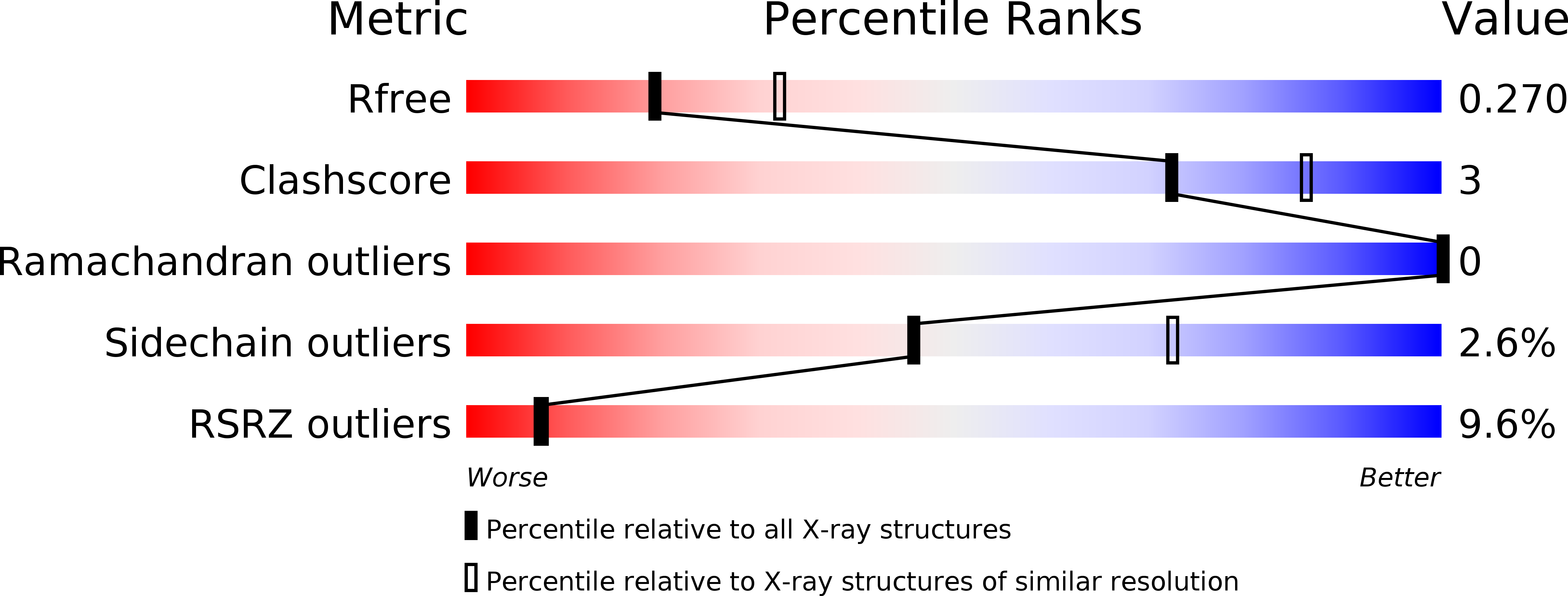
Resolution:
2.50 Å
R-Value Free:
0.27
R-Value Work:
0.25
R-Value Observed:
0.25
Space Group:
P 65
Macromolecular Entities
Structures with similar UniProt ID
Protein Blast
Polymer Type:polypeptide(L)
Molecule:RpfF protein
Gene (Uniprot):rpfF
Chain IDs:A, B, C
Chain Length:305
Number of Molecules:3
Biological Source:Xanthomonas campestris pv. campestris
Structures with similar UniProt ID
Protein Blast
Polymer Type:polypeptide(L)
Molecule:Sensory/regulatory protein rpfC
Gene (Uniprot):rpfC
Chain IDs:D, E, F
Chain Length:143
Number of Molecules:3
Biological Source:Xanthomonas campestris pv. campestris
Primary Citation
Structural Basis of the Sensor-Synthase Interaction in Autoinduction of the Quorum Sensing Signal DSF Biosynthesis
Structure 18 1199 1209 (2010)
PMID: 20826346 DOI: 10.1016/j.str.2010.06.011

Abstact

The diffusible signal factor (DSF)-dependent quorum sensing (QS) system adopts a novel protein-protein interaction mechanism to autoregulate the production of signal DSF. Here, we present the crystal structures of DSF synthase RpfF and its complex with the REC domain of sensor protein RpfC. RpfF is structurally similarity to the members of the crotonase superfamily and contains an N-terminal α/β spiral core domain and a C-terminal α-helical region. Further structural and mutational analysis identified two catalytic glutamate residues, which is the conserved feature of the enoyl-CoA hydratases/dehydratases. A putative substrate-binding pocket was unveiled and the key roles of the residues implicated in substrate binding were verified by mutational analysis. The binding of the REC domain may lock RpfF in an inactive conformation by blocking the entrance of substrate binding pocket, thereby negatively regulating DSF production. These findings provide a structural model for the RpfC-RpfF interaction-mediated QS autoinduction mechanism.

Legend

Protein

Chemical

Disease

Primary Citation of related structures
Feedback Form
Name
Email
Institute
Feedback