3M1L image
Deposition Date 2010-03-05
Release Date 2010-12-22
Last Version Date 2024-03-20
Entry Detail
PDB ID:
3M1L
Keywords:
Title:
Crystal structure of a C-terminal trunacted mutant of a putative ketoacyl reductase (FabG4) from Mycobacterium tuberculosis H37Rv at 2.5 Angstrom resolution
Biological Source:
Source Organism:
Host Organism:
Method Details:
Experimental Method:
Resolution:
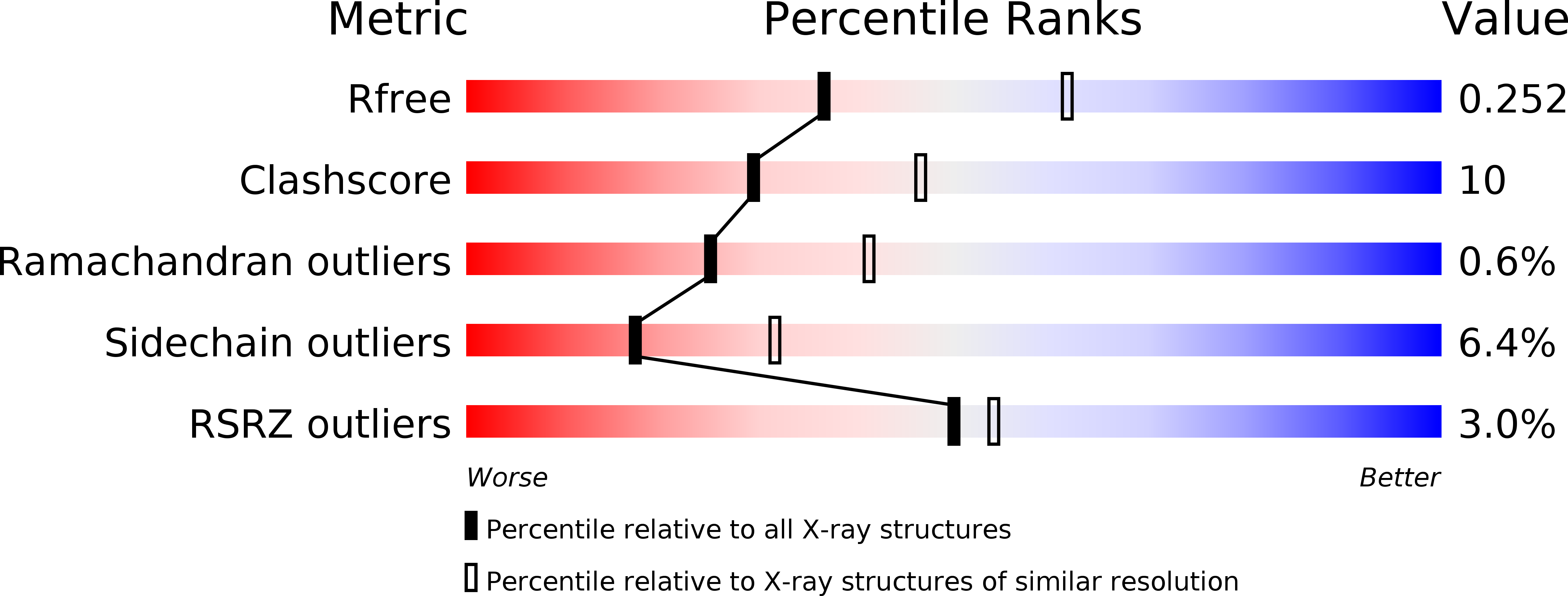
2.52 Å
R-Value Free:
0.24
R-Value Work:
0.18
R-Value Observed:
0.18
Space Group:
P 21 21 21
Macromolecular Entities
Structures with similar UniProt ID
Protein Blast
Polymer Type:polypeptide(L)
Molecule:3-oxoacyl-(Acyl-carrier-protein) reductase
Gene (Uniprot):fabG-1
Chain IDs:A, B
Chain Length:432
Number of Molecules:2
Biological Source:Mycobacterium tuberculosis
Ligand Molecules
Primary Citation
Crystal structure of FabG4 from Mycobacterium tuberculosis reveals the importance of C-terminal residues in ketoreductase activity
J.Struct.Biol. 174 147 155 (2011)
PMID: 21081168 DOI: 10.1016/j.jsb.2010.11.012

Abstact

Rv0242c, also known as FabG4, is a beta-ketoacyl CoA reductase in Mycobacterium tuberculosis. The crystal structure of C-terminal truncated FabG4 is solved at 2.5Å resolution which shows the presence of two distinct domains, domain I and II. Domain I partially resembles "flavodoxin type domain" and the domain II is a typical "ketoacyl CoA reductase (KAR) domain". The enzyme exhibits ketoacyl CoA reductase activity by reducing acetoacyl CoA to 3-hydroxyacyl CoA in presence of NADH. Conserved catalytic triad Ser347, Tyr360, and Lys364 constitute the active site residues of the KAR domain. Presence of the Tyr and the Lys residues in the triad in a particular orientation is imperative for effective catalytic mechanism. The importance of loop I and II and the role of the C-terminal residues of KAR domain are highlighted. Comparative structural analyses clearly demonstrate that loop II is stabilized by hydrophobic interaction with C-terminal residues to sustain the orientation of Tyr360. Loop I interacts with loop II via H-bonding network to restrict the active site residue Lys364 in a catalytically favorable orientation.

Legend

Protein

Chemical

Disease

Primary Citation of related structures
Feedback Form
Name
Email
Institute
Feedback