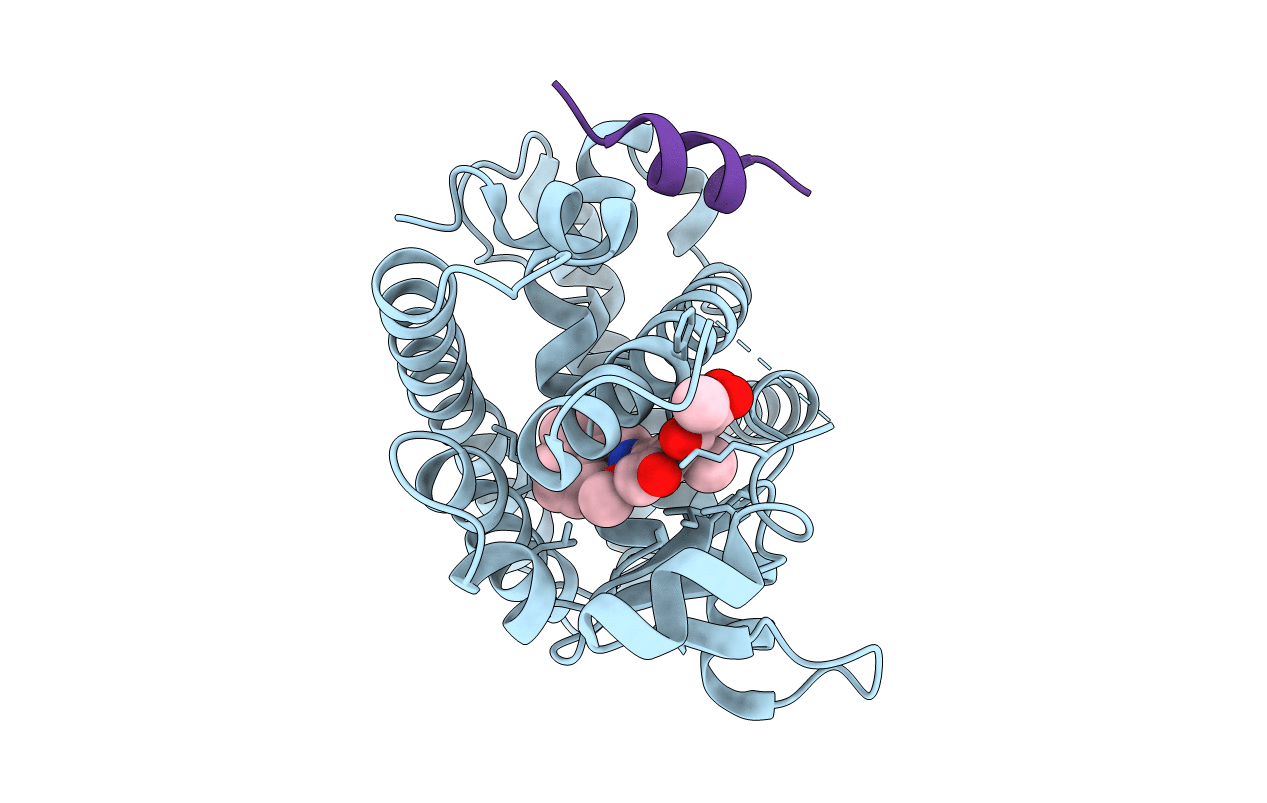
3LMP image
Deposition Date 2010-01-31
Release Date 2010-04-14
Last Version Date 2023-11-01
Entry Detail
PDB ID:
3LMP
Keywords:
Title:
Crystal structure of the PPARgamma-LBD complexed with a cercosporamide derivative modulator
Biological Source:
Source Organism:
Homo sapiens (Taxon ID: 9606)
Host Organism:
Method Details:
Experimental Method:
Resolution:
1.90 Å
R-Value Free:
0.24
R-Value Work:
0.20
R-Value Observed:
0.20
Space Group:
P 1 21 1
Macromolecular Entities
Structures with similar UniProt ID
Protein Blast
Polymer Type:polypeptide(L)
Molecule:Peroxisome proliferator-activated receptor gamma
Gene (Uniprot):PPARG
Chain IDs:A
Chain Length:283
Number of Molecules:1
Biological Source:Homo sapiens
Structures with similar UniProt ID
Protein Blast
Polymer Type:polypeptide(L)
Molecule:Peptide of Nuclear receptor coactivator 1
Gene (Uniprot):NCOA1
Chain IDs:B (auth: C)
Chain Length:15
Number of Molecules:1
Biological Source:
Ligand Molecules
Primary Citation
Discovery of a novel selective PPARgamma modulator from (-)-Cercosporamide derivatives
Bioorg.Med.Chem.Lett. 20 2095 2098 (2010)
PMID: 20219371 DOI: 10.1016/j.bmcl.2010.02.073

Abstact

In an investigation of (-)-Cercosporamide derivatives with a plasma glucose-lowering effect, we found that N-benzylcarboxamide derivative 4 was a partial agonist of PPARgamma. A SAR study of the substituents on carboxamide nitrogen afforded the N-(1-naphthyl)methylcarboxamide derivative 23 as the most potent selective PPARgamma modulator. An X-ray crystallography study revealed that compound 23 bounded to the PPARgamma ligand binding domain in a unique way without any interaction with helix12. Compound 23 displayed a potent plasma glucose-lowering effect in db/db mice without the undesirable increase in body fluid and heart weight that is typically observed when PPARgamma full agonists are administrated.

Legend

Protein

Chemical

Disease

Primary Citation of related structures
Feedback Form
Name
Email
Institute
Feedback