3KTV image
Deposition Date 2009-11-26
Release Date 2010-02-16
Last Version Date 2023-09-06
Entry Detail
PDB ID:
3KTV
Title:
Crystal structure of the human SRP19/S-domain SRP RNA complex
Biological Source:
Source Organism:
Homo sapiens (Taxon ID: 9606)
Host Organism:
Method Details:
Experimental Method:
Resolution:
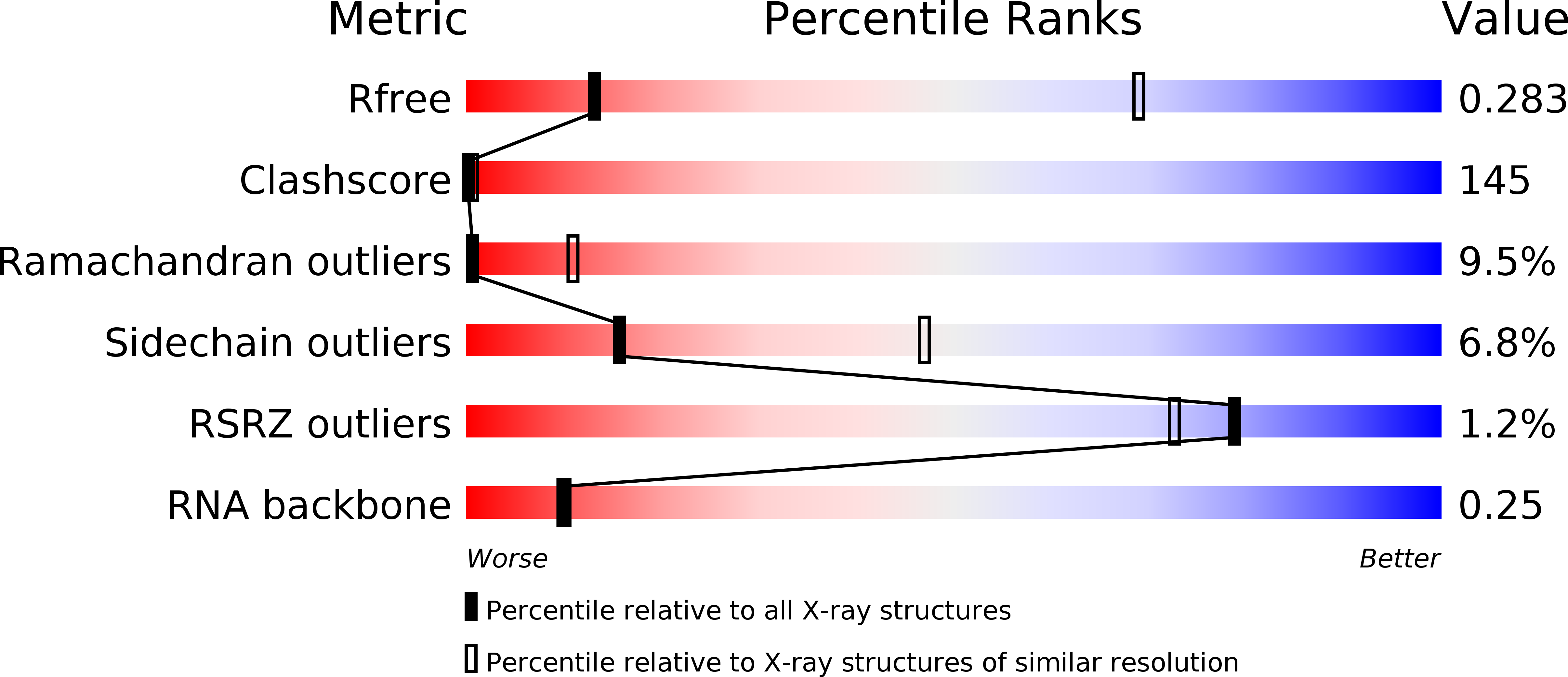
3.80 Å
R-Value Free:
0.32
R-Value Work:
0.29
R-Value Observed:
0.29
Space Group:
P 43 21 2
Macromolecular Entities
Polymer Type:polyribonucleotide
Molecule:SRP RNA
Chain IDs:A
Chain Length:108
Number of Molecules:1
Biological Source:Homo sapiens
Structures with similar UniProt ID
Protein Blast
Polymer Type:polypeptide(L)
Molecule:Signal recognition particle 19 kDa protein
Gene (Uniprot):SRP19
Chain IDs:B, D
Chain Length:128
Number of Molecules:2
Biological Source:Homo sapiens
Polymer Type:polyribonucleotide
Molecule:SRP RNA
Chain IDs:C
Chain Length:108
Number of Molecules:1
Biological Source:Homo sapiens
Modified Residue
Compound ID Chain ID Parent Comp ID Details 2D Image
GDP C G GUANOSINE-5'-DIPHOSPHATE
Primary Citation
Structural insights into the assembly of the human and archaeal signal recognition particles.
Acta Crystallogr.,Sect.D 66 295 303 (2010)
PMID: 20179341 DOI: 10.1107/S0907444910000879

Abstact

The signal recognition particle (SRP) is a conserved ribonucleoprotein (RNP) complex that co-translationally targets membrane and secretory proteins to membranes. The assembly of the particle depends on the proper folding of the SRP RNA, which in mammalia and archaea involves an induced-fit mechanism within helices 6 and 8 in the S domain of SRP. The two helices are juxtaposed and clamped together upon binding of the SRP19 protein to their apices. In the current assembly paradigm, archaeal SRP19 causes the asymmetric loop of helix 8 to bulge out and expose the binding platform for the key player SRP54. Based on a heterologous archaeal SRP19-human SRP RNA structure, mammalian SRP19 was thought not to be able to induce this change, thus explaining the different requirements of SRP19 for SRP54 recruitment. In contrast, the crystal structures of a crenarchaeal and the all-human SRP19-SRP RNA binary complexes presented here show that the asymmetric loop is bulged out in both binary complexes. Differences in SRP assembly between mammalia and archaea are therefore independent of SRP19 and are based on differences in SRP RNA itself. A new SRP-assembly scheme is presented.

Legend

Protein

Chemical

Disease

Primary Citation of related structures
Feedback Form
Name
Email
Institute
Feedback