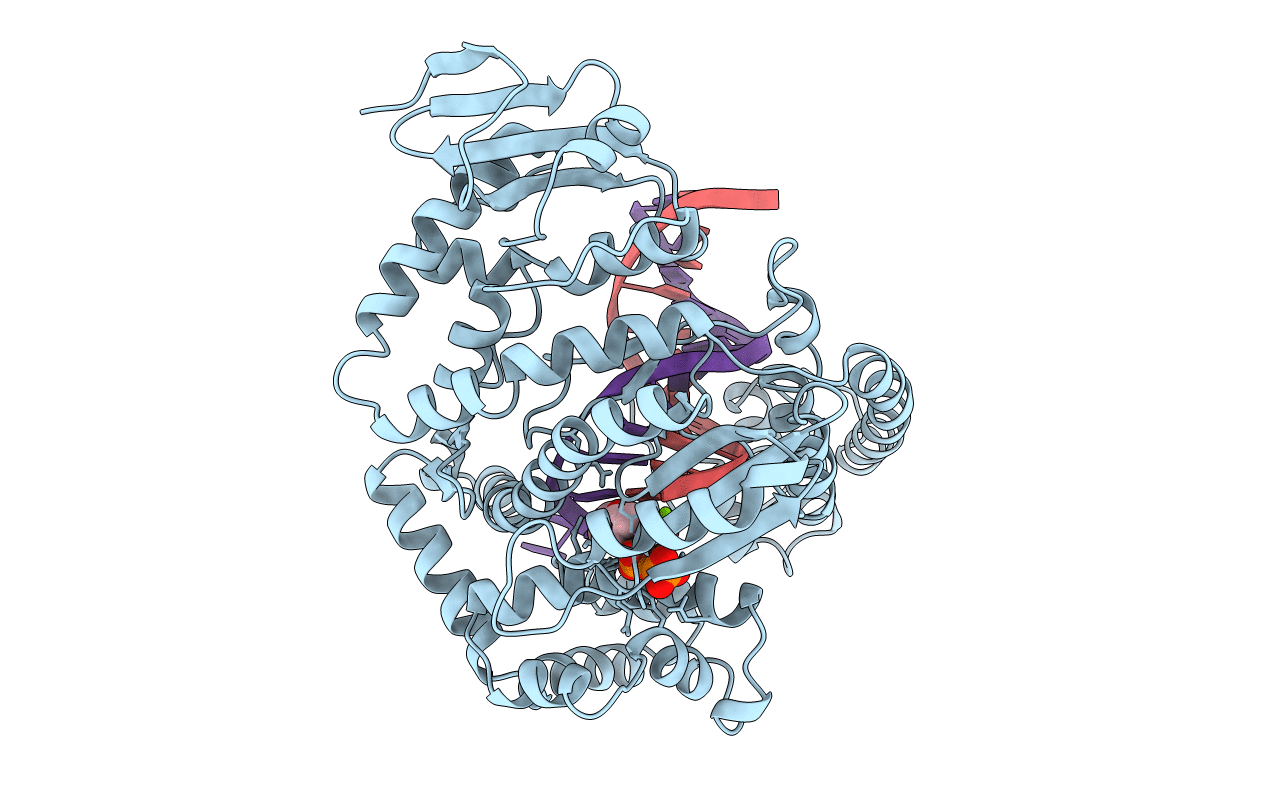
3KTQ image
Deposition Date 1998-07-28
Release Date 1999-01-13
Last Version Date 2024-02-21
Entry Detail
PDB ID:
3KTQ
Keywords:
Title:
CRYSTAL STRUCTURE OF AN ACTIVE TERNARY COMPLEX OF THE LARGE FRAGMENT OF DNA POLYMERASE I FROM THERMUS AQUATICUS
Biological Source:
Source Organism:
Host Organism:
Method Details:
Experimental Method:
Resolution:
2.30 Å
R-Value Free:
0.27
R-Value Work:
0.21
R-Value Observed:
0.21
Space Group:
P 31 2 1

Macromolecular Entities
Structures with similar UniProt ID
Protein Blast
Polymer Type:polypeptide(L)
Molecule:PROTEIN (LARGE FRAGMENT OF DNA POLYMERASE I)
Gene (Uniprot):polA
Chain IDs:C (auth: A)
Chain Length:540
Number of Molecules:1
Biological Source:Thermus aquaticus
Modified Residue
Compound ID Chain ID Parent Comp ID Details 2D Image
DOC A DC 2',3'-DIDEOXYCYTIDINE-5'-MONOPHOSPHATE
Primary Citation
Crystal structures of open and closed forms of binary and ternary complexes of the large fragment of Thermus aquaticus DNA polymerase I: structural basis for nucleotide incorporation.
EMBO J. 17 7514 7525 (1998)
PMID: 9857206 DOI: 10.1093/emboj/17.24.7514

Abstact

The crystal structures of two ternary complexes of the large fragment of Thermus aquaticus DNA polymerase I (Klentaq1) with a primer/template DNA and dideoxycytidine triphosphate, and that of a binary complex of the same enzyme with a primer/template DNA, were determined to a resolution of 2.3, 2.3 and 2.5 A, respectively. One ternary complex structure differs markedly from the two other structures by a large reorientation of the tip of the fingers domain. This structure, designated 'closed', represents the ternary polymerase complex caught in the act of incorporating a nucleotide. In the two other structures, the tip of the fingers domain is rotated outward by 46 degrees ('open') in an orientation similar to that of the apo form of Klentaq1. These structures provide the first direct evidence in DNA polymerase I enzymes of a large conformational change responsible for assembling an active ternary complex.

Legend

Protein

Chemical

Disease

Primary Citation of related structures
Feedback Form
Name
Email
Institute
Feedback