3KDZ image
Deposition Date 2009-10-23
Release Date 2010-07-07
Last Version Date 2024-10-30
Entry Detail
PDB ID:
3KDZ
Keywords:
Title:
X-ray crystal structure of a tyrosine aminomutase mutant construct with bound ligand
Biological Source:
Source Organism:
Host Organism:
Method Details:
Experimental Method:
Resolution:
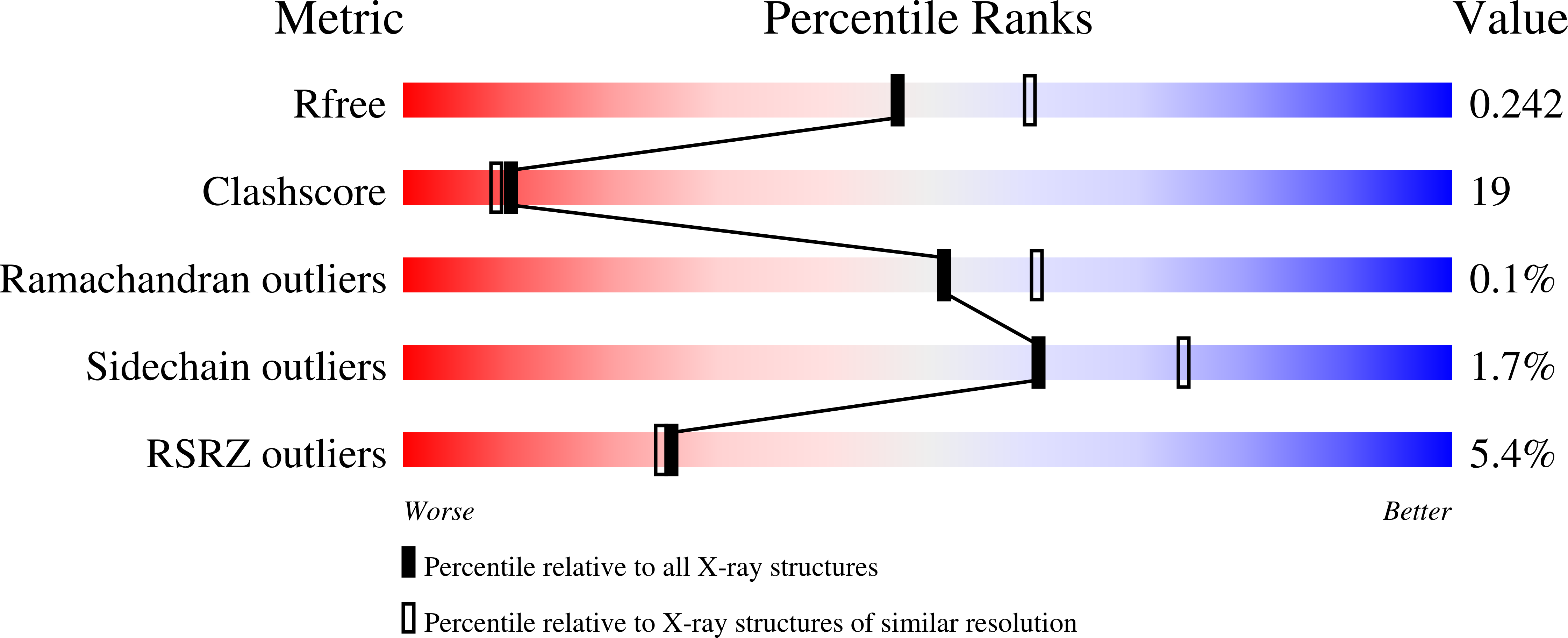
2.20 Å
R-Value Free:
0.24
R-Value Work:
0.20
R-Value Observed:
0.20
Space Group:
P 21 21 2
Macromolecular Entities
Structures with similar UniProt ID
Protein Blast
Polymer Type:polypeptide(L)
Molecule:Histidine ammonia-lyase
Mutagens:Y63F
Chain IDs:A, B
Chain Length:539
Number of Molecules:2
Biological Source:Streptomyces globisporus
Modified Residue
Compound ID Chain ID Parent Comp ID Details 2D Image
MDO A ALA ?
Ligand Molecules
Primary Citation
Probing the active site of MIO-dependent aminomutases, key catalysts in the biosynthesis of beta-amino acids incorporated in secondary metabolites
Biopolymers 93 802 810 (2010)
PMID: 20577998 DOI: 10.1002/bip.21500

Abstact

The tyrosine aminomutase SgTAM produces (S)-ss-tyrosine from L-tyrosine in the biosynthesis of the enediyne antitumor antibiotic C-1027. This conversion is promoted by the methylideneimidazole-5-one (MIO) prosthetic group. MIO was first identified in the homologous family of ammonia lyases, which deaminate aromatic amino acids to form alpha,ss-unsaturated carboxylates. Studies of substrate specificity have been described for lyases but there have been limited reports in altering the substrate specificity of aminomutases. Furthermore, it remains unclear as to what structural properties are responsible for catalyzing the presumed readdition of the amino group into the alpha,ss-unsaturated intermediates to form ss-amino acids. Attempts to elucidate specificity and mechanistic determinants of SgTAM have also proved to be difficult as it is recalcitrant to perturbations to the active site via mutagenesis. An X-ray cocrystal structure of the SgTAM mutant of the catalytic base with L-tyrosine verified important substrate binding residues as well as the enzymatic base. Further mutagenesis revealed that removal of these crucial interactions renders the enzyme inactive. Proposed structural determinants for mutase activity probed via mutagenesis, time-point assays and X-ray crystallography revealed a complicated role for these residues in maintaining key quaternary structure properties that aid in catalysis.

Legend

Protein

Chemical

Disease

Primary Citation of related structures
Feedback Form
Name
Email
Institute
Feedback