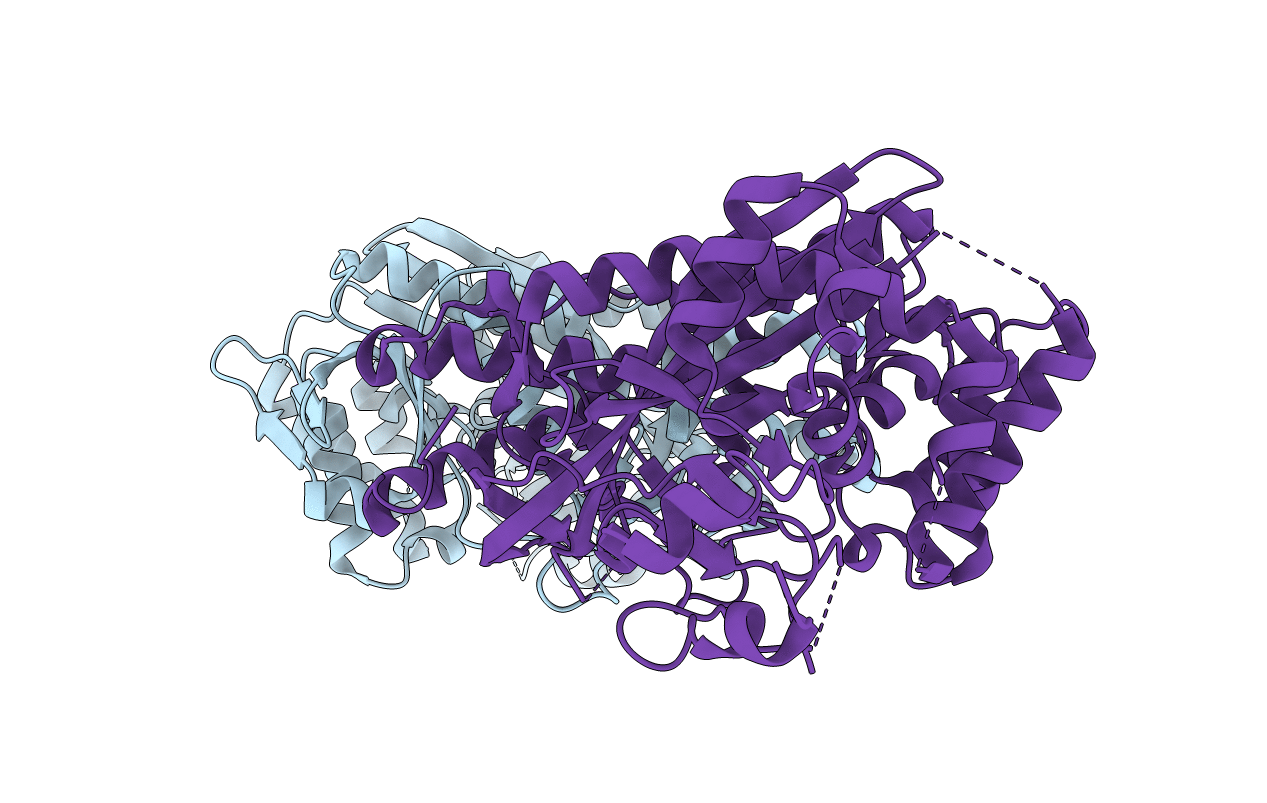
3KAJ image
Deposition Date 2009-10-19
Release Date 2009-12-22
Last Version Date 2023-09-06
Entry Detail
PDB ID:
3KAJ
Keywords:
Title:
Apoenzyme structure of homoglutathione synthetase from Glycine max in open conformation
Biological Source:
Source Organism:
Glycine max (Taxon ID: 3847)
Host Organism:
Method Details:
Experimental Method:
Resolution:
2.00 Å
R-Value Free:
0.26
R-Value Work:
0.19
R-Value Observed:
0.20
Space Group:
P 1 21 1

Macromolecular Entities
Structures with similar UniProt ID
Protein Blast
Polymer Type:polypeptide(L)
Molecule:Homoglutathione synthetase
Gene (Uniprot):hGS
Chain IDs:A, B
Chain Length:499
Number of Molecules:2
Biological Source:Glycine max
Primary Citation
Structural Basis for Evolution of Product Diversity in Soybean Glutathione Biosynthesis.
Plant Cell 21 3450 3458 (2009)
PMID: 19948790 DOI: 10.1105/tpc.109.071183

Abstact

The redox active peptide glutathione is ubiquitous in nature, but some plants also synthesize glutathione analogs in response to environmental stresses. To understand the evolution of chemical diversity in the closely related enzymes homoglutathione synthetase (hGS) and glutathione synthetase (GS), we determined the structures of soybean (Glycine max) hGS in three states: apoenzyme, bound to gamma-glutamylcysteine (gammaEC), and with hGSH, ADP, and a sulfate ion bound in the active site. Domain movements and rearrangement of active site loops change the structure from an open active site form (apoenzyme and gammaEC complex) to a closed active site form (hGSH*ADP*SO(4)(2-) complex). The structure of hGS shows that two amino acid differences in an active site loop provide extra space to accommodate the longer beta-Ala moiety of hGSH in comparison to the glycinyl group of glutathione. Mutation of either Leu-487 or Pro-488 to an Ala improves catalytic efficiency using Gly, but a double mutation (L487A/P488A) is required to convert the substrate preference of hGS from beta-Ala to Gly. These structures, combined with site-directed mutagenesis, reveal the molecular changes that define the substrate preference of hGS, explain the product diversity within evolutionarily related GS-like enzymes, and reinforce the critical role of active site loops in the adaptation and diversification of enzyme function.

Legend

Protein

Chemical

Disease

Primary Citation of related structures
Feedback Form
Name
Email
Institute
Feedback