3K14 image
Deposition Date 2009-09-25
Release Date 2009-10-06
Last Version Date 2024-02-21
Entry Detail
PDB ID:
3K14
Keywords:
Title:
Co-crystal structure of 2C-methyl-D-erythritol 2,4-cyclodiphosphate synthase from Burkholderia pseudomallei with FOL fragment 535, ethyl 3-methyl-5,6-dihydroimidazo[2,1-b][1,3]thiazole-2-carboxylate
Biological Source:
Source Organism:
Host Organism:
Method Details:
Experimental Method:
Resolution:
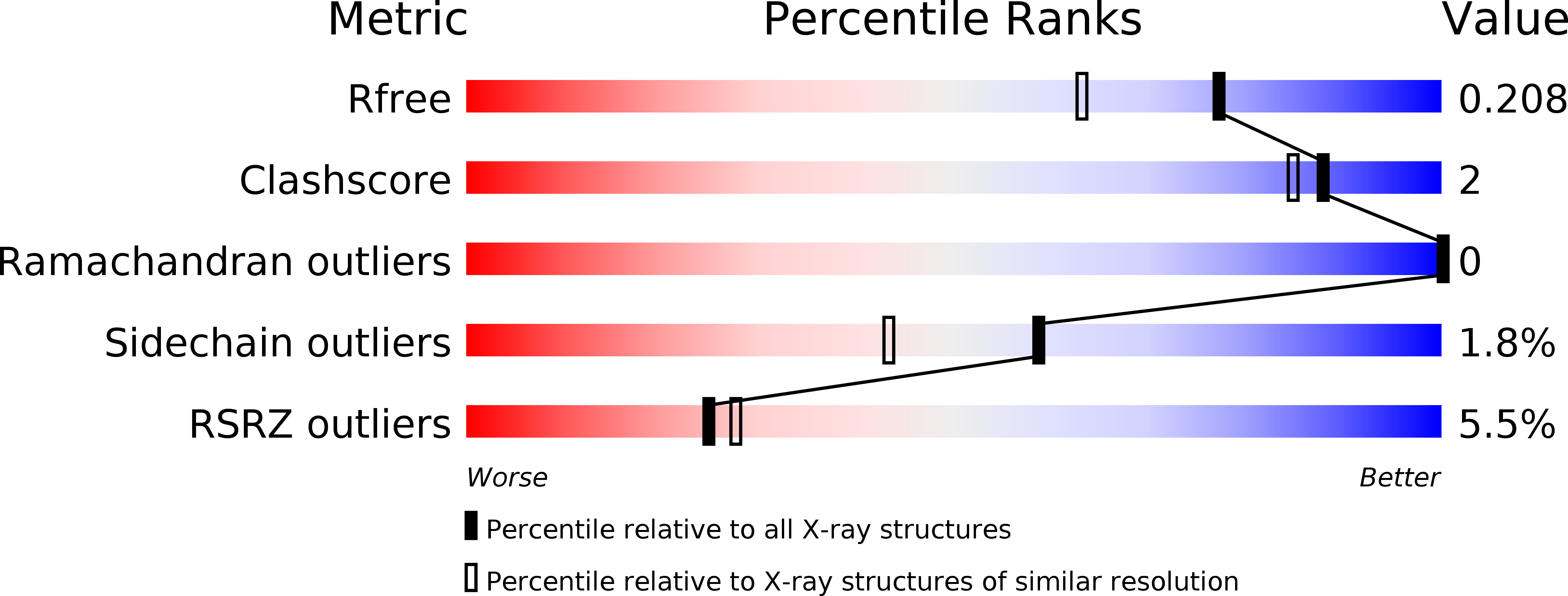
1.70 Å
R-Value Free:
0.19
R-Value Work:
0.17
R-Value Observed:
0.17
Space Group:
C 1 2 1
Macromolecular Entities
Structures with similar UniProt ID
Protein Blast
Polymer Type:polypeptide(L)
Molecule:2-C-methyl-D-erythritol 2,4-cyclodiphosphate synthase
Chain IDs:A, B, C
Chain Length:183
Number of Molecules:3
Biological Source:Burkholderia pseudomallei
Primary Citation

Abstact

As part of the Seattle Structural Genomics Center for Infectious Disease, we seek to enhance structural genomics with ligand-bound structure data which can serve as a blueprint for structure-based drug design. We have adapted fragment-based screening methods to our structural genomics pipeline to generate multiple ligand-bound structures of high priority drug targets from pathogenic organisms. In this study, we report fragment screening methods and structure determination results for 2C-methyl-D-erythritol-2,4-cyclo-diphosphate (MECP) synthase from Burkholderia pseudomallei, the gram-negative bacterium which causes melioidosis. Screening by nuclear magnetic resonance spectroscopy as well as crystal soaking followed by X-ray diffraction led to the identification of several small molecules which bind this enzyme in a critical metabolic pathway. A series of complex structures obtained with screening hits reveal distinct binding pockets and a range of small molecules which form complexes with the target. Additional soaks with these compounds further demonstrate a subset of fragments to only bind the protein when present in specific combinations. This ensemble of fragment-bound complexes illuminates several characteristics of MECP synthase, including a previously unknown binding surface external to the catalytic active site. These ligand-bound structures now serve to guide medicinal chemists and structural biologists in rational design of novel inhibitors for this enzyme.

Legend

Protein

Chemical

Disease

Primary Citation of related structures
Feedback Form
Name
Email
Institute
Feedback