3J5P image
Deposition Date 2013-10-28
Release Date 2013-12-04
Last Version Date 2024-02-21
Entry Detail
PDB ID:
3J5P
Title:
Structure of TRPV1 ion channel determined by single particle electron cryo-microscopy
Biological Source:
Source Organism(s):
Expression System(s):
Method Details:
Experimental Method:
Resolution:
3.28 Å
Aggregation State:
PARTICLE
Reconstruction Method:
SINGLE PARTICLE
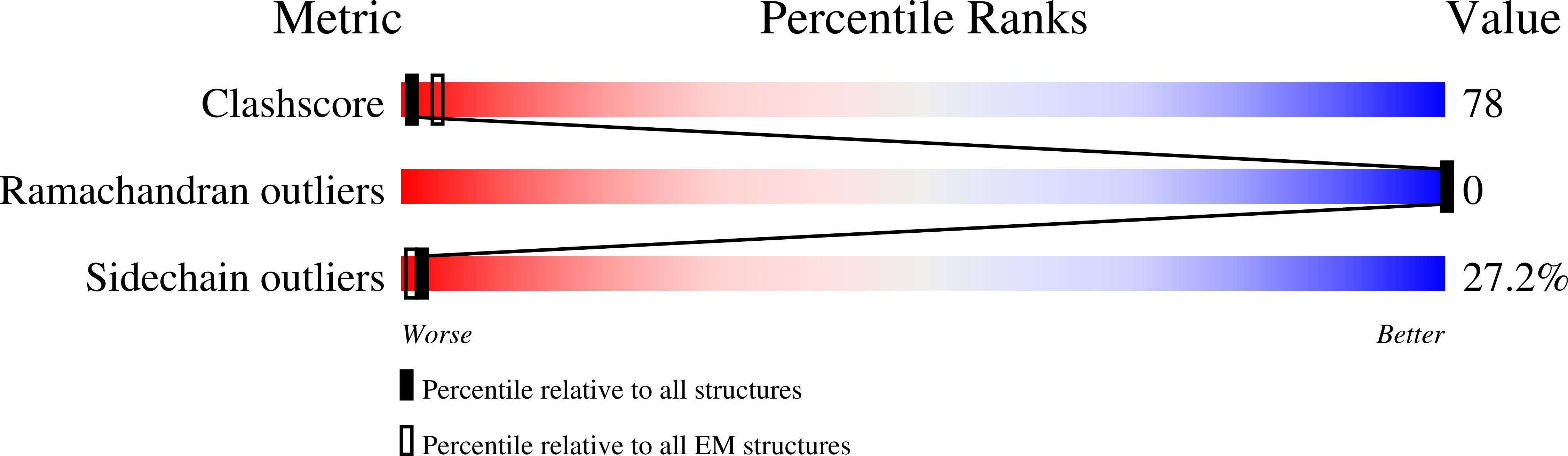
Macromolecular Entities
Structures with similar UniProt ID
Protein Blast
Polymer Type:polypeptide(L)
Molecule:Transient receptor potential cation channel subfamily V member 1
Gene (Uniprot):Trpv1
Chain IDs:A (auth: B), B (auth: A), C, D
Chain Length:598
Number of Molecules:4
Biological Source:Rattus norvegicus
Ligand Molecules
Primary Citation
Structure of the TRPV1 ion channel determined by electron cryo-microscopy.
Nature 504 107 112 (2013)
PMID: 24305160 DOI: 10.1038/nature12822

Abstact

Transient receptor potential (TRP) channels are sensors for a wide range of cellular and environmental signals, but elucidating how these channels respond to physical and chemical stimuli has been hampered by a lack of detailed structural information. Here we exploit advances in electron cryo-microscopy to determine the structure of a mammalian TRP channel, TRPV1, at 3.4 Å resolution, breaking the side-chain resolution barrier for membrane proteins without crystallization. Like voltage-gated channels, TRPV1 exhibits four-fold symmetry around a central ion pathway formed by transmembrane segments 5-6 (S5-S6) and the intervening pore loop, which is flanked by S1-S4 voltage-sensor-like domains. TRPV1 has a wide extracellular 'mouth' with a short selectivity filter. The conserved 'TRP domain' interacts with the S4-S5 linker, consistent with its contribution to allosteric modulation. Subunit organization is facilitated by interactions among cytoplasmic domains, including amino-terminal ankyrin repeats. These observations provide a structural blueprint for understanding unique aspects of TRP channel function.

Legend

Protein

Chemical

Disease

Primary Citation of related structures
Feedback Form
Name
Email
Institute
Feedback