3ITG image
Deposition Date 2009-08-28
Release Date 2010-01-12
Last Version Date 2023-09-06
Entry Detail
PDB ID:
3ITG
Keywords:
Title:
Structure the proline utilization A proline dehydrogenase domain (PutA86-630) inactivated with N-propargylglycine
Biological Source:
Source Organism:
Host Organism:
Method Details:
Experimental Method:
Resolution:
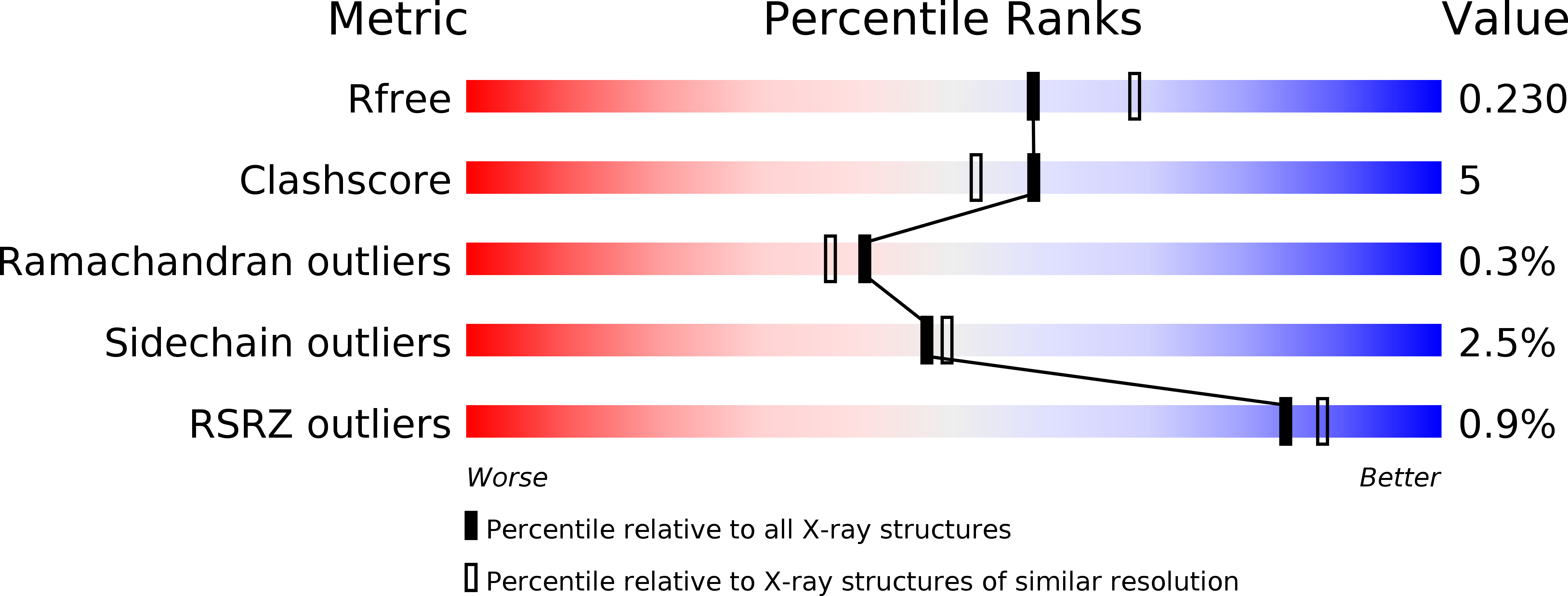
2.15 Å
R-Value Free:
0.23
R-Value Work:
0.19
R-Value Observed:
0.19
Space Group:
I 21 21 21
Macromolecular Entities
Structures with similar UniProt ID
Protein Blast
Polymer Type:polypeptide(L)
Molecule:Bifunctional protein putA
Gene (Uniprot):putA
Chain IDs:A, B
Chain Length:602
Number of Molecules:2
Biological Source:Escherichia coli K-12
Modified Residue
Compound ID Chain ID Parent Comp ID Details 2D Image
LYX A LYS N''-(2-COENZYME A)-PROPANOYL-LYSINE
Ligand Molecules
Primary Citation
The structure of the proline utilization a proline dehydrogenase domain inactivated by N-propargylglycine provides insight into conformational changes induced by substrate binding and flavin reduction.
Biochemistry 49 560 569 (2010)
PMID: 19994913 DOI: 10.1021/bi901717s

Abstact

Proline utilization A (PutA) from Escherichia coli is a flavoprotein that has mutually exclusive roles as a transcriptional repressor of the put regulon and a membrane-associated enzyme that catalyzes the oxidation of proline to glutamate. Previous studies have shown that the binding of proline in the proline dehydrogenase (PRODH) active site and subsequent reduction of the FAD trigger global conformational changes that enhance PutA-membrane affinity. These events cause PutA to switch from its repressor to its enzymatic role, but the mechanism by which this signal is propagated from the active site to the distal membrane-binding domain is largely unknown. Here, it is shown that N-propargylglycine irreversibly inactivates PutA by covalently linking the flavin N(5) atom to the epsilon-amino of Lys329. Furthermore, inactivation locks PutA into a conformation that may mimic the proline-reduced, membrane-associated form. The 2.15 A resolution structure of the inactivated PRODH domain suggests that the initial events involved in broadcasting the reduced flavin state to the distal membrane-binding domain include major reorganization of the flavin ribityl chain, severe (35 degrees) butterfly bending of the isoalloxazine ring, and disruption of an electrostatic network involving the flavin N(5) atom, Arg431, and Asp370. The structure also provides information about conformational changes associated with substrate binding. This analysis suggests that the active site is incompletely assembled in the absence of the substrate, and the binding of proline draws together conserved residues in helix 8 and the beta1-alphal loop to complete the active site.

Legend

Protein

Chemical

Disease

Primary Citation of related structures
Feedback Form
Name
Email
Institute
Feedback