3INU image
Deposition Date 2009-08-12
Release Date 2009-10-27
Last Version Date 2024-10-16
Entry Detail
PDB ID:
3INU
Keywords:
Title:
Crystal structure of an unbound KZ52 neutralizing anti-Ebolavirus antibody.
Biological Source:
Source Organism:
Homo sapiens (Taxon ID: 9606)
Host Organism:
Method Details:
Experimental Method:
Resolution:
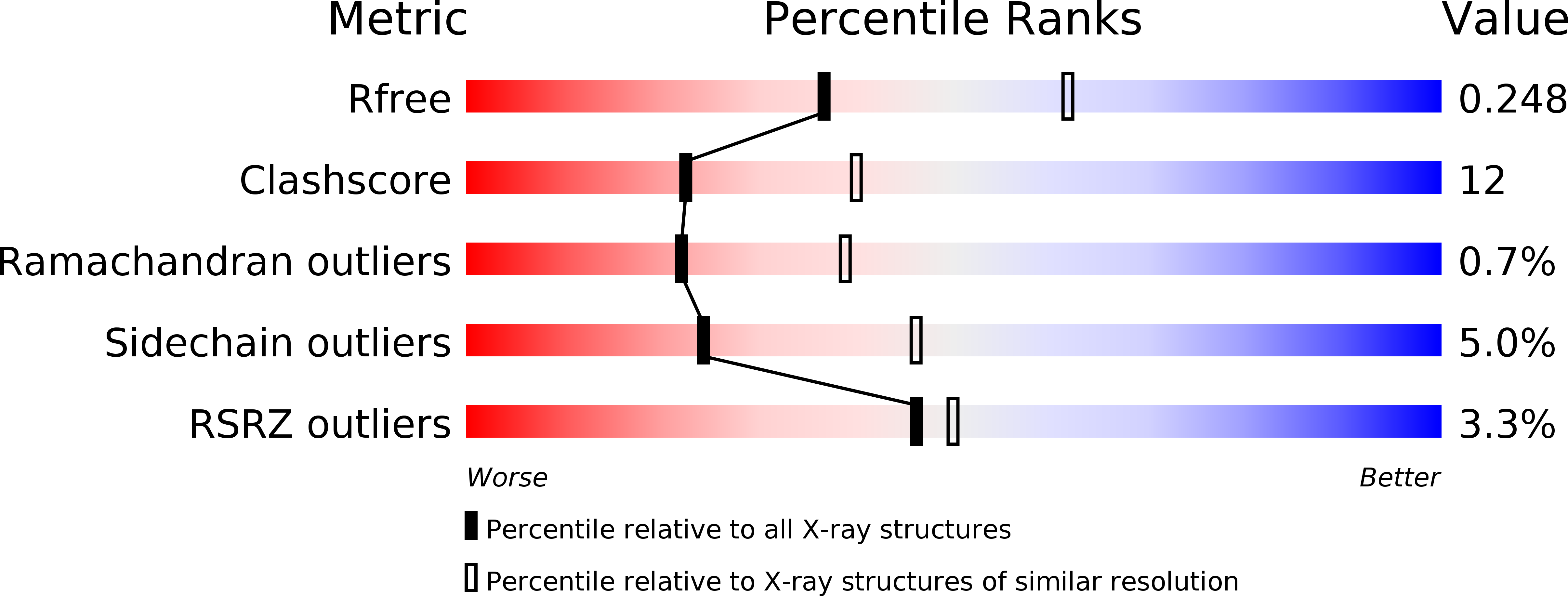
2.50 Å
R-Value Free:
0.25
R-Value Work:
0.20
R-Value Observed:
0.20
Space Group:
P 32 2 1
Macromolecular Entities
Polymer Type:polypeptide(L)
Molecule:KZ52 antibody fragment heavy chain
Chain IDs:A (auth: H), C (auth: M)
Chain Length:226
Number of Molecules:2
Biological Source:Homo sapiens
Polymer Type:polypeptide(L)
Molecule:KZ52 antibody fragment light chain
Chain IDs:B (auth: L), D (auth: N)
Chain Length:217
Number of Molecules:2
Biological Source:Homo sapiens
Primary Citation
Techniques and tactics used in determining the structure of the trimeric ebolavirus glycoprotein.
Acta Crystallogr.,Sect.D 65 1162 1180 (2009)
PMID: 19923712 DOI: 10.1107/S0907444909032314

Abstact

The trimeric membrane-anchored ebolavirus envelope glycoprotein (GP) is responsible for viral attachment, fusion and entry. Knowledge of its structure is important both for understanding ebolavirus entry and for the development of medical interventions. Crystal structures of viral glycoproteins, especially those in their metastable prefusion oligomeric states, can be difficult to achieve given the challenges in production, purification, crystallization and diffraction that are inherent in the heavily glycosylated flexible nature of these types of proteins. The crystal structure of ebolavirus GP in its trimeric prefusion conformation in complex with a human antibody derived from a survivor of the 1995 Kikwit outbreak has now been determined [Lee et al. (2008), Nature (London), 454, 177-182]. Here, the techniques, tactics and strategies used to overcome a series of technical roadblocks in crystallization and phasing are described. Glycoproteins were produced in human embryonic kidney 293T cells, which allowed rapid screening of constructs and expression of protein in milligram quantities. Complexes of GP with an antibody fragment (Fab) promoted crystallization and a series of deglycosylation strategies, including sugar mutants, enzymatic deglycosylation, insect-cell expression and glycan anabolic pathway inhibitors, were attempted to improve the weakly diffracting glycoprotein crystals. The signal-to-noise ratio of the search model for molecular replacement was improved by determining the structure of the uncomplexed Fab. Phase combination with Fab model phases and a selenium anomalous signal, followed by NCS-averaged density modification, resulted in a clear interpretable electron-density map. Model building was assisted by the use of B-value-sharpened electron-density maps and the proper sequence register was confirmed by building alternate sequences using N-linked glycan sites as anchors and secondary-structural predictions.

Legend

Protein

Chemical

Disease

Primary Citation of related structures
Feedback Form
Name
Email
Institute
Feedback