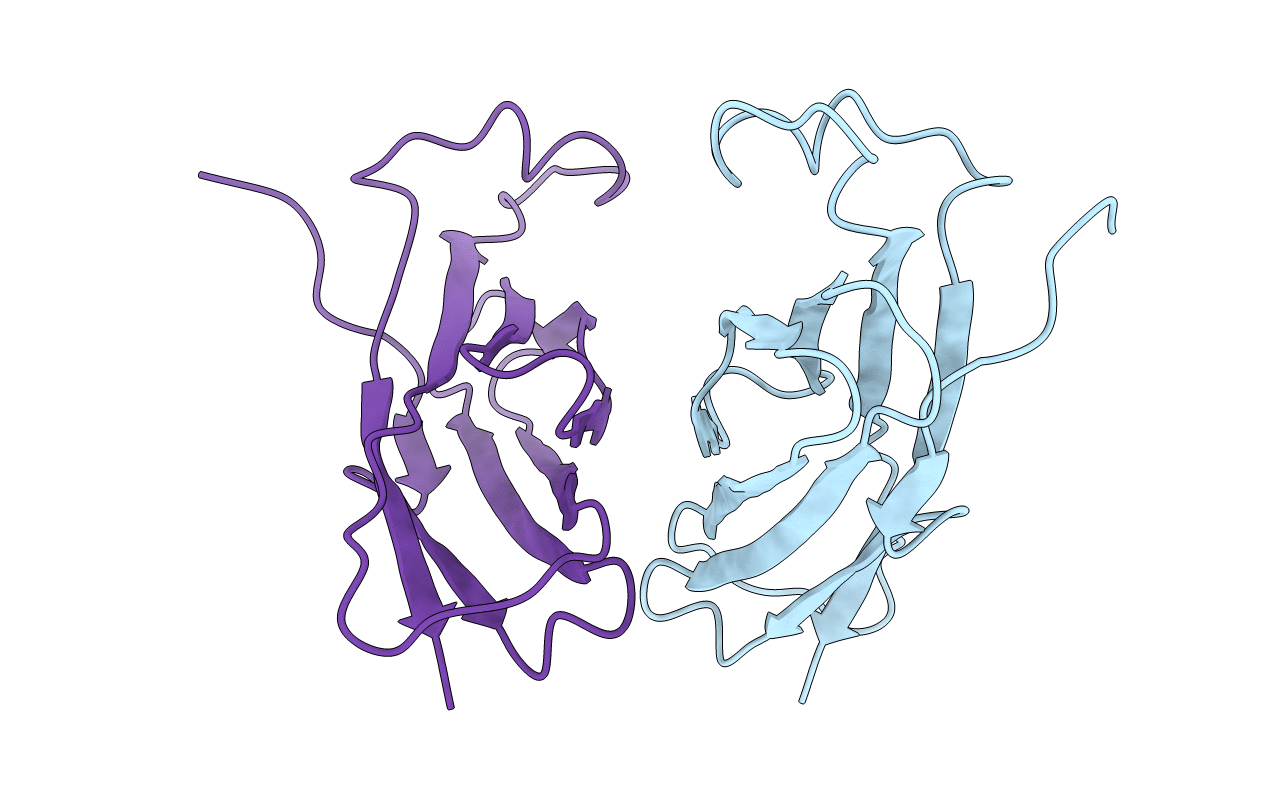
3IKK image
Deposition Date 2009-08-06
Release Date 2010-05-26
Last Version Date 2024-10-16
Entry Detail
PDB ID:
3IKK
Title:
Crystal structure analysis of msp domain
Biological Source:
Source Organism(s):
Homo sapiens (Taxon ID: 9606)
Expression System(s):
Method Details:
Experimental Method:
Resolution:
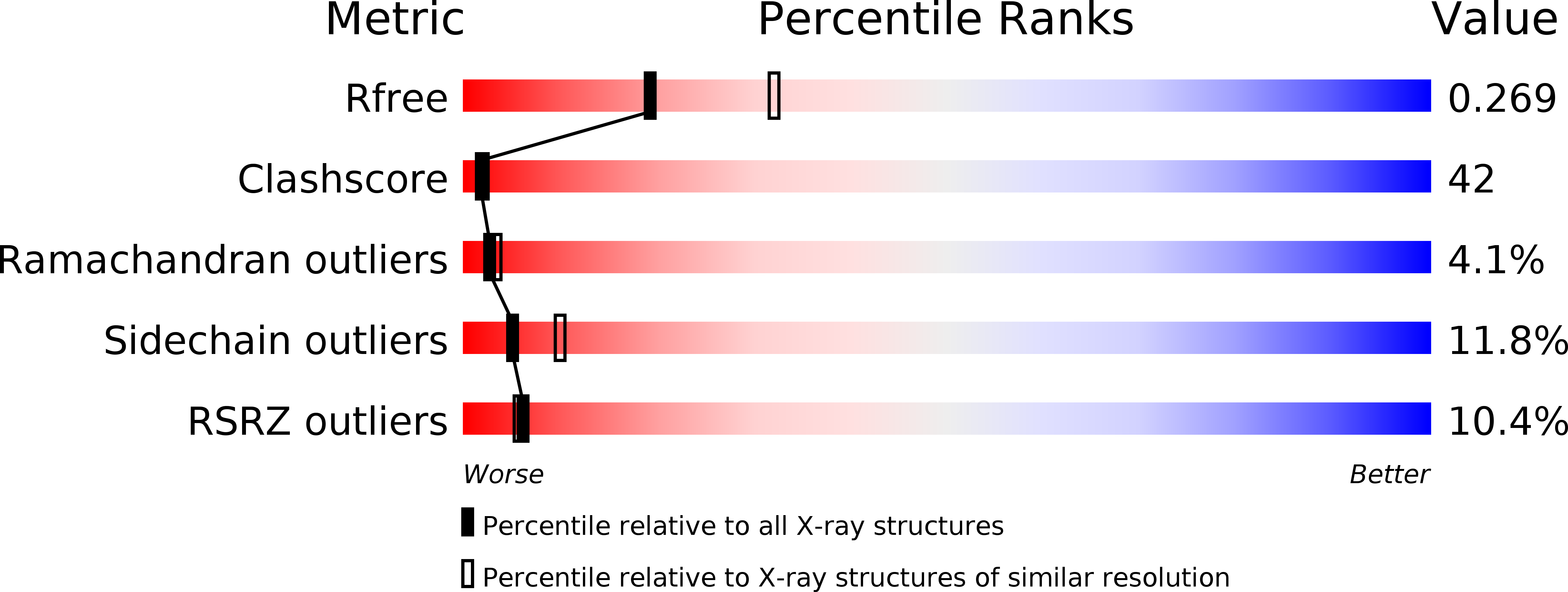
2.50 Å
R-Value Free:
0.26
R-Value Work:
0.20
R-Value Observed:
0.21
Space Group:
H 3
Macromolecular Entities
Structures with similar UniProt ID
Protein Blast
Polymer Type:polypeptide(L)
Molecule:Vesicle-associated membrane protein-associated protein B/C
Gene (Uniprot):VAPB
Chain IDs:A, B
Chain Length:127
Number of Molecules:2
Biological Source:Homo sapiens
Primary Citation
Elimination of the native structure and solubility of the hVAPB MSP domain by the Pro56Ser mutation that causes amyotrophic lateral sclerosis.
Biochemistry 49 3887 3897 (2010)
PMID: 20377183 DOI: 10.1021/bi902057a

Abstact

The Pro56Ser mutation in the human VAPB MSP domain causes a familial amyotrophic lateral sclerosis. Here we present the first structural investigation of both wild-type and Pro56Ser mutant MSP domains. The results reveal that the wild-type MSP domain is well-folded at neutral pH but can undergo acid-induced unfolding reversibly. It has a thermodynamic stability energy (DeltaG degrees (N-U)) of 7.40 kcal/mol and is also active in binding to a Nir2 peptide with a K(D) of 0.65 muM. Further determination of its crystal structure reveals that it adopts a seven-strand immunoglobulin-like beta sandwich in which Pro56 adopts the unusual cis-peptide bond conformation that appears to be critical in maintaining the characteristic S-shaped loop. Markedly, the Pro56Ser mutation renders the MSP domain insoluble in buffer. Nevertheless, as facilitated by our recent discovery that "insoluble proteins" can be solubilized in salt-free water, we have successfully characterized the residue-specific conformation of the Pro56Ser mutant by CD and heteronuclear NMR spectroscopy. The Pro56Ser mutant remains lacking of the native tight packing and secondary structures under various conditions and was further characterized as having a non-native helical conformation weakly populated at pH 3.5. Intriguingly, Pro12 located in another S-shaped loop also adopts the cis-peptide bond conformation, and its mutation to Ser is able to make the MSP domain highly insoluble and unfolded like the Pro56Ser mutant. Our study thus implies that the Pro56Ser mutation might lead to ALS by eliminating the native MSP structure, which consequently leads to aggregation and loss of functions under physiological conditions.

Legend

Protein

Chemical

Disease

Primary Citation of related structures
Feedback Form
Name
Email
Institute
Feedback