3IGI image
Deposition Date 2009-07-27
Release Date 2009-12-22
Last Version Date 2023-09-06
Entry Detail
PDB ID:
3IGI
Keywords:
Title:
Tertiary Architecture of the Oceanobacillus Iheyensis Group II Intron
Biological Source:
Source Organism:
Method Details:
Experimental Method:
Resolution:
3.13 Å
R-Value Free:
0.21
R-Value Work:
0.18
R-Value Observed:
0.18
Space Group:
P 21 21 21
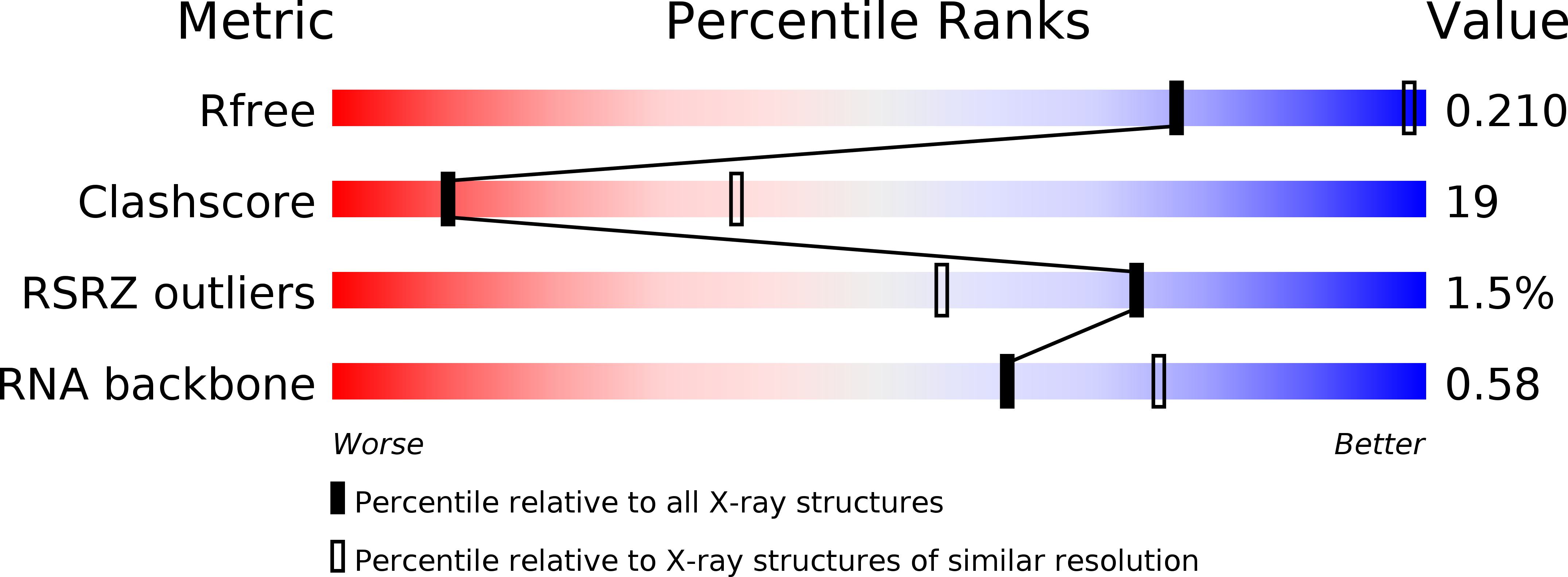
Macromolecular Entities
Polymer Type:polyribonucleotide
Molecule:Group IIC intron
Chain IDs:A
Chain Length:412
Number of Molecules:1
Biological Source:
Polymer Type:polyribonucleotide
Molecule:5'-R(*CP*GP*CP*UP*CP*UP*AP*CP*UP*CP*UP*AP*U)-3'
Chain IDs:B
Chain Length:13
Number of Molecules:1
Biological Source:
Primary Citation
Tertiary architecture of the Oceanobacillus iheyensis group II intron.
Rna 16 57 69 (2010)
PMID: 19952115 DOI: 10.1261/rna.1844010

Abstact

Group II introns are large ribozymes that act as self-splicing and retrotransposable RNA molecules. They are of great interest because of their potential evolutionary relationship to the eukaryotic spliceosome, their continued influence on the organization of many genomes in bacteria and eukaryotes, and their potential utility as tools for gene therapy and biotechnology. One of the most interesting features of group II introns is their relative lack of nucleobase conservation and covariation, which has long suggested that group II intron structures are stabilized by numerous unusual tertiary interactions and backbone-mediated contacts. Here, we provide a detailed description of the tertiary interaction networks within the Oceanobacillus iheyensis group IIC intron, for which a crystal structure was recently solved to 3.1 A resolution. The structure can be described as a set of several intricately constructed tertiary interaction nodes, each of which contains a core of extended stacking networks and elaborate motifs. Many of these nodes are surrounded by a web of ribose zippers, which appear to further stabilize local structure. As predicted from biochemical and genetic studies, the group II intron provides a wealth of new information on strategies for RNA folding and tertiary structural organization.

Legend

Protein

Chemical

Disease

Primary Citation of related structures
Feedback Form
Name
Email
Institute
Feedback