3IF8 image
Deposition Date 2009-07-24
Release Date 2010-06-09
Last Version Date 2024-03-20
Entry Detail
PDB ID:
3IF8
Keywords:
Title:
Crystal Structure of ZWILCH, a member of the RZZ kinetochore complex
Biological Source:
Source Organism(s):
Homo sapiens (Taxon ID: 9606)
Expression System(s):
Method Details:
Experimental Method:
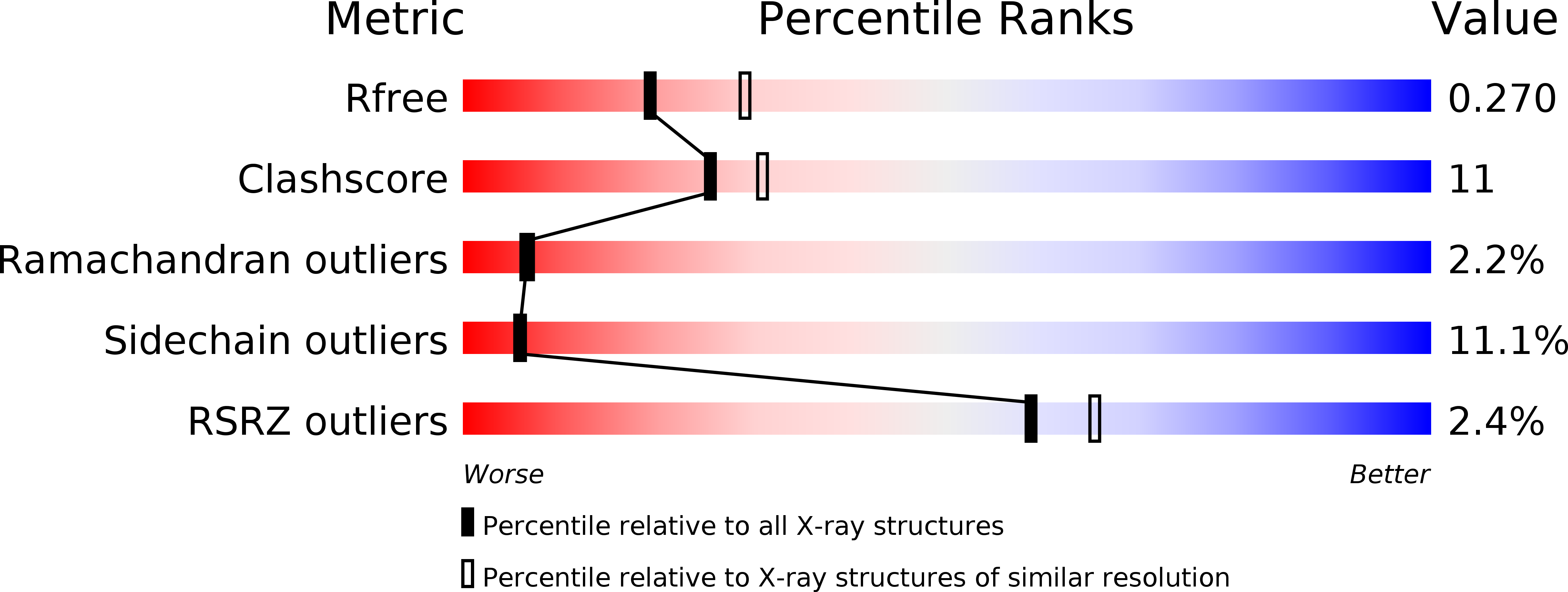
Resolution:
2.55 Å
R-Value Free:
0.27
R-Value Work:
0.22
R-Value Observed:
0.23
Space Group:
P 32 2 1
Macromolecular Entities
Structures with similar UniProt ID
Protein Blast
Polymer Type:polypeptide(L)
Molecule:Protein zwilch homolog
Gene (Uniprot):ZWILCH
Chain IDs:A
Chain Length:339
Number of Molecules:1
Biological Source:Homo sapiens
Structures with similar UniProt ID
Protein Blast
Polymer Type:polypeptide(L)
Molecule:Protein zwilch homolog
Gene (Uniprot):ZWILCH
Chain IDs:B
Chain Length:257
Number of Molecules:1
Biological Source:Homo sapiens
Primary Citation
Structural analysis of the RZZ complex reveals common ancestry with multisubunit vesicle tethering machinery.
Structure 18 616 626 (2010)
PMID: 20462495 DOI: 10.1016/j.str.2010.02.014

Abstact

The RZZ complex recruits dynein to kinetochores. We investigated structure, topology, and interactions of the RZZ subunits (ROD, ZWILCH, and ZW10) in vitro, in vivo, and in silico. We identify neuroblastoma-amplified gene (NAG), a ZW10 binder, as a ROD homolog. ROD and NAG contain an N-terminal beta propeller followed by an alpha solenoid, which is the architecture of certain nucleoporins and vesicle coat subunits, suggesting a distant evolutionary relationship. ZW10 binding to ROD and NAG is mutually exclusive. The resulting ZW10 complexes (RZZ and NRZ) respectively contain ZWILCH and RINT1 as additional subunits. The X-ray structure of ZWILCH, the first for an RZZ subunit, reveals a novel fold distinct from RINT1's. The evolutionarily conserved NRZ likely acts as a tethering complex for retrograde trafficking of COPI vesicles from the Golgi to the endoplasmic reticulum. The RZZ, limited to metazoans, probably evolved from the NRZ, exploiting the dynein-binding capacity of ZW10 to direct dynein to kinetochores.

Legend

Protein

Chemical

Disease

Primary Citation of related structures
Feedback Form
Name
Email
Institute
Feedback