3I9V image
Deposition Date 2009-07-13
Release Date 2009-09-15
Last Version Date 2024-11-06
Entry Detail
PDB ID:
3I9V
Keywords:
Title:
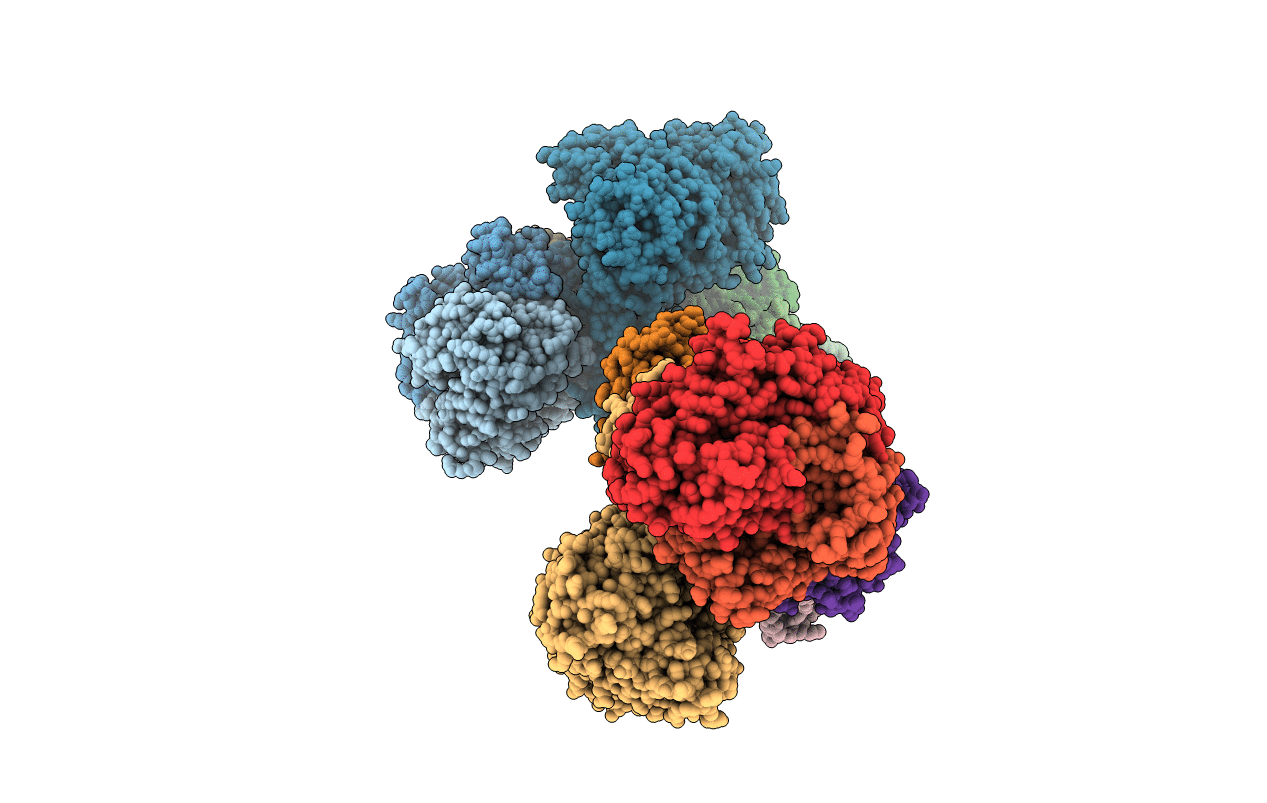
Crystal structure of the hydrophilic domain of respiratory complex I from Thermus thermophilus, oxidized, 2 mol/ASU
Biological Source:
Source Organism:
Method Details:
Experimental Method:
Resolution:
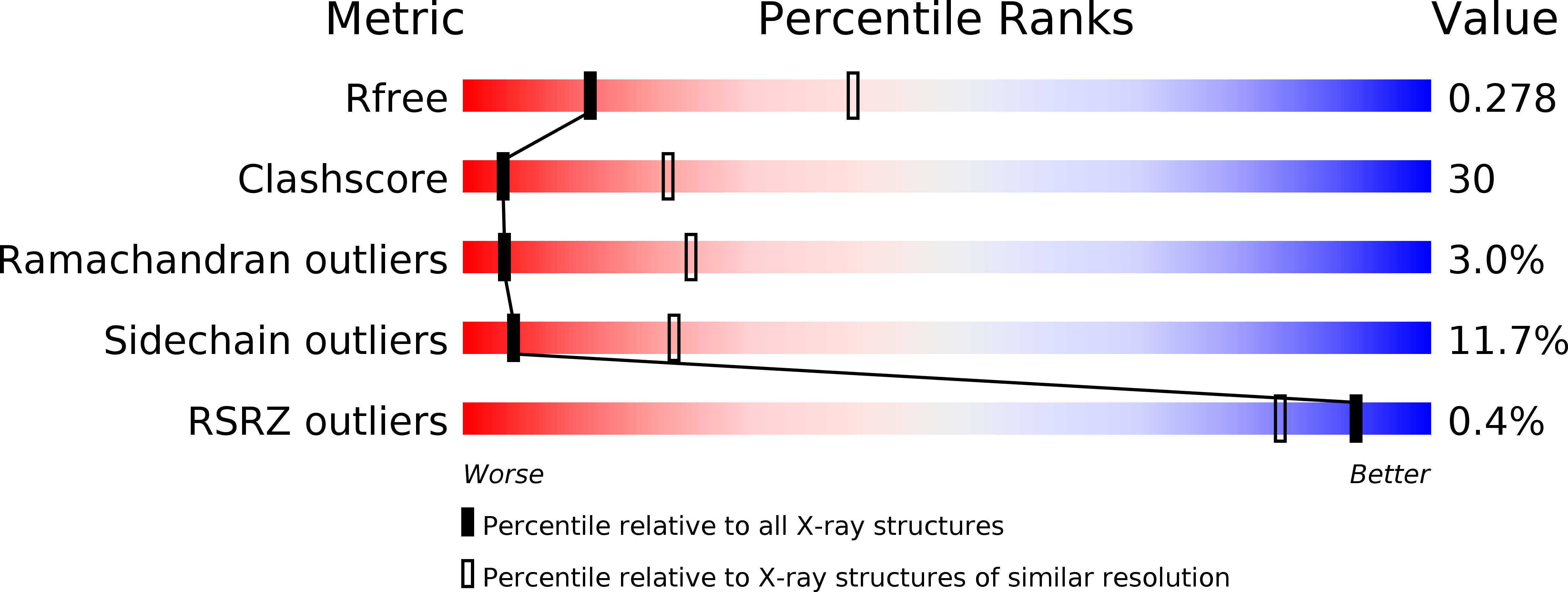
3.10 Å
R-Value Free:
0.28
R-Value Work:
0.23
R-Value Observed:
0.23
Space Group:
P 1 21 1
Macromolecular Entities
Structures with similar UniProt ID
Protein Blast
Polymer Type:polypeptide(L)
Molecule:NADH-quinone oxidoreductase subunit 1
Gene (Uniprot):nqo1
Chain IDs:A (auth: 1), I (auth: A)
Chain Length:438
Number of Molecules:2
Biological Source:Thermus thermophilus
Structures with similar UniProt ID
Protein Blast
Polymer Type:polypeptide(L)
Molecule:NADH-quinone oxidoreductase subunit 2
Gene (Uniprot):nqo2
Chain IDs:B (auth: 2), J (auth: B)
Chain Length:181
Number of Molecules:2
Biological Source:Thermus thermophilus
Structures with similar UniProt ID
Protein Blast
Polymer Type:polypeptide(L)
Molecule:NADH-quinone oxidoreductase subunit 3
Gene (Uniprot):nqo3
Chain IDs:C (auth: 3), K (auth: C)
Chain Length:783
Number of Molecules:2
Biological Source:Thermus thermophilus
Structures with similar UniProt ID
Protein Blast
Polymer Type:polypeptide(L)
Molecule:NADH-quinone oxidoreductase subunit 4
Gene (Uniprot):nqo4
Chain IDs:D (auth: 4), L (auth: D)
Chain Length:409
Number of Molecules:2
Biological Source:Thermus thermophilus
Structures with similar UniProt ID
Protein Blast
Polymer Type:polypeptide(L)
Molecule:NADH-quinone oxidoreductase subunit 5
Gene (Uniprot):nqo5
Chain IDs:E (auth: 5), M (auth: E)
Chain Length:207
Number of Molecules:2
Biological Source:Thermus thermophilus
Structures with similar UniProt ID
Protein Blast
Polymer Type:polypeptide(L)
Molecule:NADH-quinone oxidoreductase subunit 6
Gene (Uniprot):nqo6
Chain IDs:F (auth: 6), N (auth: F)
Chain Length:181
Number of Molecules:2
Biological Source:Thermus thermophilus
Structures with similar UniProt ID
Protein Blast
Polymer Type:polypeptide(L)
Molecule:NADH-quinone oxidoreductase subunit 15
Gene (Uniprot):nqo15
Chain IDs:H (auth: 7), P (auth: H)
Chain Length:129
Number of Molecules:2
Biological Source:Thermus thermophilus
Structures with similar UniProt ID
Protein Blast
Polymer Type:polypeptide(L)
Molecule:NADH-quinone oxidoreductase subunit 9
Gene (Uniprot):nqo9
Chain IDs:G (auth: 9), O (auth: G)
Chain Length:182
Number of Molecules:2
Biological Source:Thermus thermophilus
Primary Citation
Structural basis for the mechanism of respiratory complex I
J.Biol.Chem. 284 29773 29783 (2009)
PMID: 19635800 DOI: 10.1074/jbc.M109.032144

Abstact

Complex I plays a central role in cellular energy production, coupling electron transfer between NADH and quinone to proton translocation. The mechanism of this highly efficient enzyme is currently unknown. Mitochondrial complex I is a major source of reactive oxygen species, which may be one of the causes of aging. Dysfunction of complex I is implicated in many human neurodegenerative diseases. We have determined several x-ray structures of the oxidized and reduced hydrophilic domain of complex I from Thermus thermophilus at up to 3.1 A resolution. The structures reveal the mode of interaction of complex I with NADH, explaining known kinetic data and providing implications for the mechanism of reactive oxygen species production at the flavin site of complex I. Bound metals were identified in the channel at the interface with the frataxin-like subunit Nqo15, indicating possible iron-binding sites. Conformational changes upon reduction of the complex involve adjustments in the nucleotide-binding pocket, as well as small but significant shifts of several alpha-helices at the interface with the membrane domain. These shifts are likely to be driven by the reduction of nearby iron-sulfur clusters N2 and N6a/b. Cluster N2 is the electron donor to quinone and is coordinated by unique motif involving two consecutive (tandem) cysteines. An unprecedented "on/off switch" (disconnection) of coordinating bonds between the tandem cysteines and this cluster was observed upon reduction. Comparison of the structures suggests a novel mechanism of coupling between electron transfer and proton translocation, combining conformational changes and protonation/deprotonation of tandem cysteines.

Legend

Protein

Chemical

Disease

Primary Citation of related structures
Feedback Form
Name
Email
Institute
Feedback