3I91 image
Deposition Date 2009-07-10
Release Date 2009-09-08
Last Version Date 2025-03-26
Entry Detail
PDB ID:
3I91
Keywords:
Title:
Crystal structure of human chromobox homolog 8 (CBX8) with H3K9 peptide
Biological Source:
Source Organism:
Homo sapiens (Taxon ID: 9606)
Host Organism:
Method Details:
Experimental Method:
Resolution:
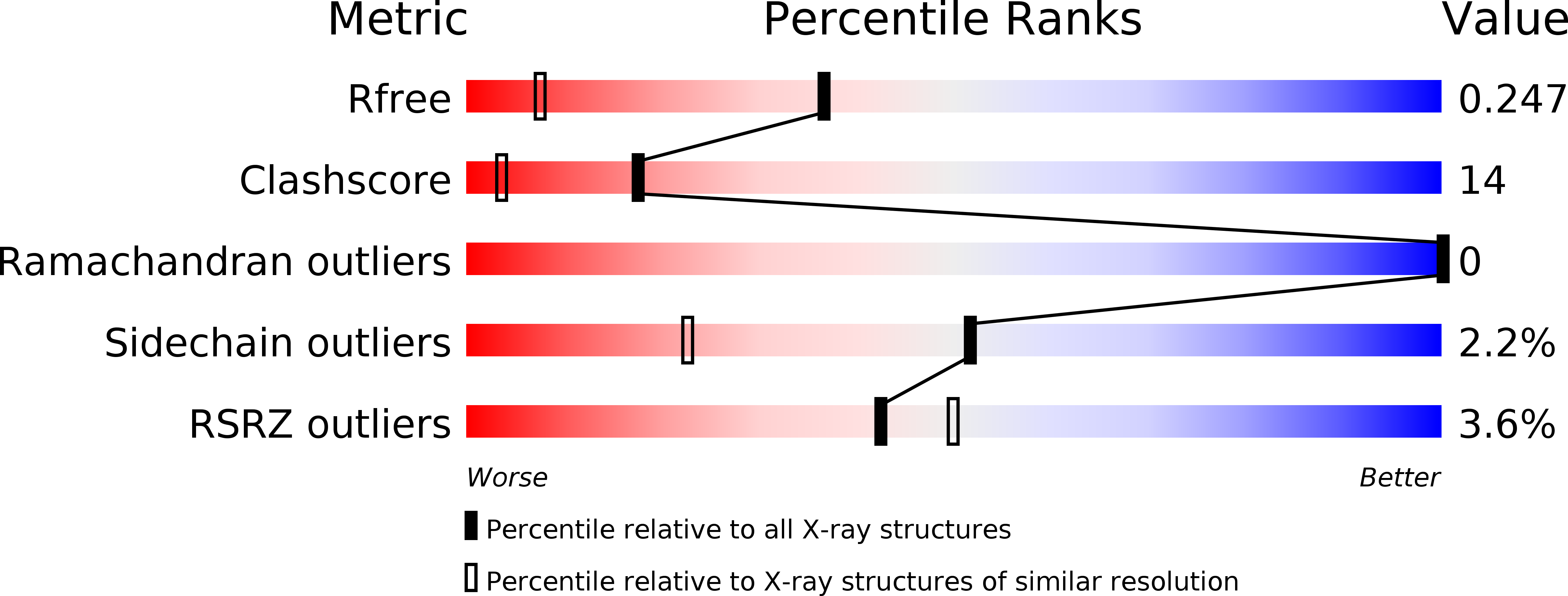
1.55 Å
R-Value Free:
0.24
R-Value Work:
0.21
R-Value Observed:
0.21
Space Group:
P 21 21 21
Macromolecular Entities
Structures with similar UniProt ID
Protein Blast
Polymer Type:polypeptide(L)
Molecule:Chromobox protein homolog 8
Gene (Uniprot):CBX8
Chain IDs:A, B
Chain Length:54
Number of Molecules:2
Biological Source:Homo sapiens
Polymer Type:polypeptide(L)
Molecule:H3K9 peptide
Chain IDs:C
Chain Length:8
Number of Molecules:1
Biological Source:
Modified Residue
Compound ID Chain ID Parent Comp ID Details 2D Image
M3L C LYS N-TRIMETHYLLYSINE
Primary Citation
Recognition and specificity determinants of the human cbx chromodomains.
J.Biol.Chem. 286 521 529 (2011)
PMID: 21047797 DOI: 10.1074/jbc.M110.191411

Abstact

The eight mammalian Cbx proteins are chromodomain-containing proteins involved in regulation of heterochromatin, gene expression, and developmental programs. They are evolutionarily related to the Drosophila HP1 (dHP1) and Pc (dPc) proteins that are key components of chromatin-associated complexes capable of recognizing repressive marks such as trimethylated Lys-9 and Lys-27, respectively, on histone H3. However, the binding specificity and function of the human homologs, Cbx1-8, remain unclear. To this end we employed structural, biophysical, and mutagenic approaches to characterize the molecular determinants of sequence contextual methyllysine binding to human Cbx1-8 proteins. Although all three human HP1 homologs (Cbx1, -3, -5) replicate the structural and binding features of their dHP counterparts, the five Pc homologs (Cbx2, -4, -6, -7, -8) bind with lower affinity to H3K9me3 or H3K27me3 peptides and are unable to distinguish between these two marks. Additionally, peptide permutation arrays revealed a greater sequence tolerance within the Pc family and suggest alternative nonhistone sequences as potential binding targets for this class of chromodomains. Our structures explain the divergence of peptide binding selectivity in the Pc subfamily and highlight previously unrecognized features of the chromodomain that influence binding and specificity.

Legend

Protein

Chemical

Disease

Primary Citation of related structures
Feedback Form
Name
Email
Institute
Feedback