3I3L image
Deposition Date 2009-06-30
Release Date 2010-03-09
Last Version Date 2024-11-20
Entry Detail
PDB ID:
3I3L
Keywords:
Title:
Crystal structure of CmlS, a flavin-dependent halogenase
Biological Source:
Source Organism:
Host Organism:
Method Details:
Experimental Method:
Resolution:
2.20 Å
R-Value Free:
0.26
R-Value Work:
0.20
R-Value Observed:
0.20
Space Group:
C 1 2 1
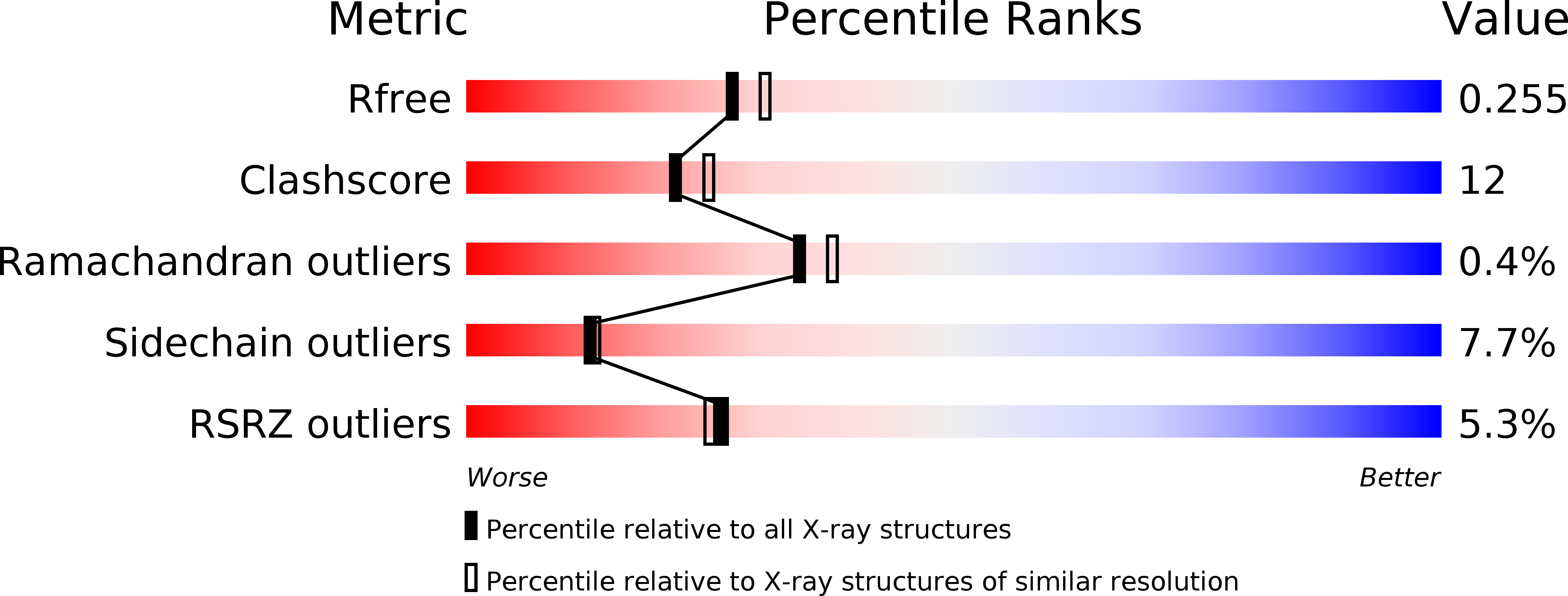
Macromolecular Entities
Structures with similar UniProt ID
Protein Blast
Polymer Type:polypeptide(L)
Molecule:Alkylhalidase CmlS
Chain IDs:A
Chain Length:591
Number of Molecules:1
Biological Source:Streptomyces venezuelae
Ligand Molecules
Primary Citation
Chloramphenicol Biosynthesis: The Structure of CmlS, a Flavin-Dependent Halogenase Showing a Covalent Flavin-Aspartate Bond
J.Mol.Biol. 397 316 331 (2010)
PMID: 20080101 DOI: 10.1016/j.jmb.2010.01.020

Abstact

Chloramphenicol is a halogenated natural product bearing an unusual dichloroacetyl moiety that is critical for its antibiotic activity. The operon for chloramphenicol biosynthesis in Streptomyces venezuelae encodes the chloramphenicol halogenase CmlS, which belongs to the large and diverse family of flavin-dependent halogenases (FDH's). CmlS was previously shown to be essential for the formation of the dichloroacetyl group. Here we report the X-ray crystal structure of CmlS determined at 2.2 A resolution, revealing a flavin monooxygenase domain shared by all FDHs, but also a unique 'winged-helix' C-terminal domain that creates a T-shaped tunnel leading to the halogenation active site. Intriguingly, the C-terminal tail of this domain blocks access to the halogenation active site, suggesting a structurally dynamic role during catalysis. The halogenation active site is notably nonpolar and shares nearly identical residues with Chondromyces crocatus tyrosyl halogenase (CndH), including the conserved Lys (K71) that forms the reactive chloramine intermediate. The exception is Y350, which could be used to stabilize enolate formation during substrate halogenation. The strictly conserved residue E44, located near the isoalloxazine ring of the bound flavin adenine dinucleotide (FAD) cofactor, is optimally positioned to function as a remote general acid, through a water-mediated proton relay, which could accelerate the reaction of the chloramine intermediate during substrate halogenation, or the oxidation of chloride by the FAD(C4alpha)-OOH intermediate. Strikingly, the 8alpha carbon of the FAD cofactor is observed to be covalently attached to D277 of CmlS, a residue that is highly conserved in the FDH family. In addition to representing a new type of flavin modification, this has intriguing implications for the mechanism of FDHs. Based on the crystal structure and in analogy to known halogenases, we propose a reaction mechanism for CmlS.

Legend

Protein

Chemical

Disease

Primary Citation of related structures
Feedback Form
Name
Email
Institute
Feedback