3HSB image
Deposition Date 2009-06-10
Release Date 2010-06-23
Last Version Date 2023-11-01
Entry Detail
PDB ID:
3HSB
Title:
Crystal structure of YmaH (Hfq) from Bacillus subtilis in complex with an RNA aptamer
Biological Source:
Source Organism(s):
Expression System(s):
Method Details:
Experimental Method:
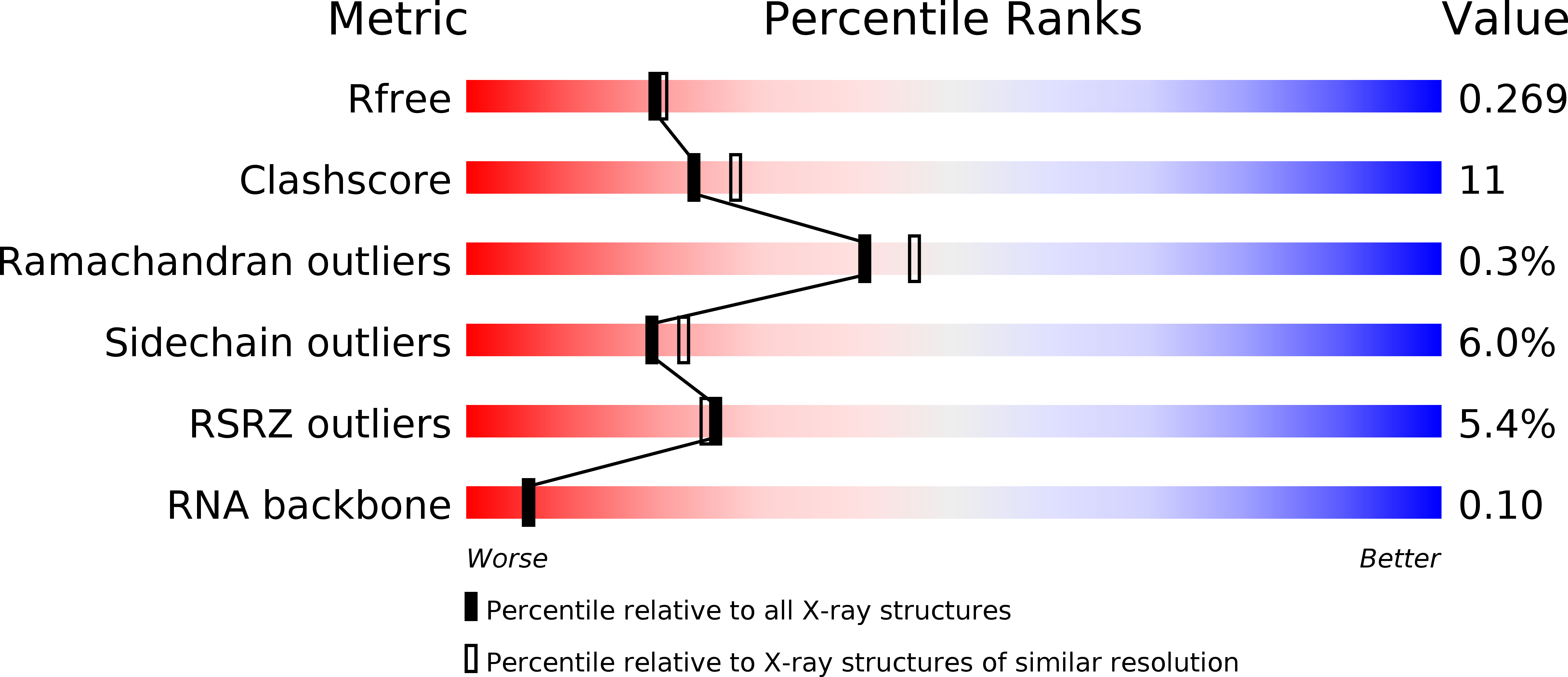
Resolution:
2.20 Å
R-Value Free:
0.22
R-Value Work:
0.21
R-Value Observed:
0.21
Space Group:
I 4 2 2
Macromolecular Entities
Structures with similar UniProt ID
Protein Blast
Polymer Type:polypeptide(L)
Molecule:Protein hfq
Gene (Uniprot):hfq
Chain IDs:A, B, C, D, E, F
Chain Length:78
Number of Molecules:6
Biological Source:Bacillus subtilis
Polymer Type:polyribonucleotide
Molecule:RNA (5'-R(*AP*GP*AP*GP*AP*GP*A)-3')
Chain IDs:G (auth: X)
Chain Length:7
Number of Molecules:1
Biological Source:
Primary Citation
Crystal structure of Hfq from Bacillus subtilis in complex with SELEX-derived RNA aptamer: insight into RNA-binding properties of bacterial Hfq
Nucleic Acids Res. 40 1856 1867 (2012)
PMID: 22053080 DOI: 10.1093/nar/gkr892

Abstact

Bacterial Hfq is a protein that plays an important role in the regulation of genes in cooperation with sRNAs. Escherichia coli Hfq (EcHfq) has two or more sites that bind RNA(s) including U-rich and/or the poly(A) tail of mRNA. However, functional and structural information about Bacillus subtilis Hfq (BsHfq) including the RNA sequences that specifically bind to it remain unknown. Here, we describe RNA aptamers including fragment (AG)(3)A that are recognized by BsHfq and crystal structures of the BsHfq-(AG)(3)A complex at 2.2 Å resolution. Mutational and structural studies revealed that the RNA fragment binds to the distal site, one of the two binding sites on Hfq, and identified amino acid residues that are critical for sequence-specific interactions between BsHfq and (AG)(3)A. In particular, R32 appears to interact with G bases in (AG)(3)A. Poly(A) also binds to the distal site of EcHfq, but the overall RNA structure and protein-RNA interaction patterns engaged in the R32 residues of BsHfq-(AG)(3)A differ from those of EcHfq-poly(A). These findings provide novel insight into how the Hfq homologue recognizes RNA.

Legend

Protein

Chemical

Disease

Primary Citation of related structures
Feedback Form
Name
Email
Institute
Feedback