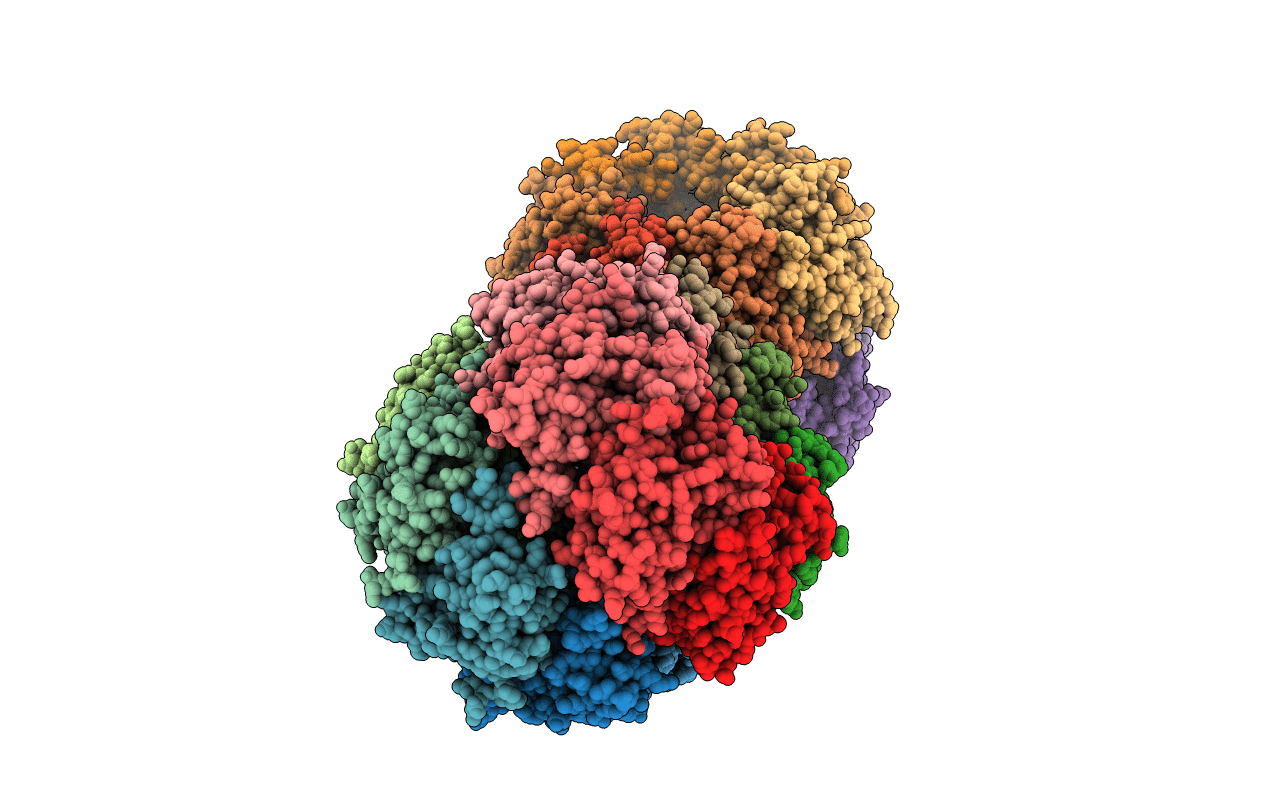
3HLN image
Deposition Date 2009-05-27
Release Date 2010-07-28
Last Version Date 2024-11-06
Entry Detail
PDB ID:
3HLN
Keywords:
Title:
Crystal structure of ClpP A153C mutant with inter-heptamer disulfide bonds
Biological Source:
Source Organism(s):
Expression System(s):
Method Details:
Experimental Method:
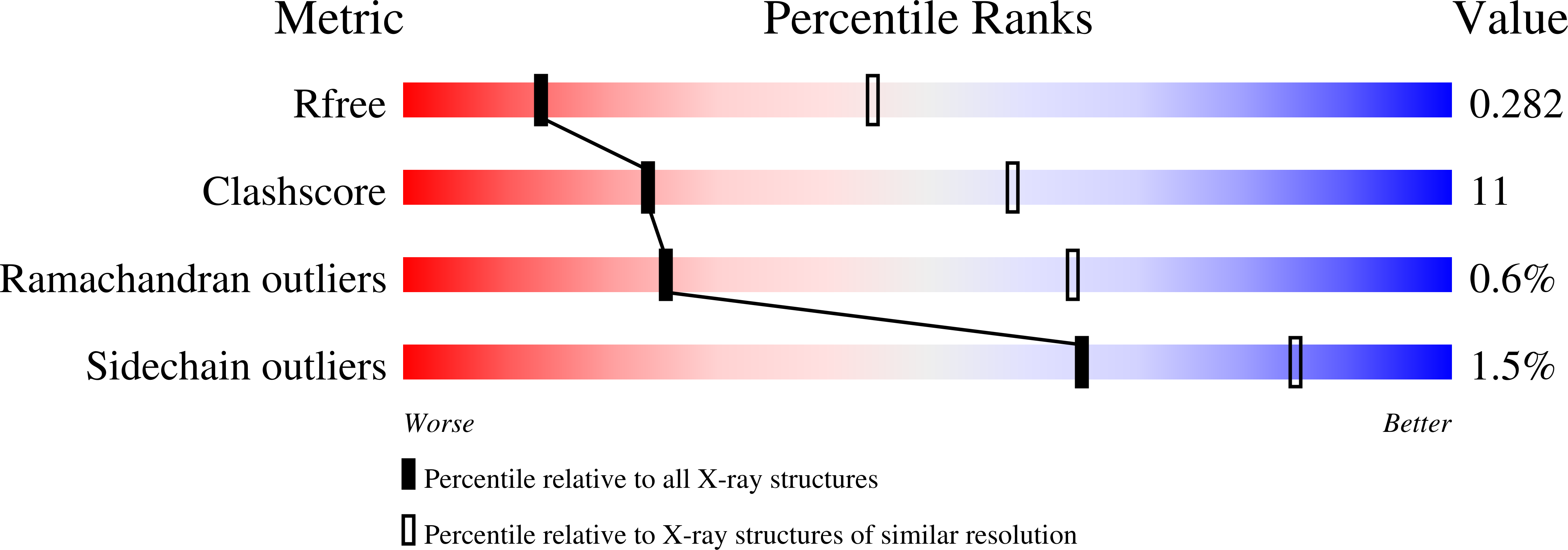
Resolution:
3.20 Å
R-Value Free:
0.25
R-Value Work:
0.21
R-Value Observed:
0.21
Space Group:
P 32 2 1
Macromolecular Entities
Structures with similar UniProt ID
Protein Blast
Polymer Type:polypeptide(L)
Molecule:ATP-dependent Clp protease proteolytic subunit
Gene (Uniprot):clpP
Mutagens:A153C
Chain IDs:A, B, C, D, E, F, G, H, I, J, K, L, M, N, O, P, Q, R, S, T, U, V, W, X, Y, Z, AA (auth: 1), BA (auth: 2)
Chain Length:193
Number of Molecules:28
Biological Source:Escherichia coli
Ligand Molecules
Primary Citation
Structural and Theoretical Studies Indicate that the Cylindrical Protease ClpP Samples Extended and Compact Conformations.
Structure 18 798 808 (2010)
PMID: 20637416 DOI: 10.1016/j.str.2010.04.008

Abstact

The highly conserved ClpP protease consists of two heptameric rings that interact by the interdigitation of an alpha-helix beta strand handle domain motif to form a tetradecameric cylinder. We previously proposed that protease dynamics results in the temporary unstructuring of interacting pairs of handle domains, opening transient equatorial side pores that allow for peptide egress. Here, we report the structure of an Escherichia coli ClpP mutant in which each opposing pair of protomers is linked by a disulfide bond. This structure resembles the compact structures of Streptococcus pneumoniae, Mycobacterium tuberculosis, and Plasmodium falciparum ClpPs, rather than the active, extended structures that have previously been determined for E. coli ClpPs. The structural data, along with normal mode analysis, support a model whereby the ClpP cylinder switches dynamically between an active extended state required for substrate degradation and an inactive compact state allowing peptide product release.

Legend

Protein

Chemical

Disease

Primary Citation of related structures
Feedback Form
Name
Email
Institute
Feedback