3HGP image
Deposition Date 2009-05-14
Release Date 2009-07-28
Last Version Date 2024-10-09
Entry Detail
PDB ID:
3HGP
Keywords:
Title:
Structure of porcine pancreatic elastase complexed with a potent peptidyl inhibitor FR130180 determined by high resolution crystallography
Biological Source:
Source Organism:
Sus scrofa (Taxon ID: 9823)
Method Details:
Experimental Method:
Resolution:
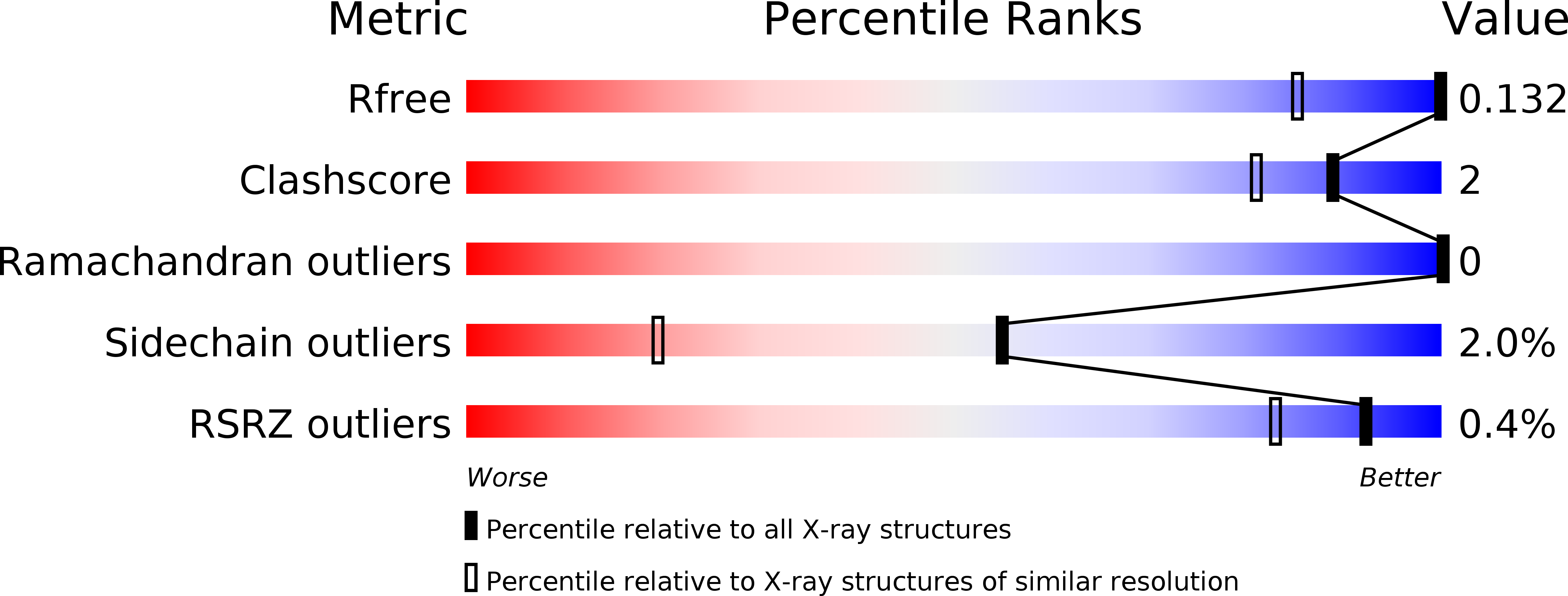
0.94 Å
R-Value Free:
0.12
R-Value Work:
0.10
Space Group:
P 21 21 21
Macromolecular Entities
Structures with similar UniProt ID
Protein Blast
Polymer Type:polypeptide(L)
Molecule:Elastase-1
Gene (Uniprot):CELA1
Chain IDs:A
Chain Length:240
Number of Molecules:1
Biological Source:Sus scrofa
Primary Citation
Combined High-Resolution Neutron and X-ray Analysis of Inhibited Elastase Confirms the Active-Site Oxyanion Hole but Rules against a Low-Barrier Hydrogen Bond
J.Am.Chem.Soc. 131 11033 11040 (2009)
PMID: 19603802 DOI: 10.1021/ja9028846

Abstact

To help resolve long-standing questions regarding the catalytic activity of the serine proteases, the structure of porcine pancreatic elastase has been analyzed by high-resolution neutron and X-ray crystallography. To mimic the tetrahedral transition intermediate, a peptidic inhibitor was used. A single large crystal was used to collect room-temperature neutron data to 1.65 A resolution and X-ray data to 1.20 A resolution. Another crystal provided a low-temperature X-ray data set to 0.94 A resolution. The neutron data are to higher resolution than previously reported for a serine protease and the X-ray data are comparable with other studies. The neutron and X-ray data show that the hydrogen bond between His57 and Asp102 (chymotrypsin numbering) is 2.60 A in length and that the hydrogen-bonding hydrogen is 0.80-0.96 A from the histidine nitrogen. This is not consistent with a low-barrier hydrogen which is predicted to have the hydrogen midway between the donor and acceptor atom. The observed interaction between His57 and Asp102 is essentially a short but conventional hydrogen bond, sometimes described as a short ionic hydrogen bond. The neutron analysis also shows that the oxygen of the oxopropyl group of the inhibitor is present as an oxygen anion rather than a hydroxyl group, supporting the role of the "oxyanion hole" in stabilizing the tetrahedral intermediate in catalysis.

Legend

Protein

Chemical

Disease

Primary Citation of related structures
Feedback Form
Name
Email
Institute
Feedback