3HBT image
Deposition Date 2009-05-05
Release Date 2010-05-05
Last Version Date 2023-11-01
Entry Detail
PDB ID:
3HBT
Title:
The structure of native G-actin
Biological Source:
Source Organism:
Method Details:
Experimental Method:
Resolution:
2.70 Å
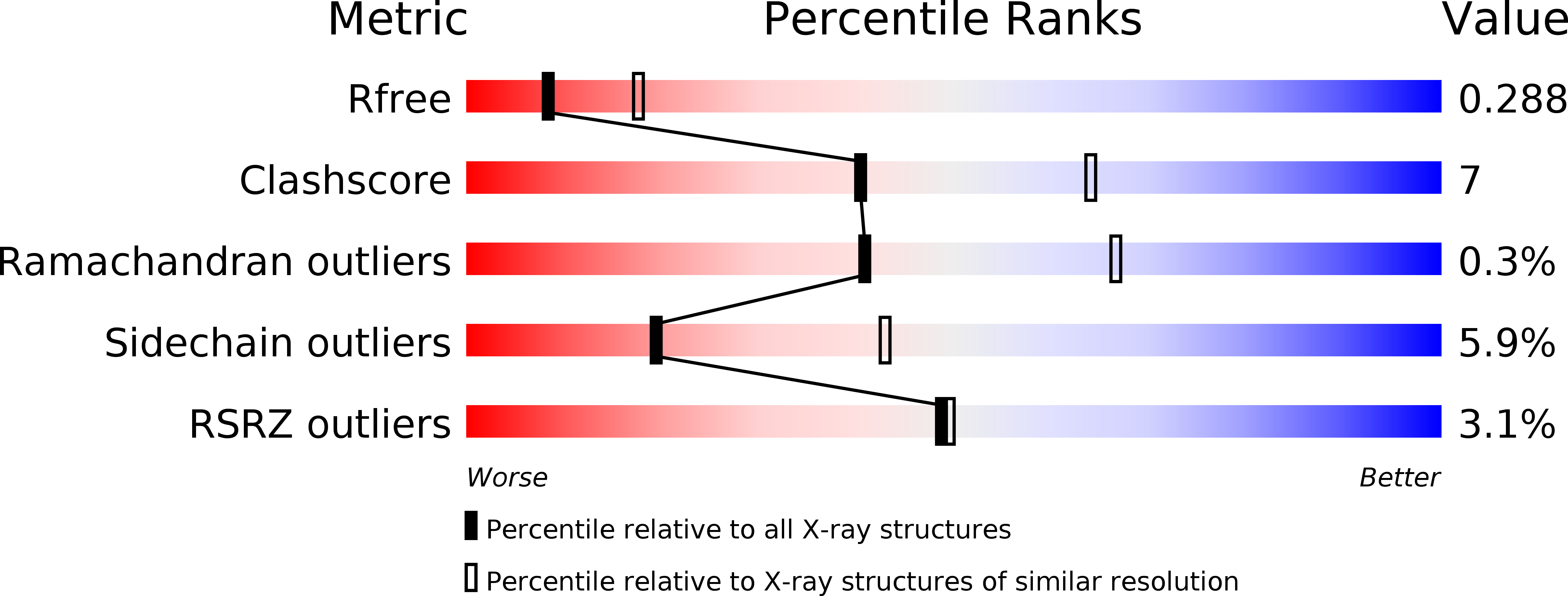
R-Value Free:
0.25
R-Value Work:
0.20
R-Value Observed:
0.20
Space Group:
P 32 2 1
Macromolecular Entities
Structures with similar UniProt ID
Protein Blast
Polymer Type:polypeptide(L)
Molecule:Actin
Gene (Uniprot):ACTA1
Chain IDs:A
Chain Length:375
Number of Molecules:1
Biological Source:Oryctolagus cuniculus
Modified Residue
Compound ID Chain ID Parent Comp ID Details 2D Image
HIC A HIS 4-METHYL-HISTIDINE
Primary Citation
The structure of native G-actin
Cytoskeleton (Hoboken) 67 456 465 (2010)
PMID: 20540085 DOI: 10.1002/cm.20458

Abstact

Heat shock proteins act as cytoplasmic chaperones to ensure correct protein folding and prevent protein aggregation. The presence of stoichiometric amounts of one such heat shock protein, Hsp27, in supersaturated solutions of unmodified G-actin leads to crystallization, in preference to polymerization, of the actin. Hsp27 is not evident in the resulting crystal structure. Thus, for the first time, we present the structure of G-actin in a form that is devoid of polymerization-deterring chemical modifications or binding partners, either of which may alter its conformation. The structure contains a calcium ion and ATP within a closed nucleotide-binding cleft, and the D-loop is disordered. This native G-actin structure invites comparison with the current F-actin model in order to understand the structural implications for actin polymerization. In particular, this analysis suggests a mechanism by which the bound cation coordinates conformational change and ATP-hydrolysis.

Legend

Protein

Chemical

Disease

Primary Citation of related structures
Feedback Form
Name
Email
Institute
Feedback