3HB6 image
Deposition Date 2009-05-04
Release Date 2009-05-12
Last Version Date 2023-09-06
Entry Detail
PDB ID:
3HB6
Keywords:
Title:
Inactive mutant H54F of Proteus mirabilis catalase
Biological Source:
Source Organism:
Host Organism:
Method Details:
Experimental Method:
Resolution:
2.30 Å
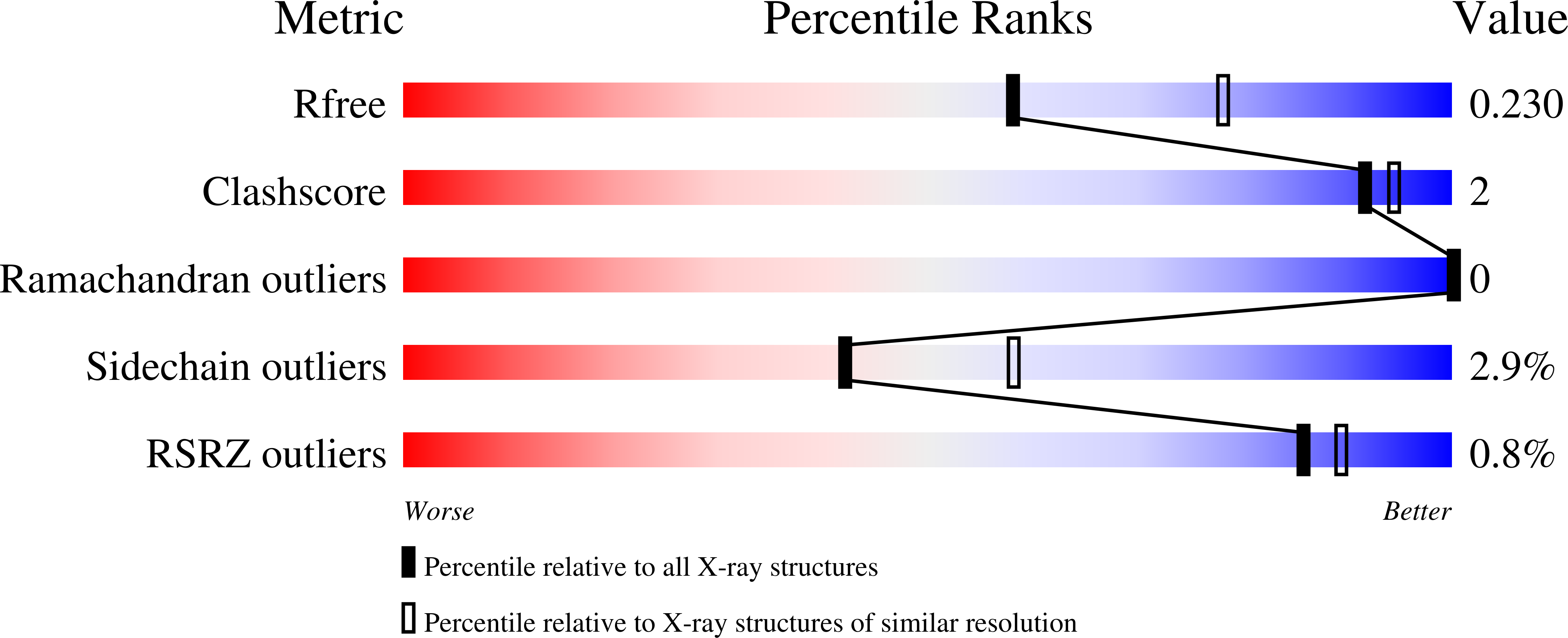
R-Value Free:
0.23
R-Value Work:
0.20
R-Value Observed:
0.20
Space Group:
P 62 2 2
Macromolecular Entities
Structures with similar UniProt ID
Protein Blast
Polymer Type:polypeptide(L)
Molecule:Catalase
Gene (Uniprot):katA
Mutagens:H54F
Chain IDs:A
Chain Length:484
Number of Molecules:1
Biological Source:Proteus mirabilis
Primary Citation
Verdoheme formation in Proteus mirabilis catalase.
Biochim.Biophys.Acta 1790 741 753 (2009)
PMID: 19394409 DOI: 10.1016/j.bbagen.2009.04.010

Abstact

BACKGROUND Heme oxidative degradation has been extensively investigated in peroxidases but not in catalases. The verdoheme formation, a product of heme oxidation which inactivates the enzyme, was studied in Proteus mirabilis catalase. METHODS The verdoheme was generated by adding peracetic acid and analyzed by mass spectrometry and spectrophotometry. RESULTS Kinetics follow-up of different catalase reactional intermediates shows that i) the formation of compound I always precedes that of verdoheme, ii) compound III is never observed, iii) the rate of compound II decomposition is not compatible with that of verdoheme formation, and iv) dithiothreitol prevents the verdoheme formation but not that of compound II, whereas NADPH prevents both of them. The formation of verdoheme is strongly inhibited by EDTA but not increased by Fe3+ or Cu2+ salts. The generation of verdoheme is facilitated by the presence of protein radicals as observed in the F194Y mutated catalase. The inability of the inactive variant (H54F) to form verdoheme, indicates that the heme oxidation is fully associated to the enzyme catalysis. CONCLUSION These data, taken together, strongly suggest that the verdoheme formation pathway originates from compound I rather than from compound II. GENERAL SIGNIFICANCE The autocatalytic verdoheme formation is likely to occur in vivo.

Legend

Protein

Chemical

Disease

Primary Citation of related structures
Feedback Form
Name
Email
Institute
Feedback