3H1U image
Deposition Date 2009-04-14
Release Date 2009-05-05
Last Version Date 2023-11-01
Entry Detail
PDB ID:
3H1U
Title:
Structure of ubiquitin in complex with Cd ions
Biological Source:
Source Organism:
Bos taurus (Taxon ID: 9913)
Method Details:
Experimental Method:
Resolution:
3.00 Å
R-Value Free:
0.25
R-Value Work:
0.22
R-Value Observed:
0.22
Space Group:
P 43 3 2
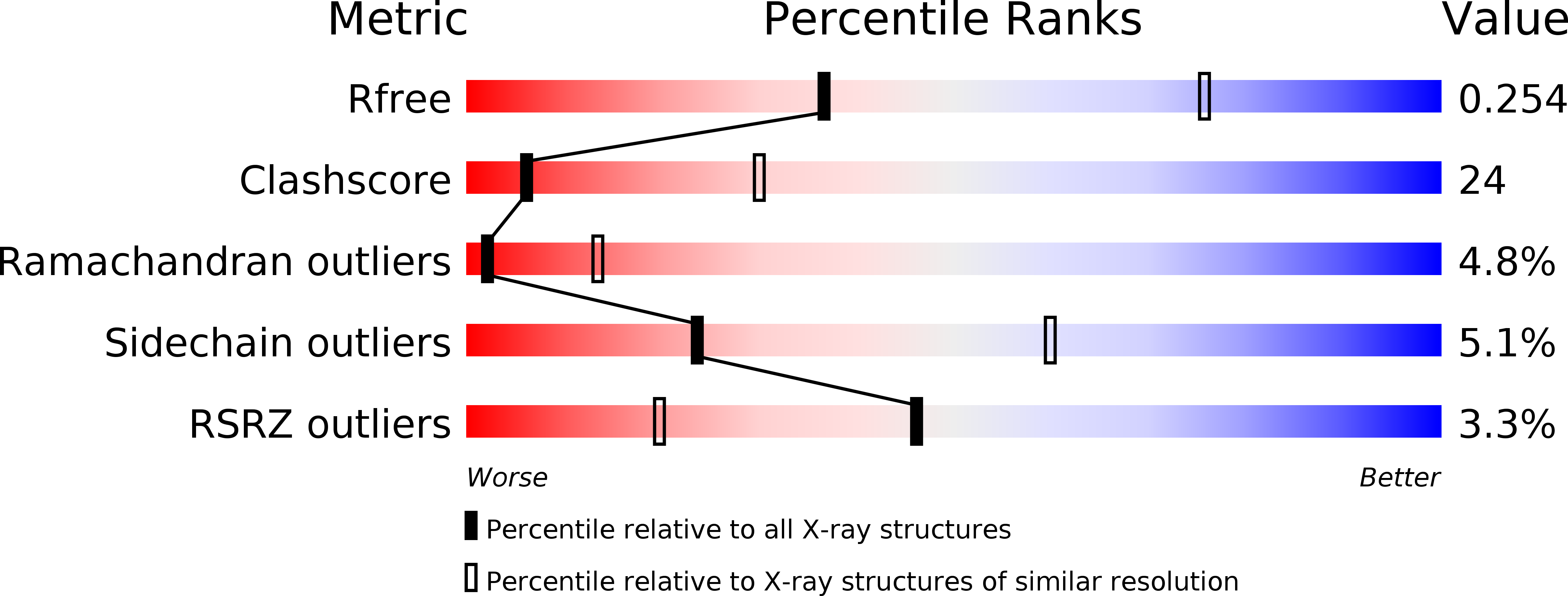
Macromolecular Entities
Structures with similar UniProt ID
Protein Blast
Polymer Type:polypeptide(L)
Molecule:Ubiquitin
Chain IDs:A, B
Chain Length:76
Number of Molecules:2
Biological Source:Bos taurus
Ligand Molecules
Primary Citation
Crystallographic structure of ubiquitin in complex with cadmium ions
BMC RES NOTES 2 251 251 (2009)
PMID: 20003470 DOI: 10.1186/1756-0500-2-251

Abstact

BACKGROUND Ubiquitination plays a critical role in regulating many cellular processes, from DNA repair and gene transcription to cell cycle and apoptosis. It is catalyzed by a specific enzymatic cascade ultimately leading to the conjugation of ubiquitin to lysine residues of the target protein that can be the ubiquitin molecule itself and to the formation of poly-ubiquitin chains. FINDINGS We present the crystal structure at 3.0 A resolution of bovine ubiquitin crystallized in presence of cadmium ions. Two molecules of ubiquitin are present in the asymmetric unit. Interestingly this non-covalent dimeric arrangement brings Lys-6 and Lys-63 of each crystallographically-independent monomer in close contact with the C-terminal ends of the other monomer. Residues Leu-8, Ile-44 and Val-70 that form a hydrophobic patch at the surface of the Ub monomer are trapped at the dimer interface. CONCLUSIONS The structural basis for signalling by poly-Ub chains relies on a visualization of conformations of alternatively linked poly-Ub chains. This arrangement of ubiquitin could illustrate how linkages involving Lys-6 or Lys-63 of ubiquitin are produced in the cell. It also details how ubiquitin molecules can specifically chelate cadmium ions.

Legend

Protein

Chemical

Disease

Primary Citation of related structures
Feedback Form
Name
Email
Institute
Feedback