3GQI image
Deposition Date 2009-03-24
Release Date 2009-08-18
Last Version Date 2024-10-16
Entry Detail
PDB ID:
3GQI
Title:
Crystal Structure of activated receptor tyrosine kinase in complex with substrates
Biological Source:
Source Organism:
Homo sapiens (Taxon ID: 9606)
Rattus norvegicus (Taxon ID: 10116)
Host Organism:
Method Details:
Experimental Method:
Resolution:
2.50 Å
R-Value Free:
0.28
R-Value Work:
0.24
Space Group:
C 1 2 1
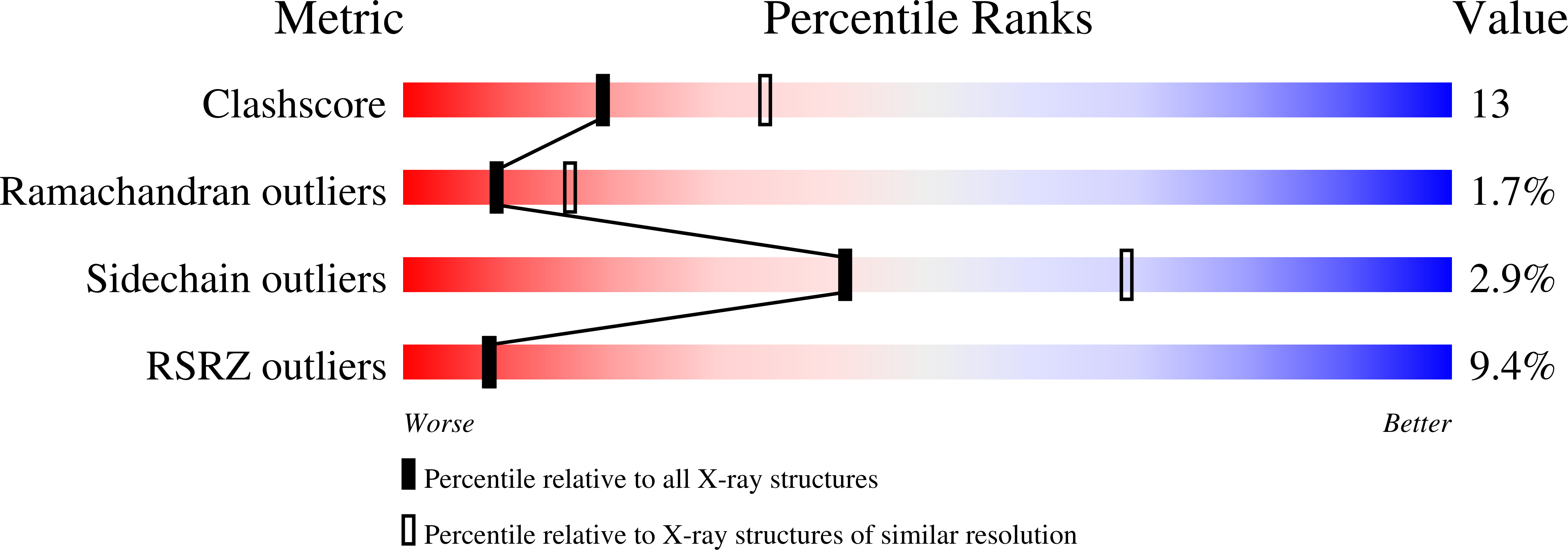
Macromolecular Entities
Structures with similar UniProt ID
Protein Blast
Polymer Type:polypeptide(L)
Molecule:Basic fibroblast growth factor receptor 1
Gene (Uniprot):FGFR1
Mutagens:C488A, Y583F, C584S, Y575F
Chain IDs:A
Chain Length:326
Number of Molecules:1
Biological Source:Homo sapiens
Structures with similar UniProt ID
Protein Blast
Polymer Type:polypeptide(L)
Molecule:Phospholipase C-gamma-1
Gene (Uniprot):Plcg1
Chain IDs:B
Chain Length:226
Number of Molecules:1
Biological Source:Rattus norvegicus
Modified Residue
Compound ID Chain ID Parent Comp ID Details 2D Image
PTR A TYR O-PHOSPHOTYROSINE
Primary Citation
The selectivity of receptor tyrosine kinase signaling is controlled by a secondary SH2 domain binding site.
Cell(Cambridge,Mass.) 138 514 524 (2009)
PMID: 19665973 DOI: 10.1016/j.cell.2009.05.028

Abstact

SH2 domain-mediated interactions represent a crucial step in transmembrane signaling by receptor tyrosine kinases. SH2 domains recognize phosphotyrosine (pY) in the context of particular sequence motifs in receptor phosphorylation sites. However, the modest binding affinity of SH2 domains to pY containing peptides may not account for and likely represents an oversimplified mechanism for regulation of selectivity of signaling pathways in living cells. Here we describe the crystal structure of the activated tyrosine kinase domain of FGFR1 in complex with a phospholipase Cgamma fragment. The structural and biochemical data and experiments with cultured cells show that the selectivity of phospholipase Cgamma binding and signaling via activated FGFR1 are determined by interactions between a secondary binding site on an SH2 domain and a region in FGFR1 kinase domain in a phosphorylation independent manner. These experiments reveal a mechanism for how SH2 domain selectivity is regulated in vivo to mediate a specific cellular process.

Legend

Protein

Chemical

Disease

Primary Citation of related structures
Feedback Form
Name
Email
Institute
Feedback