3GQA image
Deposition Date 2009-03-24
Release Date 2009-05-26
Last Version Date 2023-09-06
Entry Detail
PDB ID:
3GQA
Keywords:
Title:
Crystal Structure of the Bacteriophage phi29 gene product 12 N-terminal fragment in complex with cobalt ions
Biological Source:
Source Organism:
Host Organism:
Method Details:
Experimental Method:
Resolution:
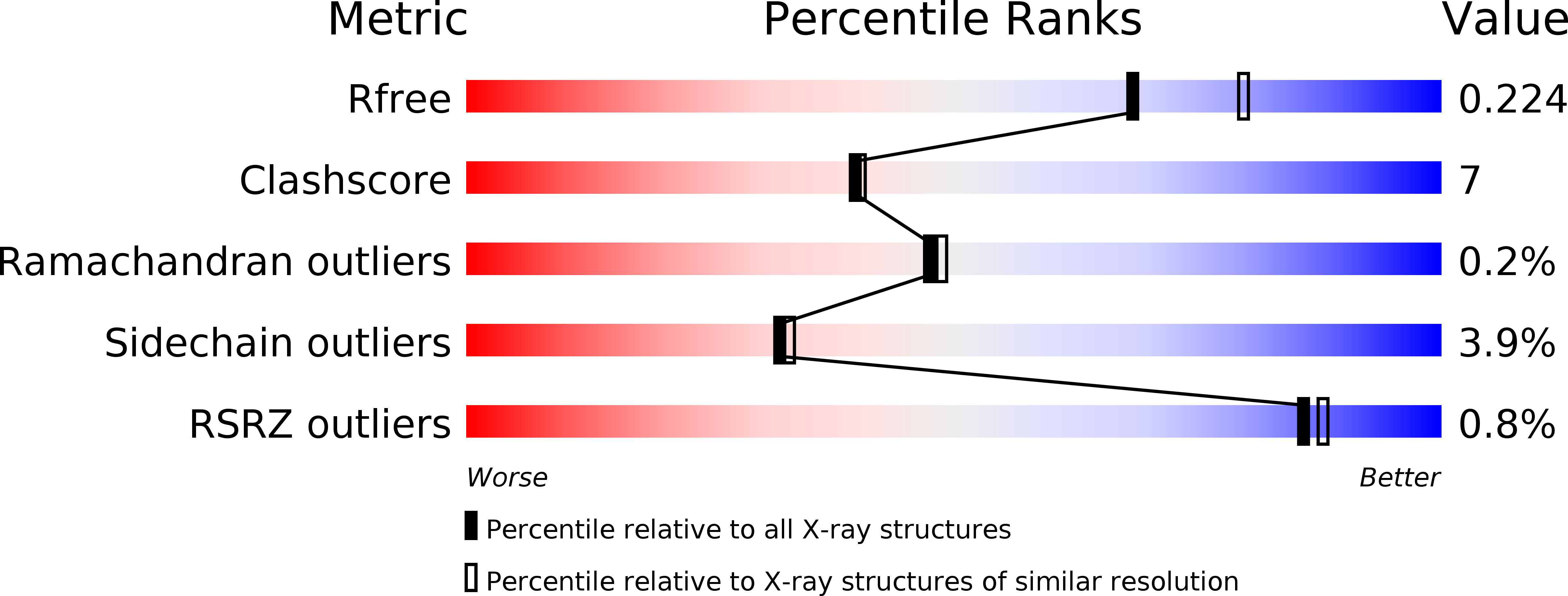
2.10 Å
R-Value Free:
0.22
R-Value Work:
0.18
R-Value Observed:
0.18
Space Group:
H 3 2
Macromolecular Entities
Structures with similar UniProt ID
Protein Blast
Polymer Type:polypeptide(L)
Molecule:Preneck appendage protein
Chain IDs:A
Chain Length:609
Number of Molecules:1
Biological Source:Bacillus phage phi29
Primary Citation
Crystallographic insights into the autocatalytic assembly mechanism of a bacteriophage tail spike.
Mol.Cell 34 375 386 (2009)
PMID: 19450535 DOI: 10.1016/j.molcel.2009.04.009

Abstact

The tailed bacteriophage phi29 has 12 "appendages" (gene product 12, gp12) attached to its neck region that participate in host cell recognition and entry. In the cell, monomeric gp12 undergoes proteolytic processing that releases the C-terminal domain during assembly into trimers. We report here crystal structures of the protein before and after catalytic processing and show that the C-terminal domain of gp12 is an "autochaperone" that aids trimerization. We also show that autocleavage of the C-terminal domain is a posttrimerization event that is followed by a unique ATP-dependent release. The posttranslationally modified N-terminal part has three domains that function to attach the appendages to the phage, digest the cell wall teichoic acids, and bind irreversibly to the host, respectively. Structural and sequence comparisons suggest that some eukaryotic and bacterial viruses as well as bacterial adhesins might have a similar maturation mechanism as is performed by phi29 gp12 for Bacillus subtilis.

Legend

Protein

Chemical

Disease

Primary Citation of related structures
Feedback Form
Name
Email
Institute
Feedback