3GOP image
Deposition Date 2009-03-19
Release Date 2009-07-07
Last Version Date 2023-09-06
Entry Detail
PDB ID:
3GOP
Keywords:
Title:
Crystal structure of the EGF receptor juxtamembrane and kinase domains
Biological Source:
Source Organism(s):
Homo sapiens (Taxon ID: 9606)
Expression System(s):
Method Details:
Experimental Method:
Resolution:
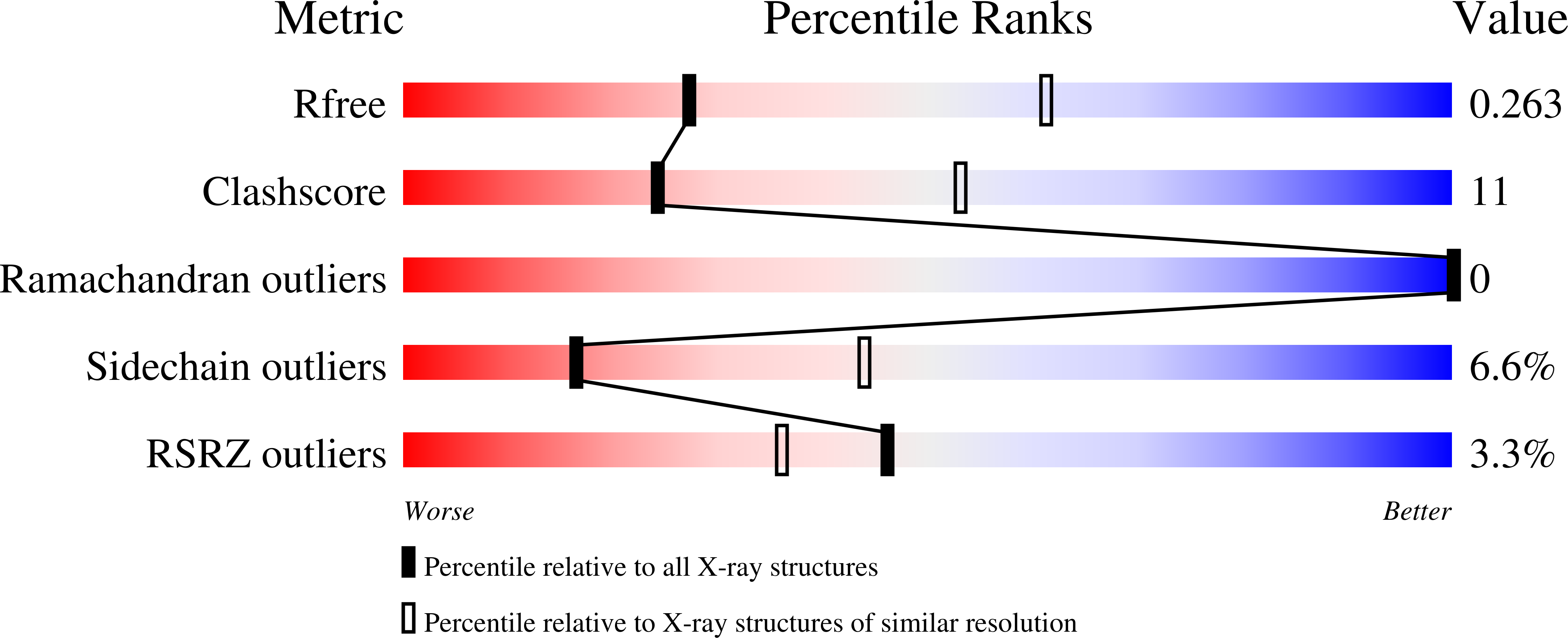
2.80 Å
R-Value Free:
0.25
R-Value Work:
0.20
R-Value Observed:
0.21
Space Group:
P 43 21 2
Macromolecular Entities
Structures with similar UniProt ID
Protein Blast
Polymer Type:polypeptide(L)
Molecule:Epidermal growth factor receptor
Gene (Uniprot):EGFR
Mutagens:K721M
Chain IDs:A
Chain Length:361
Number of Molecules:1
Biological Source:Homo sapiens
Primary Citation
The juxtamembrane region of the EGF receptor functions as an activation domain.
Mol.Cell 34 641 651 (2009)
PMID: 19560417 DOI: 10.1016/j.molcel.2009.04.034

Abstact

In several growth factor receptors, the intracellular juxtamembrane (JM) region participates in autoinhibitory interactions that must be disrupted for tyrosine kinase activation. Using alanine scanning mutagenesis and crystallographic approaches, we define a domain within the JM region of the epidermal growth factor receptor (EGFR) that instead plays an activating--rather than autoinhibitory--role. Mutations in the C-terminal 19 residues of the EGFR JM region abolish EGFR activation. In a crystal structure of an asymmetric dimer of the tyrosine kinase domain, the JM region of an acceptor monomer makes extensive contacts with the C lobe of a donor monomer, thus stabilizing the dimer. We describe how an uncharacterized lung cancer mutation in this JM activation domain (V665M) constitutively activates EGFR by augmenting its capacity to act as an acceptor in the asymmetric dimer. This JM mutant promotes cellular transformation by EGFR in vitro and is tumorigenic in a xenograft assay.

Legend

Protein

Chemical

Disease

Primary Citation of related structures
Feedback Form
Name
Email
Institute
Feedback