3GLW image
Deposition Date 2009-03-12
Release Date 2009-09-15
Last Version Date 2024-11-20
Entry Detail
PDB ID:
3GLW
Title:
Quaternary Structure of Drosophila melanogaster IC/Tctex-1/LC8; Allosteric Interactions of Dynein Light Chains with Dynein Intermediate Chain
Biological Source:
Source Organism(s):
Expression System(s):
Method Details:
Experimental Method:
Resolution:
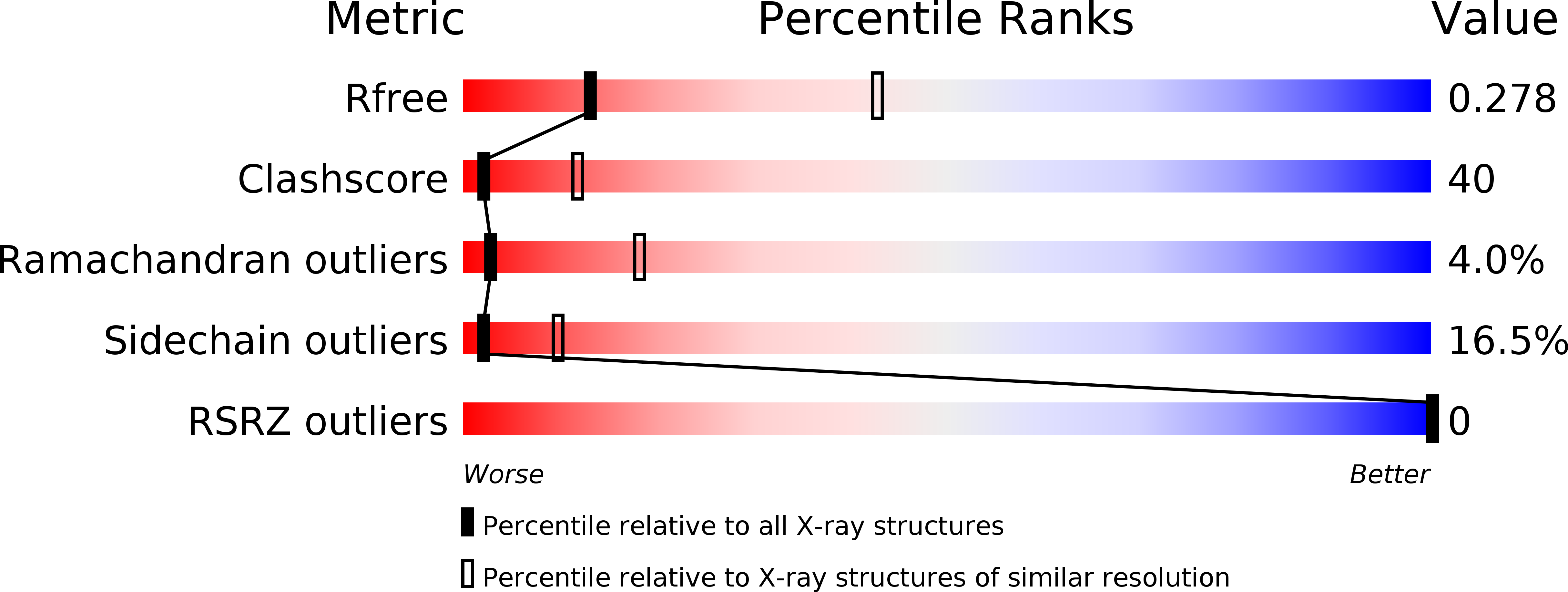
3.15 Å
R-Value Free:
0.27
R-Value Work:
0.20
R-Value Observed:
0.20
Space Group:
P 61 2 2
Macromolecular Entities
Structures with similar UniProt ID
Protein Blast
Polymer Type:polypeptide(L)
Molecule:Dynein light chain 1, cytoplasmic
Gene (Uniprot):ctp
Chain IDs:A
Chain Length:89
Number of Molecules:1
Biological Source:Drosophila melanogaster
Primary Citation
Multivalency in the assembly of intrinsically disordered Dynein intermediate chain.
J.Biol.Chem. 284 33115 33121 (2009)
PMID: 19759397 DOI: 10.1074/jbc.M109.048587

Abstact

Dynein light chains are thought to increase binding efficiency of dynein intermediate chain to both dynein heavy chain and dynactin, but their exact role is not clear. Isothermal titration calorimetry and x-ray crystallography reported herein indicate that multivalency effects underlie efficient dynein assembly and regulation. For a ternary complex of a 60-amino acid segment of dynein intermediate chain (IC) bound to two homodimeric dynein light chains Tctex1 and LC8, there is a 50-fold affinity enhancement for the second light chain binding. For a designed IC construct containing two LC8 sites, observed the 1000-fold enhancement reflects a remarkably pure entropic chelate effect of a magnitude commensurate with theoretical predictions. The lower enhancement in wild-type IC is attributed to unfavorable free energy changes associated with incremental interactions of IC with Tctex1. Our results show assembled dynein IC as an elongated, flexible polybivalent duplex, and suggest that polybivalency is an important general mechanism for constructing stable yet reversible and functionally versatile complexes.

Legend

Protein

Chemical

Disease

Primary Citation of related structures
Feedback Form
Name
Email
Institute
Feedback