3G65 image
Deposition Date 2009-02-06
Release Date 2009-05-26
Last Version Date 2023-09-06
Entry Detail
PDB ID:
3G65
Keywords:
Title:
Crystal Structure of the Human Rad9-Rad1-Hus1 DNA Damage Checkpoint Complex
Biological Source:
Source Organism:
Homo sapiens (Taxon ID: 9606)
Host Organism:
Method Details:
Experimental Method:
Resolution:
2.90 Å
R-Value Free:
0.27
R-Value Work:
0.22
R-Value Observed:
0.22
Space Group:
P 1 21 1
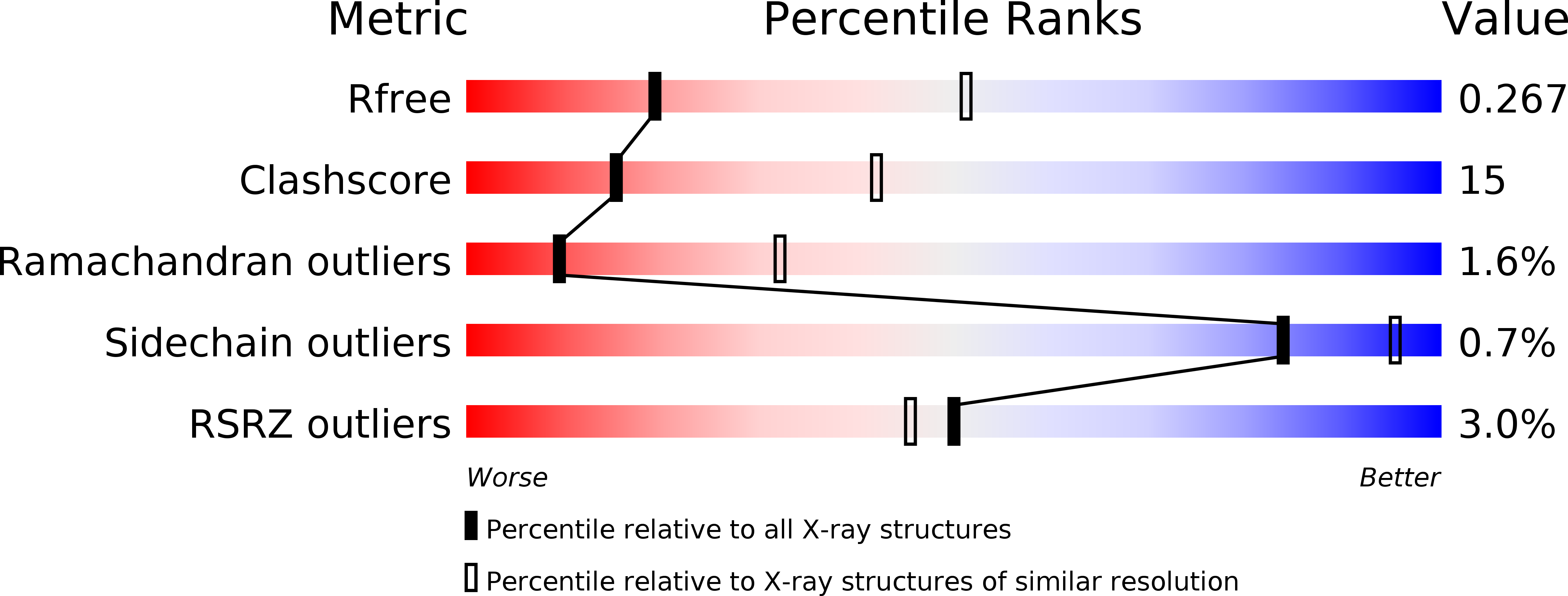
Macromolecular Entities
Structures with similar UniProt ID
Protein Blast
Polymer Type:polypeptide(L)
Molecule:Cell cycle checkpoint control protein RAD9A
Gene (Uniprot):RAD9A
Chain IDs:A
Chain Length:296
Number of Molecules:1
Biological Source:Homo sapiens
Structures with similar UniProt ID
Protein Blast
Polymer Type:polypeptide(L)
Molecule:Cell cycle checkpoint protein RAD1
Gene (Uniprot):RAD1
Chain IDs:B
Chain Length:282
Number of Molecules:1
Biological Source:Homo sapiens
Structures with similar UniProt ID
Protein Blast
Polymer Type:polypeptide(L)
Molecule:Checkpoint protein HUS1
Gene (Uniprot):HUS1
Chain IDs:C
Chain Length:280
Number of Molecules:1
Biological Source:Homo sapiens
Primary Citation
Crystal structure of the rad9-rad1-hus1 DNA damage checkpoint complex--implications for clamp loading and regulation.
Mol.Cell 34 735 745 (2009)
PMID: 19446481 DOI: 10.1016/j.molcel.2009.04.027

Abstact

Rad9, Rad1, and Hus1 form a heterotrimeric complex (9-1-1) that is loaded onto DNA at sites of DNA damage. DNA-loaded 9-1-1 activates signaling through the Chk1 arm of the DNA damage checkpoint response via recruitment and stimulation of ATR. Additionally, 9-1-1 may play a direct role in facilitating DNA damage repair via interaction with a number of DNA repair enzymes. We have now determined the crystal structure of the human 9-1-1 complex, revealing a toroidal structure with a similar architecture to the homotrimeric PCNA DNA-binding clamp. The structure explains the formation of a unique heterotrimeric arrangement and reveals significant differences among the three subunits in the sites implicated in binding to the clamp loader and to ligand proteins. Biochemical analysis reveals a single repair enzyme-binding site on 9-1-1 that can be blocked competitively by the PCNA-binding cell-cycle regulator p21(cip1/waf1).

Legend

Protein

Chemical

Disease

Primary Citation of related structures
Feedback Form
Name
Email
Institute
Feedback