3G5W image
Deposition Date 2009-02-05
Release Date 2009-02-17
Last Version Date 2024-02-21
Entry Detail
PDB ID:
3G5W
Title:
Crystal structure of Blue Copper Oxidase from Nitrosomonas europaea
Biological Source:
Source Organism:
Method Details:
Experimental Method:
Resolution:
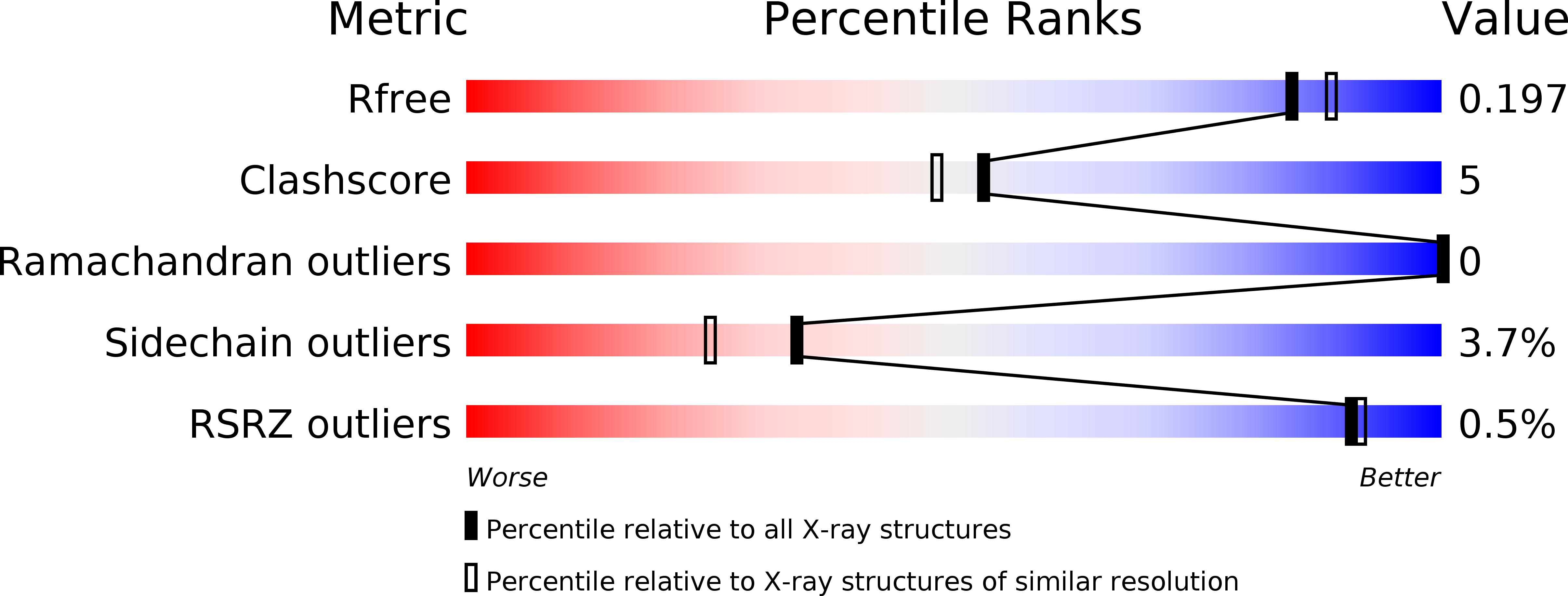
1.90 Å
R-Value Free:
0.19
R-Value Work:
0.16
R-Value Observed:
0.16
Space Group:
P 1
Macromolecular Entities
Structures with similar UniProt ID
Protein Blast
Polymer Type:polypeptide(L)
Molecule:Multicopper oxidase type 1
Gene (Uniprot):pan1
Chain IDs:A, B, C, D, E, F
Chain Length:318
Number of Molecules:6
Biological Source:Nitrosomonas europaea
Primary Citation
Crystal structure of a two-domain multicopper oxidase: implications for the evolution of multicopper blue proteins.
J.Biol.Chem. 284 10174 10180 (2009)
PMID: 19224923 DOI: 10.1074/jbc.M900179200

Abstact

The two-domain multicopper oxidases are proposed to be key intermediates in the evolution of three-domain multicopper oxidases. A number of two-domain multicopper oxidases have been identified from genome sequences and are classified as type A, type B, or type C on the basis of the predicted location of the type 1 copper center. The crystal structure of blue copper oxidase, a type C two-domain multicopper oxidase from Nitrosomonas europaea, has been determined to 1.9 A resolution. Blue copper oxidase is a trimer, of which each subunit comprises two cupredoxin domains. Each subunit houses a type 1 copper site in domain 1 and a type 2/type 3 trinuclear copper cluster at the subunit-subunit interface. The coordination geometry at the trinuclear copper site is consistent with reduction of the copper ions. Although the overall architecture of blue copper oxidase is similar to nitrite reductases, detailed structural alignments show that the fold and domain orientation more closely resemble the three-domain multicopper oxidases. These observations have important implications for the evolution of nitrite reductases and multicopper oxidases.

Legend

Protein

Chemical

Disease

Primary Citation of related structures
Feedback Form
Name
Email
Institute
Feedback