3FXB image
Deposition Date 2009-01-20
Release Date 2009-05-26
Last Version Date 2024-10-30
Entry Detail
PDB ID:
3FXB
Title:
Crystal structure of the ectoine-binding protein UehA
Biological Source:
Source Organism:
Host Organism:
Method Details:
Experimental Method:
Resolution:
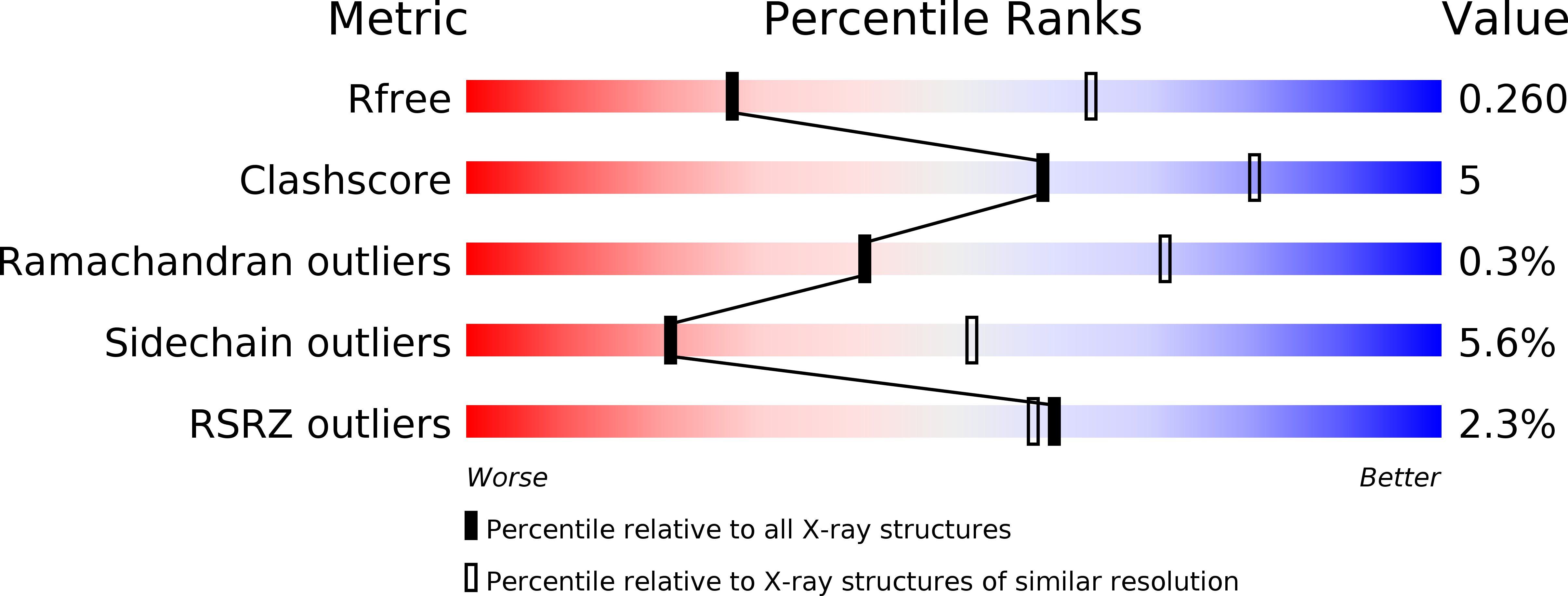
2.90 Å
R-Value Free:
0.26
R-Value Work:
0.21
R-Value Observed:
0.22
Space Group:
P 1 21 1
Macromolecular Entities
Structures with similar UniProt ID
Protein Blast
Polymer Type:polypeptide(L)
Molecule:TRAP dicarboxylate transporter, DctP subunit
Gene (Uniprot):uehA
Chain IDs:A, B
Chain Length:326
Number of Molecules:2
Biological Source:Silicibacter pomeroyi DSS-3
Ligand Molecules
Primary Citation
The crystal structure of UehA in complex with ectoine-A comparison with other TRAP-T binding proteins.
J.Mol.Biol. 389 58 73 (2009)
PMID: 19362561 DOI: 10.1016/j.jmb.2009.03.077

Abstact

Substrate-binding proteins or extracellular solute receptors (ESRs) are components of both ABC (ATP binding cassette) and TRAP-T (tripartite ATP-independent periplasmic transporter). The TRAP-T system UehABC from Silicibacter pomeroyi DSS-3 imports the compatible solutes ectoine and 5-hydroxyectoine as nutrients. UehA, the ESR of the UehABC operon, binds both ectoine and 5-hydroxyectoine with high affinity (K(d) values of 1.4+/-0.1 and 1.1+/-0.1 microM, respectively) and delivers them to the TRAP-T complex. The crystal structure of UehA in complex with ectoine was determined at 2.9-A resolution and revealed an overall fold common for all ESR proteins from TRAP systems determined so far. A comparison of the recently described structure of TeaA from Halomonas elongata and an ectoine-binding protein (EhuB) from an ABC transporter revealed a conserved ligand binding mode that involves both directed and cation-pi interactions. Furthermore, a comparison with other known TRAP-T ESRs revealed a helix that might act as a selectivity filter imposing restraints on the ESRs that fine-tune ligand recognition and binding and finally might determine the selection of the cognate substrate.

Legend

Protein

Chemical

Disease

Primary Citation of related structures
Feedback Form
Name
Email
Institute
Feedback