3FD9 image
Deposition Date 2008-11-25
Release Date 2009-06-23
Last Version Date 2024-11-27
Entry Detail
PDB ID:
3FD9
Title:
Crystal Structure of the transcriptional anti-activator ExsD from Pseudomonas aeruginosa
Biological Source:
Source Organism:
Host Organism:
Method Details:
Experimental Method:
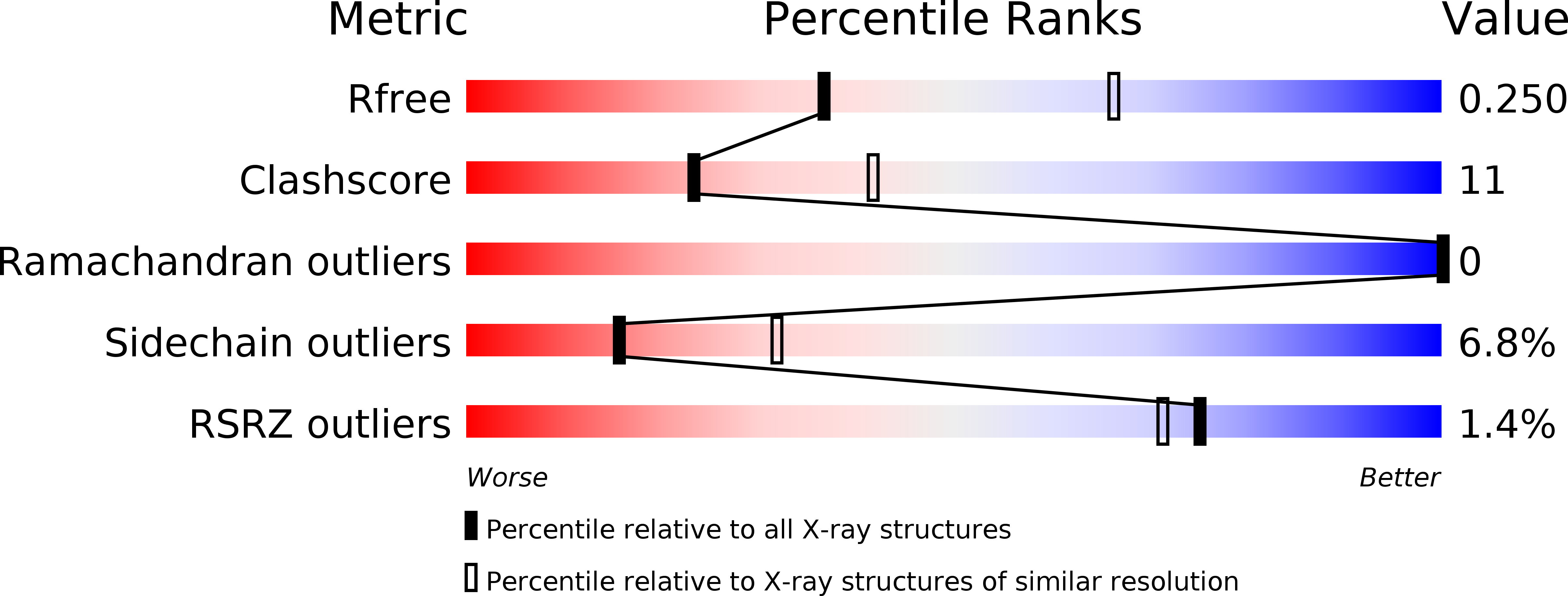
Resolution:
2.60 Å
R-Value Free:
0.26
R-Value Work:
0.21
R-Value Observed:
0.21
Space Group:
P 21 21 2
Macromolecular Entities
Structures with similar UniProt ID
Protein Blast
Polymer Type:polypeptide(L)
Molecule:Uncharacterized protein
Chain IDs:A, B, C
Chain Length:256
Number of Molecules:3
Biological Source:Pseudomonas aeruginosa UCBPP-PA14
Modified Residue
Compound ID Chain ID Parent Comp ID Details 2D Image
MSE A MET SELENOMETHIONINE
Primary Citation
Structural evidence suggests that antiactivator ExsD from Pseudomonas aeruginosa is a DNA binding protein
Protein Sci. 18 503 513 (2009)
PMID: 19235906 DOI: 10.1002/pro.48

Abstact

The opportunistic pathogen P. aeruginosa utilizes a type III secretion system (T3SS) to support acute infections in predisposed individuals. In this bacterium, expression of all T3SS-related genes is dependent on the AraC-type transcriptional activator ExsA. Before host contact, the T3SS is inactive and ExsA is repressed by the antiactivator protein ExsD. The repression, thought to occur through direct interactions between the two proteins, is relieved upon opening of the type III secretion (T3S) channel when secretion chaperone ExsC sequesters ExsD. We have solved the crystal structure of Delta20ExsD, a protease-resistant fragment of ExsD that lacks only the 20 amino terminal residues of the wild-type protein at 2.6 A. Surprisingly the structure revealed similarities between ExsD and the DNA binding domain of transcriptional repressor KorB. A model of an ExsD-DNA complex constructed on the basis of this homology produced a realistic complex that is supported by the prevalence of conserved residues in the putative DNA binding site and the results of differential scanning fluorimetry studies. Our findings challenge the currently held model that ExsD solely acts through interactions with ExsA and raise new questions with respect to the underlying mechanism of ExsA regulation.

Legend

Protein

Chemical

Disease

Primary Citation of related structures
Feedback Form
Name
Email
Institute
Feedback