3F69 image
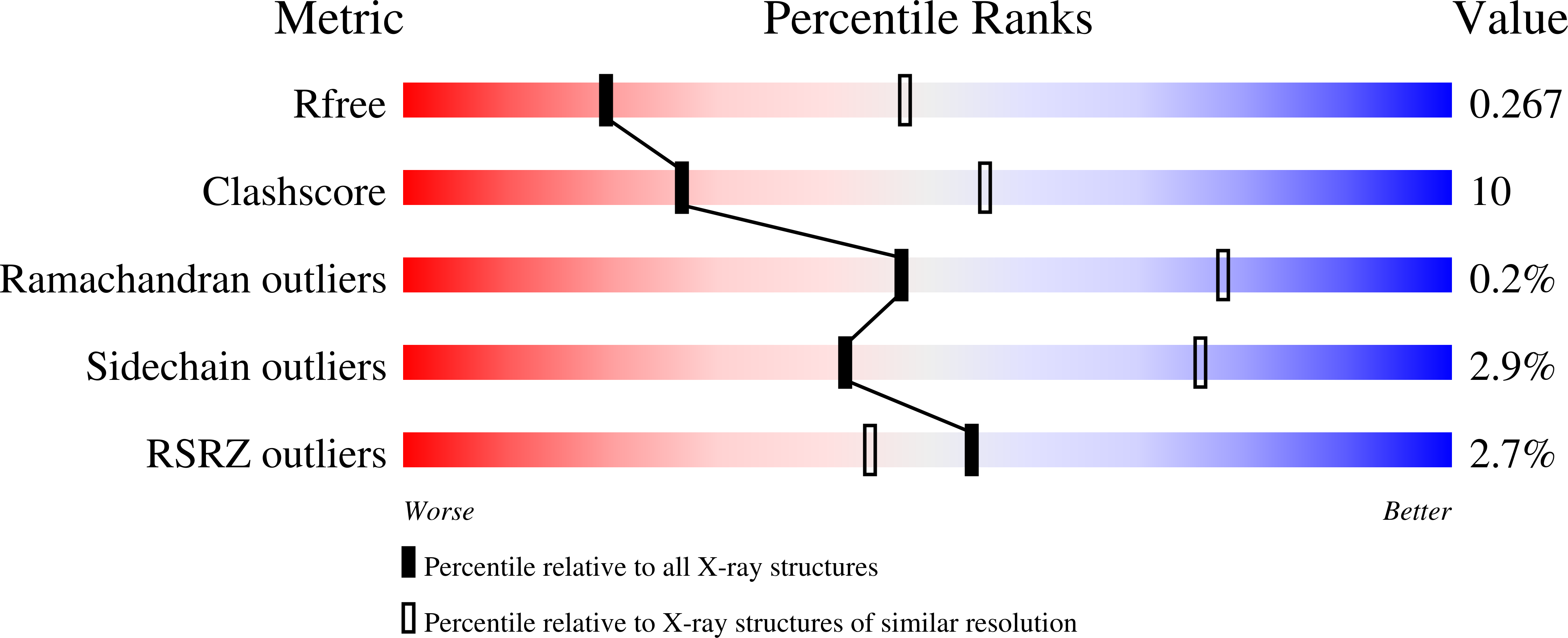
Deposition Date 2008-11-05
Release Date 2008-12-02
Last Version Date 2024-10-16
Entry Detail
PDB ID:
3F69
Keywords:
Title:
Crystal structure of the Mycobacterium tuberculosis PknB mutant kinase domain in complex with KT5720
Biological Source:
Source Organism:
Host Organism:
Method Details:
Experimental Method:
Resolution:
2.80 Å
R-Value Free:
0.26
R-Value Work:
0.21
R-Value Observed:
0.22
Space Group:
F 41 3 2
Macromolecular Entities
Structures with similar UniProt ID
Protein Blast
Polymer Type:polypeptide(L)
Molecule:Serine/threonine-protein kinase pknB
Mutagens:L33D, M145L, M155V
Chain IDs:A, B
Chain Length:311
Number of Molecules:2
Biological Source:Mycobacterium tuberculosis
Modified Residue
Compound ID Chain ID Parent Comp ID Details 2D Image
TPO B THR PHOSPHOTHREONINE
Primary Citation
Auto-activation mechanism of the Mycobacterium tuberculosis PknB receptor Ser/Thr kinase.
Embo J. 27 3186 3197 (2008)
PMID: 19008858 DOI: 10.1038/emboj.2008.236

Abstact

Many Ser/Thr protein kinases are activated by autophosphorylation, but the mechanism of this process has not been defined. We determined the crystal structure of a mutant of the Ser/Thr kinase domain (KD) of the mycobacterial sensor kinase PknB in complex with an ATP competitive inhibitor and discovered features consistent with an activation complex. The complex formed an asymmetric dimer, with the G helix and the ordered activation loop of one KD in contact with the G helix of the other. The activation loop of this putative 'substrate' KD was disordered, with the ends positioned at the entrance to the partner KD active site. Single amino-acid substitutions in the G-helix interface reduced activation-loop phosphorylation, and multiple replacements abolished KD phosphorylation and kinase activation. Phosphorylation of an inactive mutant KD was reduced by G-helix substitutions in both active and inactive KDs, as predicted by the idea that the asymmetric dimer mimics a trans-autophosphorylation complex. These results support a model in which a structurally and functionally asymmetric, 'front-to-front' association mediates autophosphorylation of PknB and homologous kinases.

Legend

Protein

Chemical

Disease

Primary Citation of related structures
Feedback Form
Name
Email
Institute
Feedback