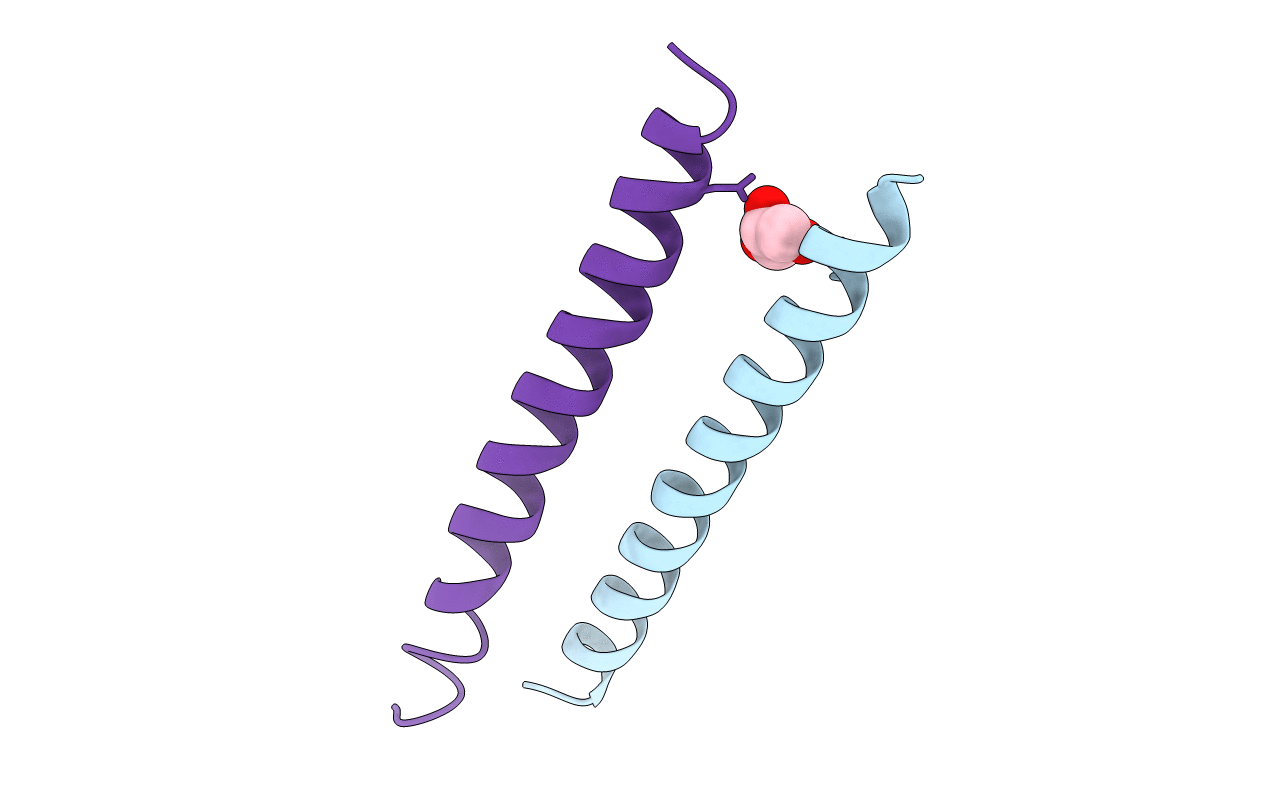
3F50 image
Deposition Date 2008-11-03
Release Date 2009-09-15
Last Version Date 2023-11-15
Entry Detail
PDB ID:
3F50
Keywords:
Title:
HIV gp41 six-helix bundle composed of an alpha/beta-peptide analogue of the CHR domain in complex with an NHR domain alpha-peptide
Method Details:
Experimental Method:
Resolution:
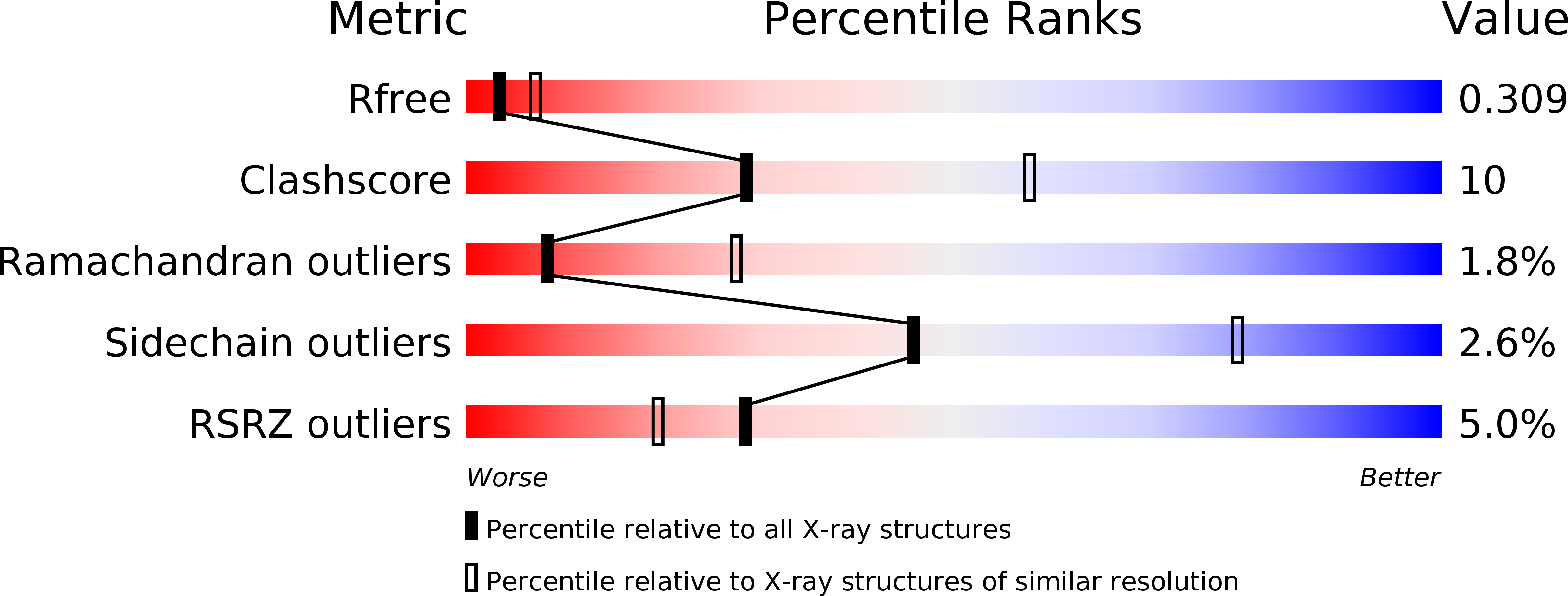
2.80 Å
R-Value Free:
0.30
R-Value Work:
0.26
R-Value Observed:
0.26
Space Group:
P 41 3 2
Macromolecular Entities
Structures with similar UniProt ID
Protein Blast
Polymer Type:polypeptide(L)
Molecule:Envelope glycoprotein gp160
Gene (Uniprot):env
Chain IDs:A
Chain Length:38
Number of Molecules:1
Biological Source:
Polymer Type:polypeptide(L)
Molecule:alpha/beta-peptide analogue of the HIV gp41 CHR domain
Chain IDs:B
Chain Length:40
Number of Molecules:1
Biological Source:
Modified Residue
Compound ID Chain ID Parent Comp ID Details 2D Image
B3E B GLU (3S)-3-AMINOHEXANEDIOIC ACID
Ligand Molecules
Primary Citation
Structural and biological mimicry of protein surface recognition by alpha/beta-peptide foldamers
Proc.Natl.Acad.Sci.USA 106 14751 14756 (2009)
PMID: 19706443 DOI: 10.1073/pnas.0902663106

Abstact

Unnatural oligomers that can mimic protein surfaces offer a potentially useful strategy for blocking biomedically important protein-protein interactions. Here we evaluate an approach based on combining alpha- and beta-amino acid residues in the context of a polypeptide sequence from the HIV protein gp41, which represents an excellent testbed because of the wealth of available structural and biological information. We show that alpha/beta-peptides can mimic structural and functional properties of a critical gp41 subunit. Physical studies in solution, crystallographic data, and results from cell-fusion and virus-infectivity assays collectively indicate that the gp41-mimetic alpha/beta-peptides effectively block HIV-cell fusion via a mechanism comparable to that of gp41-derived alpha-peptides. An optimized alpha/beta-peptide is far less susceptible to proteolytic degradation than is an analogous alpha-peptide. Our findings show how a two-stage design approach, in which sequence-based alpha-->beta replacements are followed by site-specific backbone rigidification, can lead to physical and biological mimicry of a natural biorecognition process.

Legend

Protein

Chemical

Disease

Primary Citation of related structures
Feedback Form
Name
Email
Institute
Feedback