Planned Maintenance: Some services may turn out to be unavailable from 15th January, 2026 to 16th January, 2026. We apologize for the inconvenience!

3EY6 image
Deposition Date 2008-10-19
Release Date 2009-10-27
Last Version Date 2023-09-06
Entry Detail
PDB ID:
3EY6
Keywords:
Title:
Crystal structure of the FK506-binding domain of human FKBP38
Method Details:
Experimental Method:
Resolution:
1.05 Å
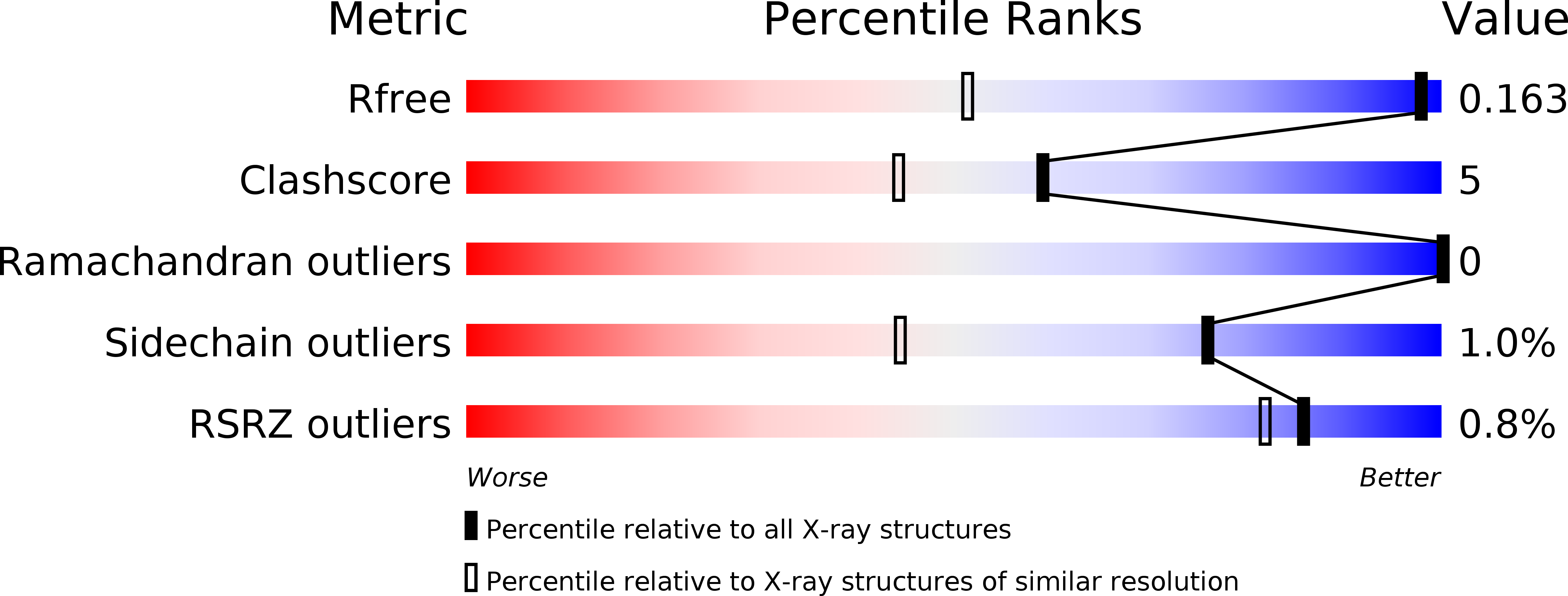
R-Value Free:
0.16
R-Value Work:
0.13
R-Value Observed:
0.13
Space Group:
P 1 21 1
Macromolecular Entities
Structures with similar UniProt ID
Protein Blast
Polymer Type:polypeptide(L)
Molecule:FK506-binding protein 8
Gene (Uniprot):FKBP8
Chain IDs:A
Chain Length:121
Number of Molecules:1
Biological Source:Homo sapiens
Primary Citation
A charge-sensitive loop in the FKBP38 catalytic domain modulates Bcl-2 binding.
J.Mol.Recognit. 24 23 34 (2011)
PMID: 20140889 DOI: 10.1002/jmr.1020

Abstact

The Bcl-2 inhibitor FKBP38 is regulated by the Ca(2+)-sensor calmodulin (CaM). Here we show a hitherto unknown low-affinity cation-binding site in the FKBP domain of FKBP38, which may afford an additional level of regulation based on electrostatic interactions. Fluorescence titration experiments indicate that in particular the physiologically relevant Ca(2+) ion binds to this site. NMR-based chemical shift perturbation data locate this cation-interaction site within the β5-α1 loop (Leu90-Ile96) of the FKBP domain, which contains the acidic Asp92 and Asp94 side-chains. Binding constants were subsequently determined for K(+), Mg(2+), Ca(2+), and La(3+), indicating that the net charge and the radius of the ion influences the binding interaction. X-ray diffraction data furthermore show that the conformation of the β5-α1 loop is influenced by the presence of a positively charged guanidinium group belonging to a neighboring FKBP38 molecule in the crystal lattice. The position of the cation-binding site has been further elucidated based on pseudocontact shift data obtained by NMR via titration with Tb(3+). Elimination of the Ca(2+)-binding capacity by substitution of the respective aspartate residues in a D92N/D94N double-substituted variant reduces the Bcl-2 affinity of the FKBP38(35-153)/CaM complex to the same degree as the presence of Ca(2+) in the wild-type protein. Hence, this charge-sensitive site in the FKBP domain participates in the regulation of FKBP38 function by enabling electrostatic interactions with ligand proteins and/or salt ions such as Ca(2+).

Legend

Protein

Chemical

Disease

Primary Citation of related structures
Feedback Form
Name
Email
Institute
Feedback