3ESW image
Deposition Date 2008-10-06
Release Date 2008-11-11
Last Version Date 2023-09-06
Entry Detail
PDB ID:
3ESW
Keywords:
Title:
Complex of yeast PNGase with GlcNAc2-IAc.
Biological Source:
Source Organism:
Host Organism:
Method Details:
Experimental Method:
Resolution:
3.40 Å
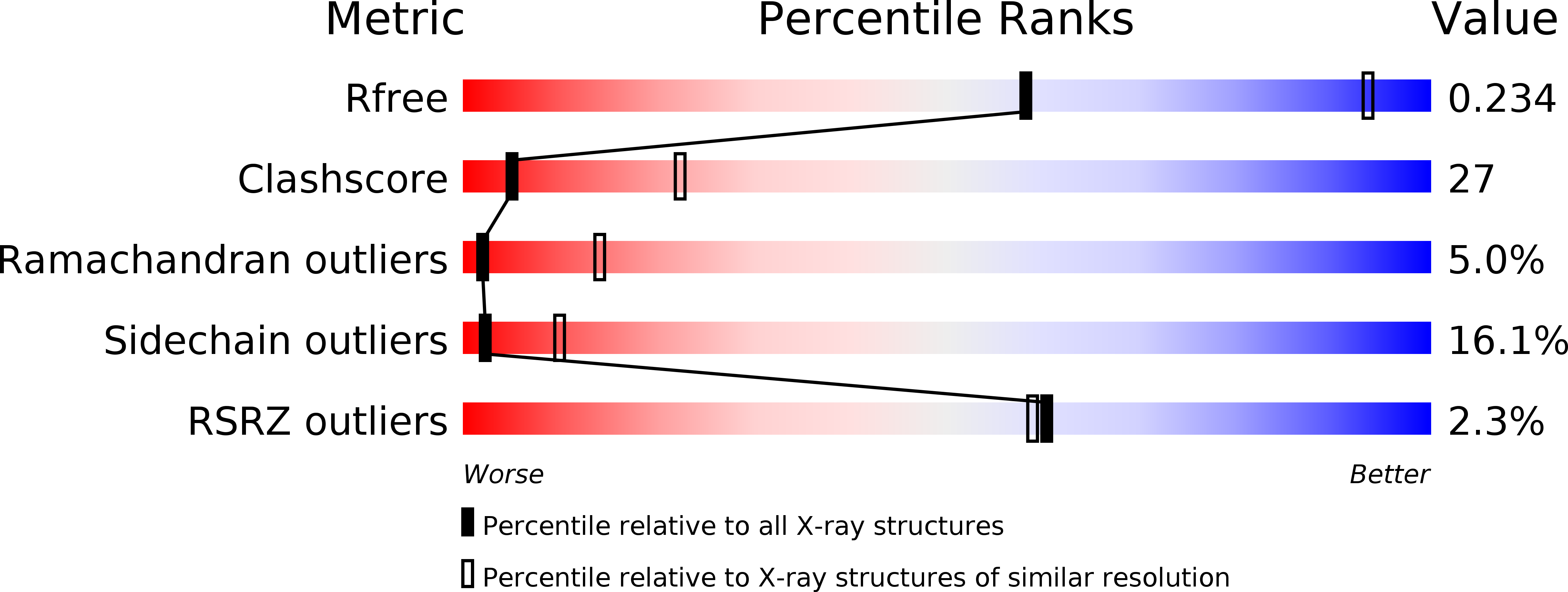
R-Value Free:
0.23
R-Value Work:
0.19
R-Value Observed:
0.19
Space Group:
P 31 2 1
Macromolecular Entities
Structures with similar UniProt ID
Protein Blast
Polymer Type:polypeptide(L)
Molecule:Peptide-N(4)-(N-acetyl-beta-glucosaminyl)asparagine amidase
Gene (Uniprot):PNG1
Chain IDs:A
Chain Length:355
Number of Molecules:1
Biological Source:Saccharomyces cerevisiae
Structures with similar UniProt ID
Protein Blast
Polymer Type:polypeptide(L)
Molecule:UV excision repair protein RAD23
Gene (Uniprot):RAD23
Chain IDs:B
Chain Length:55
Number of Molecules:1
Biological Source:Saccharomyces cerevisiae
Modified Residue
Compound ID Chain ID Parent Comp ID Details 2D Image
YCM A CYS S-(2-AMINO-2-OXOETHYL)-L-CYSTEINE
Ligand Molecules
Primary Citation
Structural and mutational studies on the importance of oligosaccharide binding for the activity of yeast PNGase.
Glycobiology 19 118 125 (2009)
PMID: 18854368 DOI: 10.1093/glycob/cwn108

Abstact

Peptide:N-glycanase (PNGase) is an important component of the endoplasmic reticulum-associated protein degradation pathway in which it de-glycosylates misfolded glycoproteins, thus facilitating their proteasomal degradation. PNGase belongs to the transglutaminase superfamily and features a Cys, His, and Asp catalytic triad, which is essential for its enzymatic activity. An elongated substrate-binding groove centered on the active site Cys191 was visualized in the crystal structure of apo-PNGase, whereas its complex with Z-VAD-fmk, a peptide-based inhibitor of PNGase, revealed that the inhibitor occupied one end of the substrate-binding groove while being covalently linked to the active site Cys. Recently, haloacetamidyl-containing carbohydrate-based inhibitors of PNGase were developed and shown to specifically label the active site Cys. In this study, we describe the crystal structure of yeast PNGase in complex with N,N'-diacetylchitobiose (chitobiose). We found that the chitobiose binds on the side opposite to the peptide binding site with the active site Cys191 being located approximately midway between the carbohydrate and peptide binding sites. Mutagenesis studies confirm the critical role of the chitobiose-interacting residues in substrate binding and suggest that efficient oligosaccharide binding is required for PNGase activity. In addition, the N-terminus of a symmetry-related PNGase was found to bind to the proposed peptide-binding site of PNGase. Together with the bound chitobiose, this enables us to propose a model for glycoprotein binding to PNGase. Finally, deleting the C-terminal residues of yeast PNGase, which are disordered in all structures of this enzyme, results in a significant reduction in enzyme activity, indicating that these residues might be involved in binding of the mannose residues of the glycan chain.

Legend

Protein

Chemical

Disease

Primary Citation of related structures
Feedback Form
Name
Email
Institute
Feedback