3ERH image
Deposition Date 2008-10-02
Release Date 2009-03-31
Last Version Date 2024-10-30
Entry Detail
PDB ID:
3ERH
Keywords:
Title:
First structural evidence of substrate specificity in mammalian peroxidases: Crystal structures of substrate complexes with lactoperoxidases from two different species
Biological Source:
Source Organism:
Method Details:
Experimental Method:
Resolution:
2.40 Å
R-Value Free:
0.19
R-Value Work:
0.18
R-Value Observed:
0.18
Space Group:
P 1 21 1
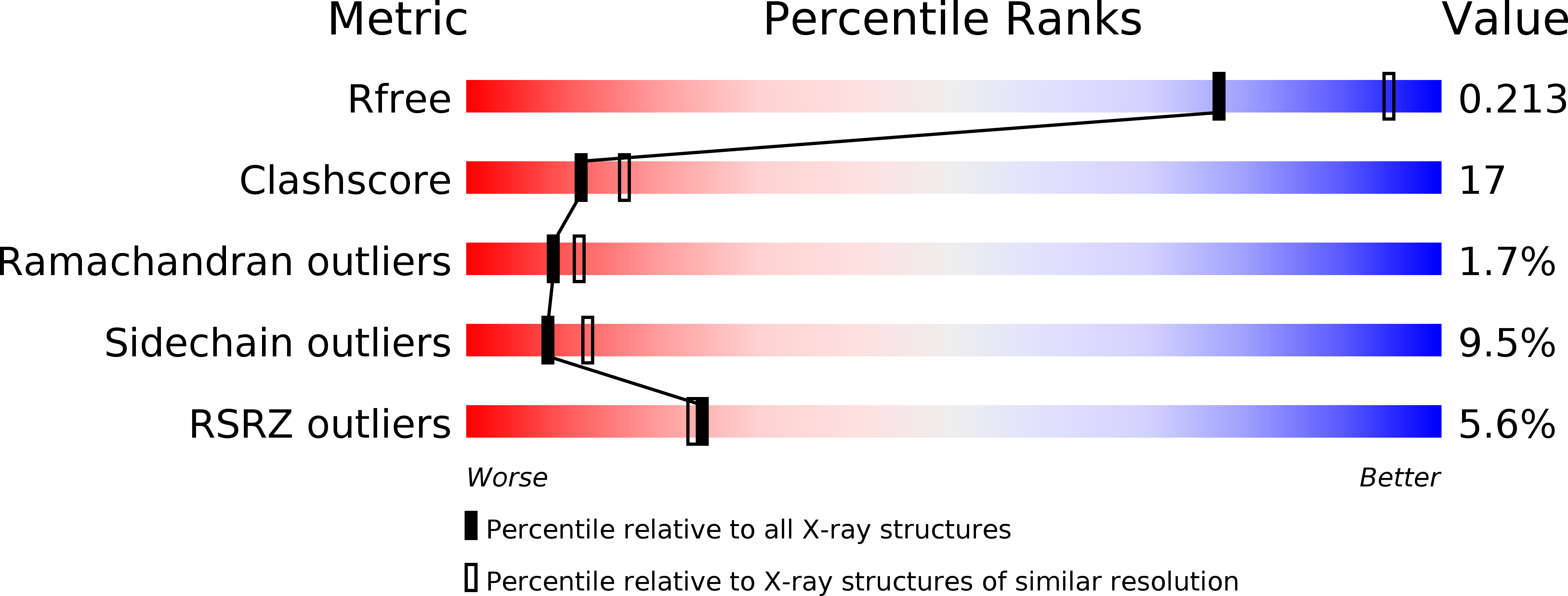
Macromolecular Entities
Structures with similar UniProt ID
Protein Blast
Polymer Type:polypeptide(L)
Molecule:Lactoperoxidase
Gene (Uniprot):LPO
Chain IDs:A
Chain Length:595
Number of Molecules:1
Biological Source:Bubalus bubalis
Modified Residue
Compound ID Chain ID Parent Comp ID Details 2D Image
ASN A ASN GLYCOSYLATION SITE
SEP A SER PHOSPHOSERINE
Primary Citation
Structural Evidence of Substrate Specificity in Mammalian Peroxidases: STRUCTURE OF THE THIOCYANATE COMPLEX WITH LACTOPEROXIDASE AND ITS INTERACTIONS AT 2.4 A RESOLUTION
J.Biol.Chem. 284 14849 14856 (2009)
PMID: 19339248 DOI: 10.1074/jbc.M807644200

Abstact

The crystal structure of the complex of lactoperoxidase (LPO) with its physiological substrate thiocyanate (SCN(-)) has been determined at 2.4A resolution. It revealed that the SCN(-) ion is bound to LPO in the distal heme cavity. The observed orientation of the SCN(-) ion shows that the sulfur atom is closer to the heme iron than the nitrogen atom. The nitrogen atom of SCN(-) forms a hydrogen bond with a water (Wat) molecule at position 6'. This water molecule is stabilized by two hydrogen bonds with Gln(423) N(epsilon2) and Phe(422) oxygen. In contrast, the placement of the SCN(-) ion in the structure of myeloperoxidase (MPO) occurs with an opposite orientation, in which the nitrogen atom is closer to the heme iron than the sulfur atom. The site corresponding to the positions of Gln(423), Phe(422) oxygen, and Wat(6)' in LPO is occupied primarily by the side chain of Phe(407) in MPO due to an entirely different conformation of the loop corresponding to the segment Arg(418)-Phe(431) of LPO. This arrangement in MPO does not favor a similar orientation of the SCN(-) ion. The orientation of the catalytic product OSCN(-) as reported in the structure of LPO.OSCN(-) is similar to the orientation of SCN(-) in the structure of LPO.SCN(-). Similarly, in the structure of LPO.SCN(-).CN(-), in which CN(-) binds at Wat(1), the position and orientation of the SCN(-) ion are also identical to that observed in the structure of LPO.SCN.

Legend

Protein

Chemical

Disease

Primary Citation of related structures
Feedback Form
Name
Email
Institute
Feedback