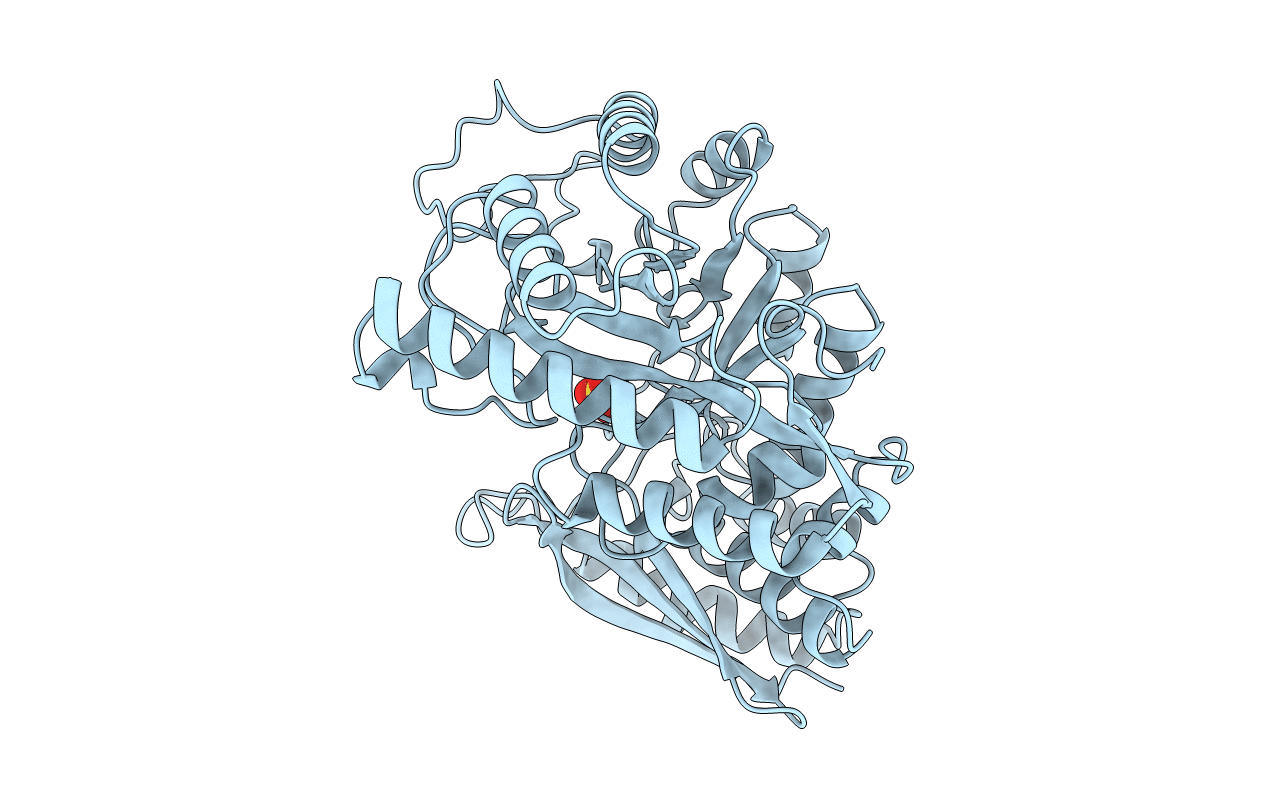
3ENL image
Deposition Date 1990-11-13
Release Date 1992-04-15
Last Version Date 2024-02-21
Entry Detail
PDB ID:
3ENL
Title:
REFINED STRUCTURE OF YEAST APO-ENOLASE AT 2.25 ANGSTROMS RESOLUTION
Biological Source:
Source Organism:
Method Details:
Experimental Method:
Resolution:
2.25 Å
R-Value Observed:
0.15
Space Group:
P 42 21 2

Macromolecular Entities
Structures with similar UniProt ID
Protein Blast
Polymer Type:polypeptide(L)
Molecule:ENOLASE
Gene (Uniprot):ENO1
Chain IDs:A
Chain Length:436
Number of Molecules:1
Biological Source:Saccharomyces cerevisiae
Ligand Molecules
Primary Citation
Refined structure of yeast apo-enolase at 2.25 A resolution.
J.Mol.Biol. 211 235 248 (1990)
PMID: 2405163 DOI: 10.1016/0022-2836(90)90023-F

Abstact

The crystal structure of apo-enolase from baker's yeast (Saccharomyces cerevisiae) was established at 2.25 A resolution using a restrained least-squares refinement method. Based on 21,077 independent reflections of better than 8 A resolution, a final R-factor of 15.4% was obtained with a model obeying standard geometry within 0.017 A in bond length and 3.5 degrees in bond angles. The upper limit for the co-ordinate accuracy of the atoms was estimated to be 0.18 A. The refinement confirmed the heterodox, non-parallel character of the 8-fold beta alpha-barrel domain with beta beta alpha alpha(beta alpha)6 topology. The reported structure for which the data were collected at pH 5.0 represents an apo-form of the enzyme. Of the three carboxylic ligands that form the conformational metal ion binding site two, Glu295 and Asp320, are very close and presumably form a strong acidic type hydrogen bond with the proton partially replacing the electric charge of the physiological cofactor Mg2+. The single sulfate ion found in the structure is in the active site cavity, co-ordinated to the side-chains of Lys345 and Arg374, and to the N atom of Ser375. It is located about 7.4 A from the conformational metal ion binding site. It occupies the site in which the phosphate group of the substrate binds.

Legend

Protein

Chemical

Disease

Primary Citation of related structures
Feedback Form
Name
Email
Institute
Feedback