3EH8 image
Deposition Date 2008-09-11
Release Date 2009-01-13
Last Version Date 2023-08-30
Entry Detail
PDB ID:
3EH8
Keywords:
Title:
Crystal structure of Y2 I-AniI variant (F13Y/S111Y)/DNA complex with calcium
Biological Source:
Source Organism:
Host Organism:
Method Details:
Experimental Method:
Resolution:
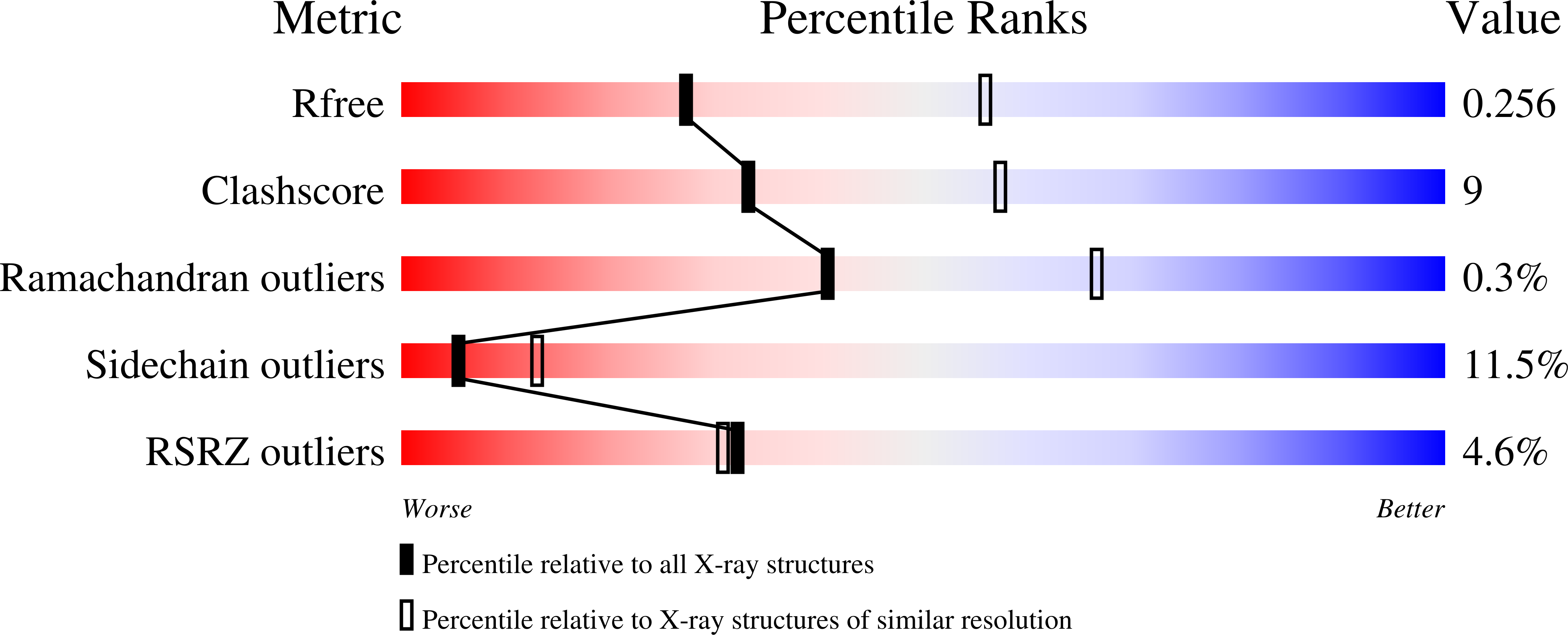
2.70 Å
R-Value Free:
0.25
R-Value Work:
0.19
R-Value Observed:
0.20
Space Group:
C 2 2 21
Macromolecular Entities
Structures with similar UniProt ID
Protein Blast
Polymer Type:polypeptide(L)
Molecule:Intron-encoded DNA endonuclease I-AniI
Gene (Uniprot):I-AniI
Mutagens:F13Y, F80K, S111Y, L232K
Chain IDs:A, B (auth: D), C (auth: G)
Chain Length:254
Number of Molecules:3
Biological Source:Emericella nidulans
Ligand Molecules
Primary Citation
Optimization of in vivo activity of a bifunctional homing endonuclease and maturase reverses evolutionary degradation.
Nucleic Acids Res. 37 877 890 (2009)
PMID: 19103658 DOI: 10.1093/nar/gkn1007

Abstact

The LAGLIDADG homing endonuclease (LHE) I-AniI has adopted an extremely efficient secondary RNA splicing activity that is beneficial to its host, balanced against inefficient DNA cleavage. A selection experiment identified point mutations in the enzyme that act synergistically to improve endonuclease activity. The amino-acid substitutions increase target affinity, alter the thermal cleavage profile and significantly increase targeted recombination in transfected cells. The RNA splicing activity is not affected by these mutations. The improvement in DNA cleavage activity is largely focused on one of the enzyme's two active sites, corresponding to a rearrangement of a lysine residue hypothesized to act as a general base. Most of the constructs isolated in the screen contain one or more mutations that revert an amino-acid identity to a residue found in one or more close homologues of I-AniI. This implies that mutations that have previously reduced the endonuclease activity of I-AniI are identified and reversed, sometimes in combination with additional 'artificial' mutations, to optimize its in vivo activity.

Legend

Protein

Chemical

Disease

Primary Citation of related structures
Feedback Form
Name
Email
Institute
Feedback