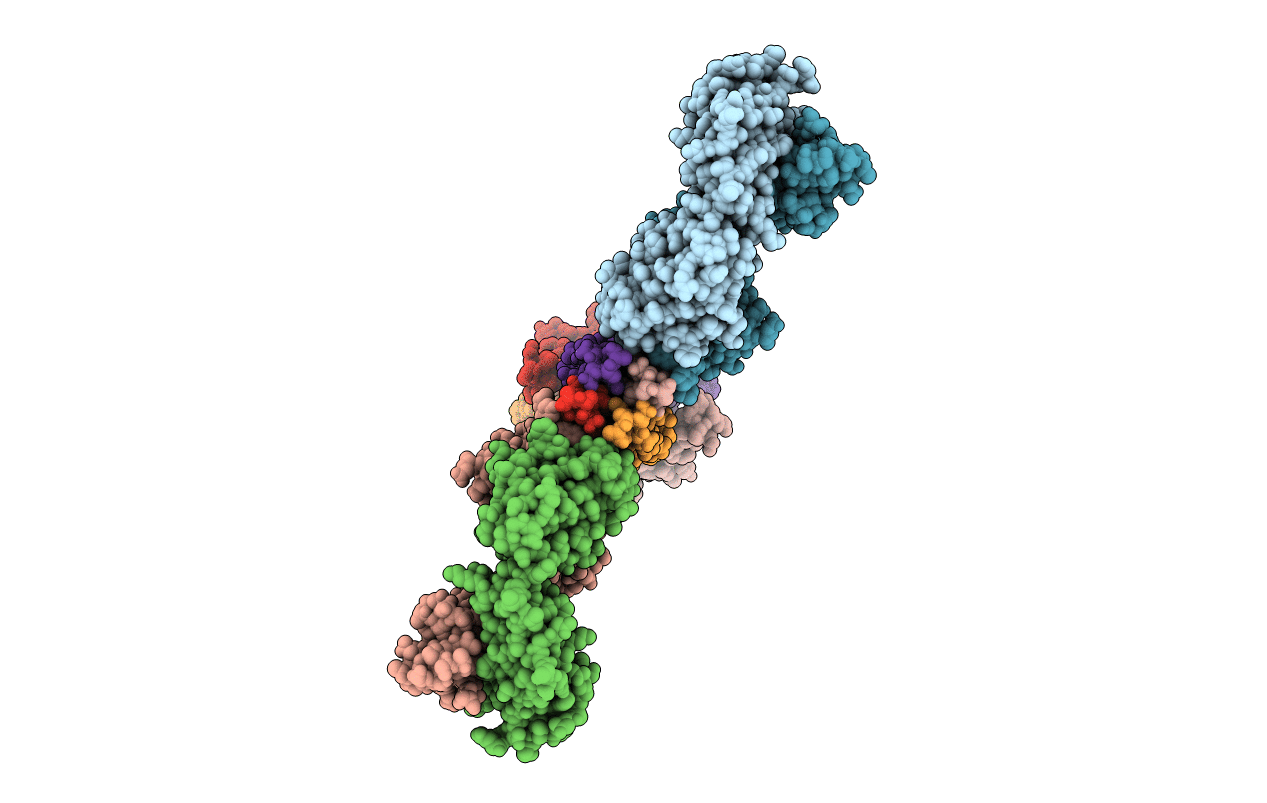
3EFF image
Deposition Date 2008-09-08
Release Date 2009-04-14
Last Version Date 2024-11-20
Entry Detail
PDB ID:
3EFF
Title:
The Crystal Structure of Full-Length KcsA in its Closed Conformation
Biological Source:
Source Organism:
Method Details:
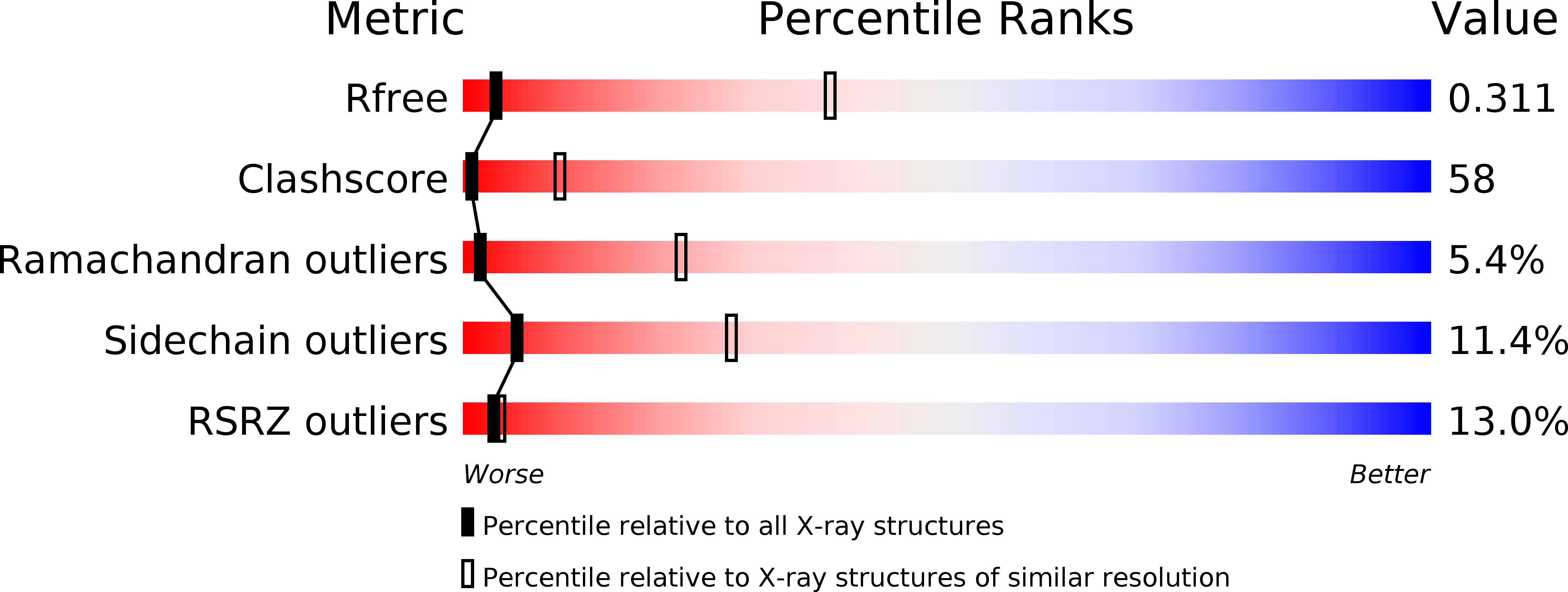
Experimental Method:
Resolution:
3.80 Å
R-Value Free:
0.33
R-Value Work:
0.27
R-Value Observed:
0.28
Space Group:
I 2 2 2
Macromolecular Entities
Polymer Type:polypeptide(L)
Molecule:FAB
Chain IDs:A, C
Chain Length:215
Number of Molecules:2
Biological Source:Mus musculus
Polymer Type:polypeptide(L)
Molecule:FAB
Chain IDs:B, D
Chain Length:224
Number of Molecules:2
Biological Source:Mus musculus
Structures with similar UniProt ID
Protein Blast
Polymer Type:polypeptide(L)
Molecule:Voltage-gated potassium channel
Gene (Uniprot):kcsA
Chain IDs:E (auth: K), F (auth: L), G (auth: M), H (auth: N)
Chain Length:139
Number of Molecules:4
Biological Source:Streptomyces lividans
Ligand Molecules
Primary Citation
Crystal structure of full-length KcsA in its closed conformation.
Proc.Natl.Acad.Sci.USA 106 6644 6649 (2009)
PMID: 19346472 DOI: 10.1073/pnas.0810663106

Abstact

KcsA is a proton-activated, voltage-modulated K(+) channel that has served as the archetype pore domain in the Kv channel superfamily. Here, we have used synthetic antigen-binding fragments (Fabs) as crystallographic chaperones to determine the structure of full-length KcsA at 3.8 A, as well as that of its isolated C-terminal domain at 2.6 A. The structure of the full-length KcsA-Fab complex reveals a well-defined, 4-helix bundle that projects approximately 70 A toward the cytoplasm. This bundle promotes a approximately 15 degree bending in the inner bundle gate, tightening its diameter and shifting the narrowest point 2 turns of helix below. Functional analysis of the full-length KcsA-Fab complex suggests that the C-terminal bundle remains whole during gating. We suggest that this structure likely represents the physiologically relevant closed conformation of KcsA.

Legend

Protein

Chemical

Disease

Primary Citation of related structures
Feedback Form
Name
Email
Institute
Feedback