3ED8 image
Deposition Date 2008-09-02
Release Date 2009-01-20
Last Version Date 2024-11-06
Entry Detail
PDB ID:
3ED8
Title:
Application of the superfolder YFP bimolecular fluorescence complementation for studying protein-protein interactions in vitro
Biological Source:
Source Organism:
Host Organism:
Method Details:
Experimental Method:
Resolution:
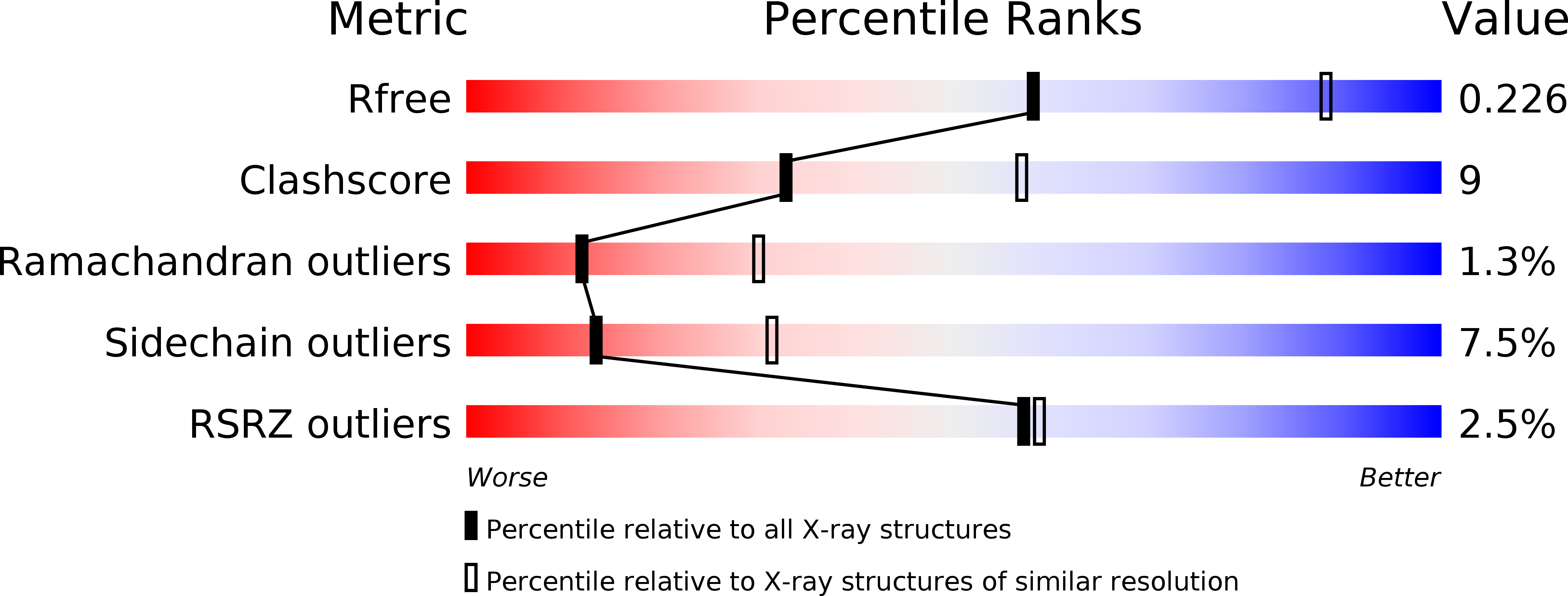
2.70 Å
R-Value Free:
0.21
R-Value Work:
0.17
R-Value Observed:
0.17
Space Group:
P 43 21 2
Macromolecular Entities
Structures with similar UniProt ID
Protein Blast
Polymer Type:polypeptide(L)
Molecule:yellow fluorescence protein
Mutagens:S30R,Y39I,F64L,F99S,N105K,E111V,I128T,Y145F,M153T,V163A,K166T,I167V,I171V,S205T,A206V
Chain IDs:A, B, C, D, E
Chain Length:262
Number of Molecules:5
Biological Source:Aequorea victoria
Modified Residue
Compound ID Chain ID Parent Comp ID Details 2D Image
CRO A GLY ?
Primary Citation
Applicability of superfolder YFP bimolecular fluorescence complementation in vitro.
Biol.Chem. 390 81 90 (2009)
PMID: 19007309 DOI: 10.1515/BC.2009.008

Abstact

Bimolecular fluorescence complementation (BiFC) using yellow fluorescent protein (YFP) is a widely employed method to study protein-protein interactions in cells. As yet, this technique has not been used in vitro. To evaluate a possible application of BiFC in vitro, we constructed a 'superfolder split YFP' system where 15 mutations enhance expression of the fusion proteins in Escherichia coli and enable a native purification due to improved solubility. Here, we present the crystal structure of 'superfolder YFP', providing the structural basis for the enhanced folding and stability characteristics. Complementation between the two non-fluorescent YFP fragments fused to HRas and Raf1RBD or to 14-3-3 and PMA2-CT52 resulted in the constitution of the functional fluorophore. The in vivo BiFC with these protein interaction pairs was demonstrated in eukaryotic cell lines as well. Here, we present for the first time BiFC in vitro studies with natively purified superfolder YFP fusion proteins and show the potential and drawbacks of this method for analyzing protein-protein interactions.

Legend

Protein

Chemical

Disease

Primary Citation of related structures
Feedback Form
Name
Email
Institute
Feedback