3E0M image
Deposition Date 2008-07-31
Release Date 2009-06-16
Last Version Date 2024-05-29
Entry Detail
PDB ID:
3E0M
Keywords:
Title:
Crystal structure of fusion protein of MsrA and MsrB
Biological Source:
Source Organism:
Host Organism:
Method Details:
Experimental Method:
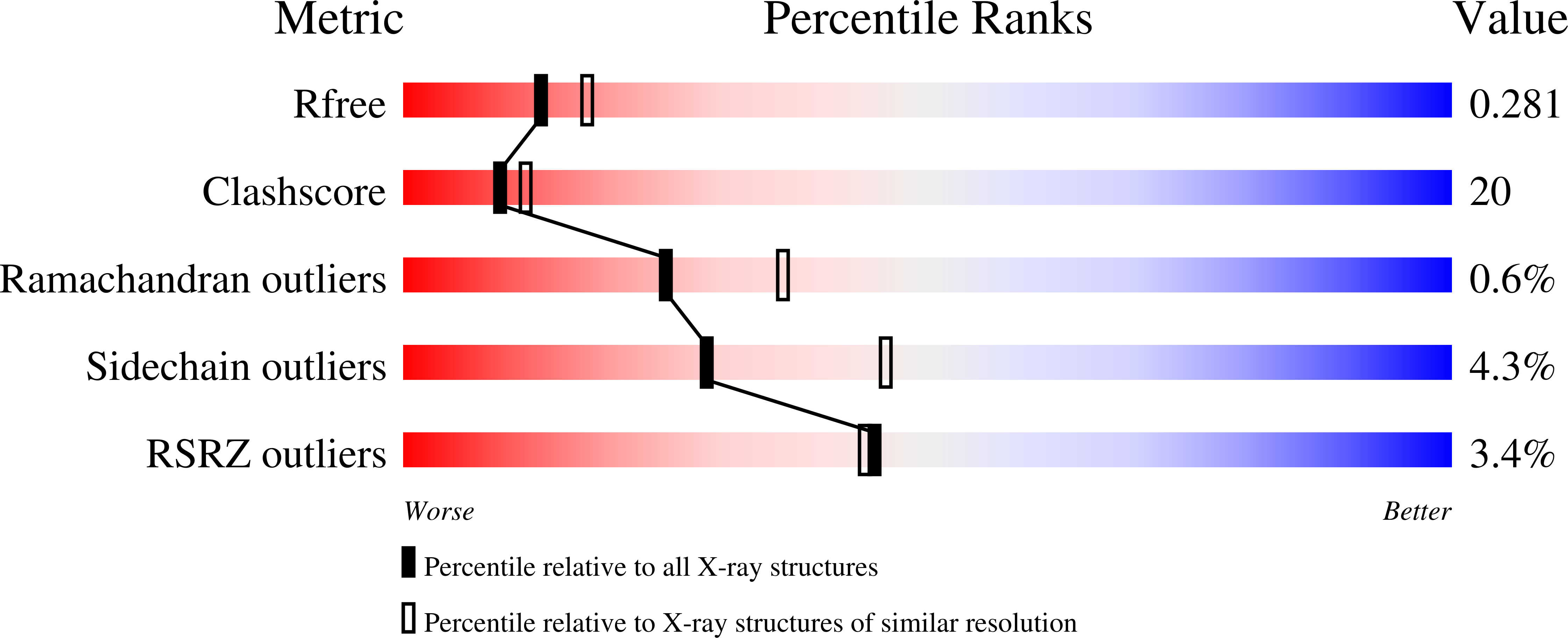
Resolution:
2.40 Å
R-Value Free:
0.28
R-Value Work:
0.23
R-Value Observed:
0.23
Space Group:
P 21 21 2
Macromolecular Entities
Structures with similar UniProt ID
Protein Blast
Polymer Type:polypeptide(L)
Molecule:Peptide methionine sulfoxide reductase msrA/msrB 1
Gene (Uniprot):msrAB1
Mutagens:I238L
Chain IDs:A, B, C, D
Chain Length:313
Number of Molecules:4
Biological Source:Streptococcus pneumoniae
Polymer Type:polypeptide(L)
Molecule:Short peptide SHMAEI
Chain IDs:E, F, G
Chain Length:6
Number of Molecules:3
Biological Source:
Primary Citation
Structural and Kinetic Analysis of an MsrA-MsrB Fusion Protein from Streptococcus pneumoniae
Mol.Microbiol. 72 699 709 (2009)
PMID: 19400786 DOI: 10.1111/j.1365-2958.2009.06680.x

Abstact

Methionine sulphoxide reductases (Msr) catalyse the reduction of oxidized methionine to methionine. These enzymes are divided into two classes, MsrA and MsrB, according to substrate specificity. Although most MsrA and MsrB exist as separate enzymes, in some bacteria these two enzymes are fused to form a single polypeptide (MsrAB). Here, we report the first crystal structure of MsrAB from Streptococcus pneumoniae (SpMsrAB) at 2.4 A resolution. SpMsrAB consists of an N-terminal MsrA domain, a C-terminal MsrB domain and a linker. The linker is composed of 13 residues and contains one 3(10)-helix and several hydrogen bonds interacting with both MsrA and MsrB domains. Interestingly, our structure includes the MsrB domain complexed with an SHMAEI hexa-peptide that is the N-terminal region of neighbouring MsrA domain. A kinetic analysis showed that the apparent K(m) of SpMsrAB for the R-form-substrate was 20-fold lower than that for the S-form substrate, indicating that the MsrB domain had a much higher affinity for the substrate than the MsrA domain. Our study reveals the first structure of the MsrAB by providing insights into the formation of a disulphide bridge in the MsrB, the structure of the linker region, and the distinct structural nature of active site of each MsrA and MsrB domain.

Legend

Protein

Chemical

Disease

Primary Citation of related structures
Feedback Form
Name
Email
Institute
Feedback